People hesitate to run an air purifier 24/7 because they assume it will spike the power bill. In reality, a typical purifier draws between 5 and 50 watts depending on fan speed — less than a light bulb on low, and about the same as a laptop on high. The cost that actually adds up is the filter.
This guide breaks down both, so you can budget honestly before you buy.
- Electricity: roughly $10–$40 per year running 24/7 at medium speed, depending on your rate.
- Filters: $30–$80 per year — usually the larger cost.
- Cheapest to run: a unit with a washable pre-filter and a low-wattage motor.
- Biggest saving: run on low overnight and use auto mode during the day.
- Do not: turn it off to save power — intermittent running wastes the filter you already paid for.
On this page
The electricity math
Electricity cost is simple: watts × hours × your rate. A purifier drawing 20 watts for 24 hours uses 0.48 kWh per day. At the US average of about 17 cents per kWh, that is roughly 8 cents a day, or about $30 a year.
| Fan speed | Typical draw | kWh/day (24h) | Cost/year at $0.17/kWh |
|---|---|---|---|
| Low | 5–10 W | 0.12–0.24 | $7–$15 |
| Medium | 15–30 W | 0.36–0.72 | $22–$45 |
| High | 40–60 W | 0.96–1.44 | $60–$89 |
For context, a refrigerator uses roughly 1.5 kWh per day and a window air conditioner several times that. A purifier is one of the cheapest appliances in the home to run.
The filter cost that dominates
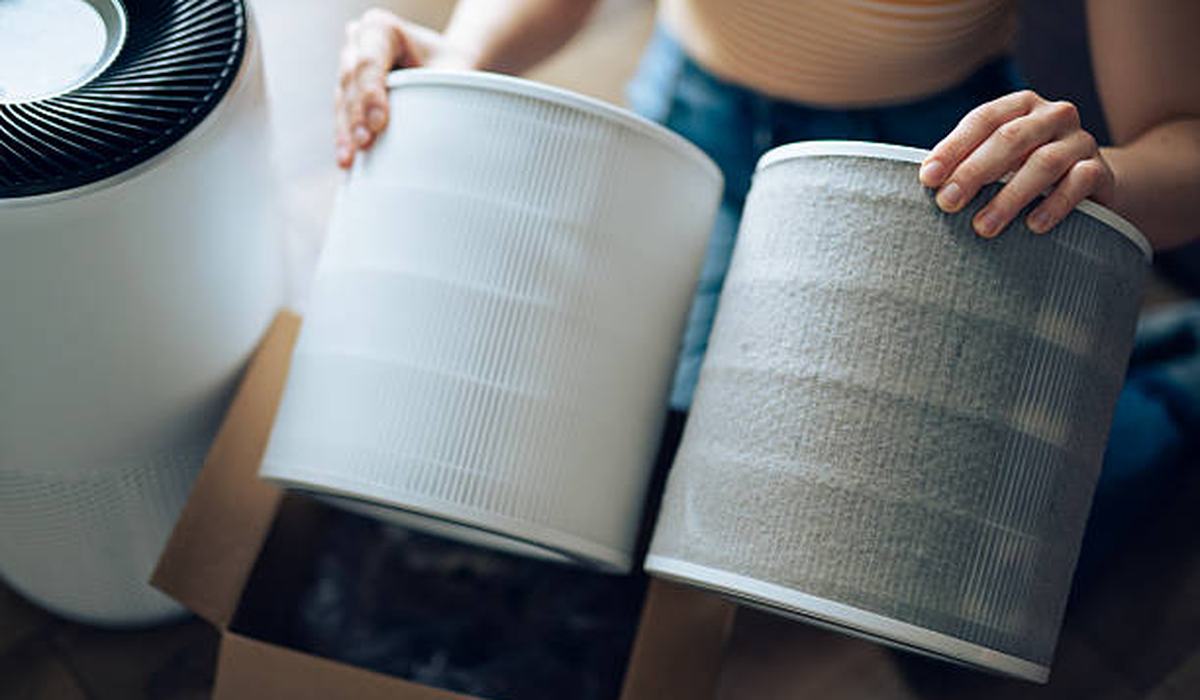
A HEPA filter costs $25 to $60 and lasts six to twelve months. A carbon filter costs $10 to $30 and lasts two to six months. Add those up and the annual filter cost is typically $30 to $80 — more than the electricity in most homes.
| Filter | Typical price | Life | Annual cost |
|---|---|---|---|
| HEPA | $25–$60 | 6–12 months | $25–$60 |
| Carbon | $10–$30 | 2–6 months | $20–$60 |
| Washable pre-filter | $0 (rinse) | Indefinite | $0 |
| Total | — | — | $45–$120 |
A loaded HEPA filter forces the fan to work harder, which raises power draw and lowers cleaning performance. Delaying a filter change to save money backfires: you pay more in electricity and breathe dirtier air.
Cost by fan speed
The cheapest way to run a purifier is on low, all the time. Because air cleaning is cumulative, a unit running 24 hours at low speed removes more total particles than one running two hours at high speed — and it costs a fraction as much.
| Strategy | Daily kWh | Daily cost | Particles removed |
|---|---|---|---|
| 24h on low | 0.18 | ~$0.03 | Most (continuous) |
| 24h on medium | 0.54 | ~$0.09 | More per hour |
| 2h on high | 0.12 | ~$0.02 | Least (intermittent) |
| Auto mode | 0.30 | ~$0.05 | Balanced |
How to cut the running cost
- Run on low overnight. You are asleep; you do not need maximum airflow. Low speed is quiet and cheap.
- Use auto mode by day. The unit ramps up only when particles are detected, which is cheaper than running high constantly.
- Rinse the pre-filter often. A clean pre-filter protects the HEPA filter and keeps airflow high, which lowers power draw.
- Buy a unit with a washable pre-filter. It is the single biggest filter-cost saving available.
- Do not oversize. A purifier rated for twice your room runs on low and lasts longer than an undersized one screaming on high.
- Check your electricity rate. In a high-rate state the electricity cost doubles, but it is still small next to filters.
Running an air purifier 24/7 costs roughly $10 to $40 a year in electricity — less than most people expect. Filters cost more, at $45 to $120 a year. Run on low, use auto mode, and rinse the pre-filter to keep both numbers down.
Frequently asked questions
Efficient purifiers
An Energy Star purifier costs less to run all year.