Wildfire smoke is not ordinary dust. It is a mix of very fine particulate — mostly under 1 micron, which is exactly the size range that reaches deep into your lungs — plus a cocktail of gases and odorous compounds from burning vegetation and structures. A purifier built for everyday pollen and dander will help, but the spec that matters is different.
This page covers what to buy, how to size it for smoke, the DIY alternative that costs about $70, and how to run any of them so indoor levels stay low when it is terrible outside.
- What you need: true HEPA (H13) for the particles, plus substantial activated carbon for the smell and gases.
- Size up. For smoke, use CADR at least equal to your room's square footage, not two-thirds.
- DIY option that works: a 20-inch box fan with a MERV 13 furnace filter taped on the intake — cheap, effective, ugly.
- Keep windows shut and run the unit continuously while smoke persists. This is the one scenario where continuous running is justified.
On this page
Why smoke is different from dust
- Particle size. Wildfire smoke PM2.5 is mostly in the 0.4–1 micron range. True HEPA captures 99.97% at 0.3 microns, so it handles this well — but only if air actually passes through the media and not around it.
- Gas phase. Burning vegetation produces VOCs and odorous gases. Particles alone do not carry them, so HEPA without carbon removes the haze but leaves the smell.
- Duration. A smoke event lasts days or weeks. Your purifier will run continuously, which is a real filter-life and electricity commitment.
- Infiltration. Smoke enters through gaps, under doors, and via shared ventilation. Sealing matters as much as filtering.
The spec that matters
| Feature | Minimum | Ideal | Why |
|---|---|---|---|
| Filtration | True HEPA / H13 | True HEPA + H13 pre-filter | Captures the 0.4–1 micron range |
| Carbon | Thick or washable layer | 2–4 kg of carbon if available | Removes the smell and gases HEPA ignores |
| Seal | No visible bypass | Gasketed cartridge that needs a press | Bypass defeats the whole unit |
| CADR | ≥ room sq ft | 1.5× room sq ft in CFM | Smoke needs faster air changes |
| Noise on high | Tolerable — you will run it a lot | Sleep mode under 25 dB for night | You will run it 24/7 for days |
Thin carbon sheets — the kind glued to a cheap pre-filter — saturate within days under heavy smoke. If the smell persists after the haze clears, that is carbon saturation, not a failing purifier. Units with washable carbon honeycomb layers or large carbon canisters hold up far better.
How to size for smoke
The usual guidance is CADR of two-thirds of room square footage for a two-air-changes target. For smoke, throw that out and aim higher, because you want to clear the room fast and keep it clear while smoke keeps infiltrating.
| Room | Everyday CADR target | Smoke-event CADR target |
|---|---|---|
| 150 sq ft bedroom | 100 CFM | 150–225 CFM |
| 300 sq ft studio | 200 CFM | 300–450 CFM |
| 450 sq ft one-bed | 300 CFM | 450–675 CFM |
| 700 sq ft two-bed | 460 CFM | 700–1,000 CFM |
If you cannot afford a unit that big, do not leave the room unfiltered — build the box-fan option below in the room you actually sleep in, and use it alongside the purifier you have.
The DIY box-fan option that genuinely works
This is not a gimmick. Public health agencies have recommended it during wildfire events for years, and independent tests repeatedly show a well-sealed box-fan filter achieving a useful CADR at a fraction of the price.
- Buy a 20-inch box fan (about $25) and a 20×20 MERV 13 furnace filter (about $25–$35).
- Tape the filter to the intake side of the fan with the arrow pointing into the fan. Use duct tape and seal all four edges — leaks are what kill the performance.
- Optionally add a second filter on the output side, or use a cardboard shroud to shape a clean airflow path.
- Run it on medium, not high. A slower airflow through the media captures more particles per pass than a fast one that rips through.
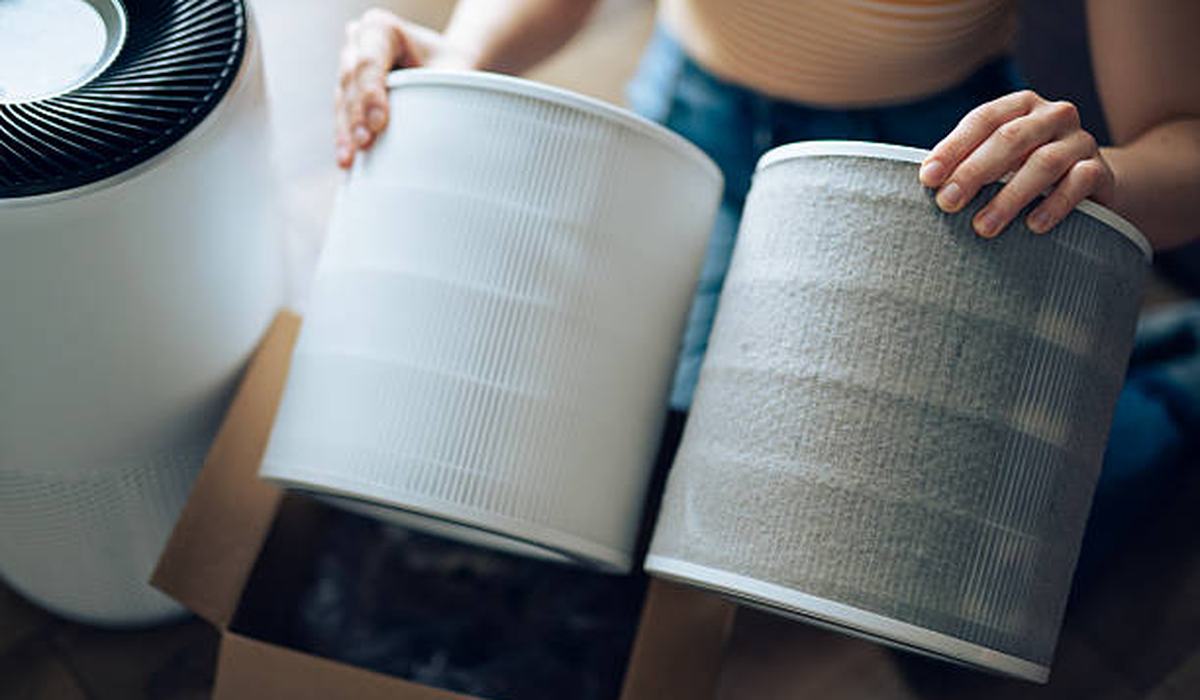
- Replace the filter when it visibly darkens or airflow drops. Under heavy smoke that can be every few weeks.
It works, it is loud, and it is ugly. Expect box-fan noise rather than purifier quiet. But a $60 build in a bedroom will measurably lower PM2.5 during a smoke event, and that is the point. Do not leave a box fan unattended overnight unless it is on a stable, non-flammable surface.
Running it during a smoke event
- Keep windows and doors shut. The goal is to reduce infiltration, not to ventilate. This is the opposite of the normal advice.
- Run the purifier continuously on a medium-high setting. This is one of the few times continuous running is the right call.
- Seal the obvious gaps. A towel at the bottom of the front door, and window seals checked. Smoke infiltration is driven by gaps.
- Do not run the bathroom or kitchen extract fan. Exhausting air out means pulling smoky outdoor air in.
- Use a monitor. Watch indoor PM2.5 and confirm the unit is holding it below outdoor levels. If it climbs, the unit is undersized or bypassing.
- Watch the filter. Smoke loads filters fast. Check weekly, replace early.
Our picks for smoke
Levoit Core 300 — good for a bedroom, size up for a studio
Fine for a single bedroom during moderate smoke. For a studio or a one-bed that you occupy all day, choose a larger unit or run two.
Check Price on Amazon →
Coway AP-1512HH — stronger filtration for smoke season
Higher CADR and a real carbon stage. The better choice if you live somewhere smoke events are an annual certainty rather than a one-off.
Check Price on Amazon →
Winix 5500-2 — best for the smell, not just the haze
The washable carbon honeycomb is the differentiator under smoke: it holds up on odour and VOC removal far longer than thin carbon pads.
Check Price on Amazon →For smoke, prioritise true HEPA plus real carbon, and size up rather than matching. If budget is tight, build the box-fan filter for the bedroom — it genuinely works. Keep the windows shut, run continuously, and verify with a monitor that indoor PM2.5 is well below outdoor.