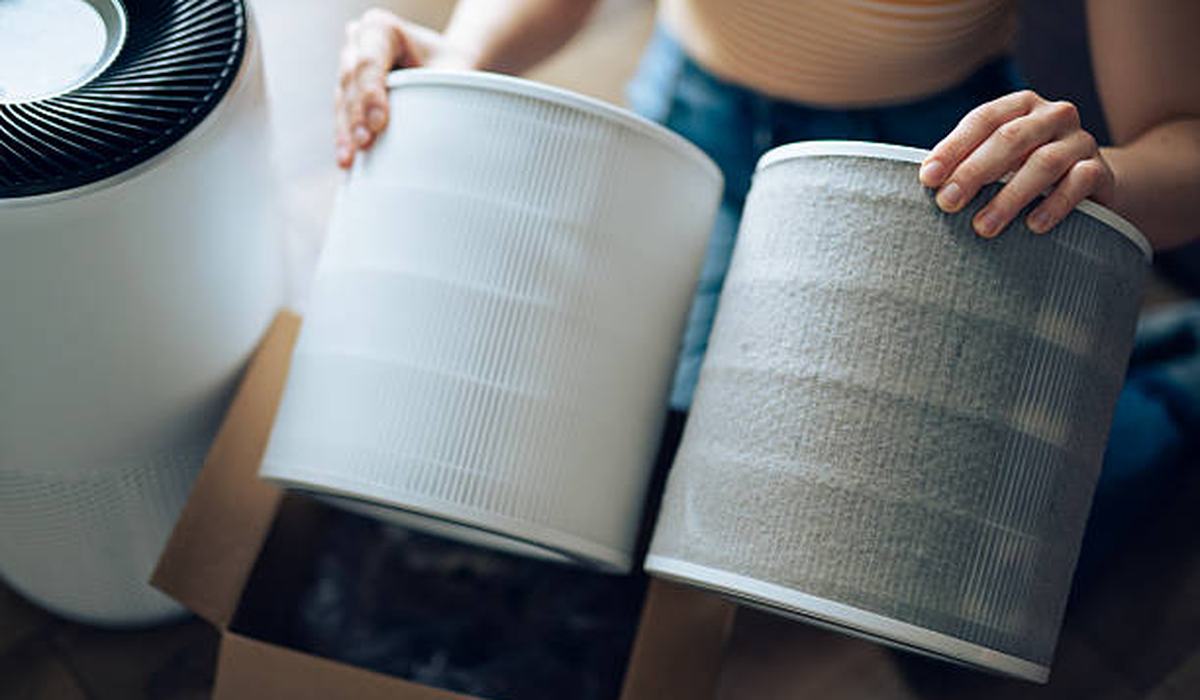
Air purifier filters are the most commonly mis-bought part in the home. They look similar, some fit loosely, and a filter that does not seal lets air bypass it entirely — so the purifier runs and cleans nothing.
This guide shows you how to find your model number, match the correct filter, and avoid the counterfeit cartridges that are common on marketplaces.
Find your model number
The model number is the key to everything. Without it you are guessing, and guessing is how people end up with a filter that does not seal.
- Under the unit. Most purifiers have a label on the base with the model and serial number.
- Behind the filter door. Some models print the filter part number inside the housing.
- On the original filter. The cartridge itself often has the part number printed on its frame.
- In the manual or the app. If you registered the purifier, the model is in your account.
Match the filter
Once you have the model number, search for that exact number plus “replacement filter”. Then check three things:
- The filter part number. Brands like Levoit use specific cartridge numbers (for example, the Core 300 uses the Core 300-RF). Match the part number, not just the brand.
- The filtration type. If the original was true HEPA (H13), the replacement should be too. A “HEPA-type” filter is not the same thing.
- The carbon stage. If your original had an activated carbon layer for odours, the replacement should as well.
| Brand | Common model | Filter part |
|---|---|---|
| Levoit | Core 300 | Core 300-RF |
| Levoit | Core 300S | Core 300-RF |
| Levoit | Core 400S | Core 400S-RF |
| Coway | Airmega AP-1512HH | AP-1512HH-FP |
| Winix | 5500-2 | 115115 |
| GermGuardian | AC4825 | FLT4825 |
Spotting counterfeits
Counterfeit and low-quality filters are common, especially for popular models. A counterfeit may use a thin filter media that does not capture fine particles, or a carbon layer that is mostly fabric.
- Price too good. A genuine HEPA filter has a real cost. A cartridge at a quarter of the normal price is not the same product.
- No part number. Genuine filters print the part number on the frame. A blank frame is a warning sign.
- Loose fit. If it does not seal snugly, air bypasses it. That is the whole point of the filter.
- Vague claims. “HEPA-type” or “HEPA-like” is not true HEPA. Look for H13 or a stated efficiency.
- Buy from the brand or a certified seller. The manufacturer's store or a reputable retailer is the safest route.
Checking the fit
When the new filter arrives, check the fit before you rely on it. A filter that does not seal is worse than an old one, because it gives you false confidence.
- Remove the old filter and note how it seated.
- Fit the new one and check it sits flush with no gaps around the edges.
- Close the housing and confirm it latches without forcing.
- Run the purifier on high for a few minutes and check the airflow from the outlet.
- Reset the filter indicator if your model has one.
Brand-by-brand notes
Filter naming varies by brand, and knowing the pattern saves a lot of searching.
- Levoit. Filters are named after the model with an “-RF” suffix — the Core 300 uses the Core 300-RF. The Core 300 and 300S share a filter; the 400S uses its own.
- Coway. The Airmega range uses model-specific filters, often with an “-FP” suffix. The AP-1512HH filter is not the same as the 250’s.
- Winix. Filters are numbered rather than named — the 5500-2 uses filter 115115. Check the number, not the model name.
- GermGuardian. Uses “FLT” part numbers, such as FLT4825 for the AC4825.
- Blueair. Filters are named by the model range, and the fabric pre-filter is often sold separately.
The pattern to remember: match the part number, not the brand. Two purifiers from the same brand can use completely different cartridges.
Building a replacement schedule
Once you know the part number, note the replacement interval and set a reminder. Most purifiers also have a filter-life indicator, but it is based on run hours, not on how dirty your air actually is.
| Situation | Replace every |
|---|---|
| No pets, no smoke, occasional use | 12 months |
| Daily use, average home | 8–10 months |
| Pets or allergies | 6–8 months |
| Smoke or heavy dust | 4–6 months |
| Visible grey clogging | Immediately |
Check the filter monthly by looking at it. If it is grey and matted, replace it regardless of the calendar — a clogged filter makes the purifier work harder and clean less.
Replacement filters
Once you have the part number, a genuine or certified replacement filter keeps the purifier working as designed.
Frequently asked questions
How do I find my air purifier model number?
Can I use a different brand of filter in my air purifier?
What is the difference between HEPA and HEPA-type filters?
How often should I replace an air purifier filter?
Why does my new filter not fit properly?
Related guides