A refrigerator has a dial, not a thermostat display. The numbers on that dial are arbitrary — they are a relative position, not degrees. So when someone says the fridge feels warm, or food is spoiling early, the first useful step is to put a thermometer in it and get an actual reading.
It costs $10–$30, it takes a few hours to settle, and it turns a vague complaint into a diagnosis. There is no other appliance where a cheap instrument pays back as fast.
- Refrigerator: 35–38°F (1.5–3.5°C) — below 40°F is the food-safety line.
- Freezer: 0°F (-18°C) or colder.
- Danger zone: above 40°F, bacteria multiply rapidly.
- Measure: the middle of the compartment, not against the wall or next to a vent.
- Wait: readings need 4–6 hours to stabilise after any change.
On this page
Why you need one
- The dial is not in degrees. '4' on the dial means nothing except colder than 3.
- Food spoiling early is a temperature problem before it is anything else.
- A cooling complaint needs a baseline. Was it 45°F or 38°F before you started replacing parts?
- It verifies your repair. After replacing a gasket or a thermistor, the thermometer confirms it worked.
- It catches the slow failures — a partial blockage or a weak compressor shows as 42°F, not as obvious warmth.
- It is $10. The single best-value diagnostic tool for a fridge.
Types of fridge thermometer
| Type | Pros | Cons | Best for |
|---|---|---|---|
| Analogue dial | No battery, cheap, robust | Slower, less precise | A permanent fridge monitor |
| Digital with display | Reads at a glance, min/max | Battery | Day-to-day use |
| Wireless with remote display | Read without opening the door | Costlier | Frequent monitoring |
| Dual-probe | Fridge and freezer in one | Two probes to place | Complete check |
| IR (non-contact) | Instant surface read | Not air temperature | Quick verification |
The 4 best picks
| Model | Type | Best for | Approx price |
|---|---|---|---|
| Rubbermaid Fridge/Freezer | Analogue dual | Best overall value | ~$10 |
| ThermoPro TP50 | Digital min/max | Best digital | ~$13 |
| Govee Bluetooth | Wireless remote | Best for monitoring | ~$25 |
| ThermoWorks DOT | Probe + alarm | Best accuracy | ~$40 |
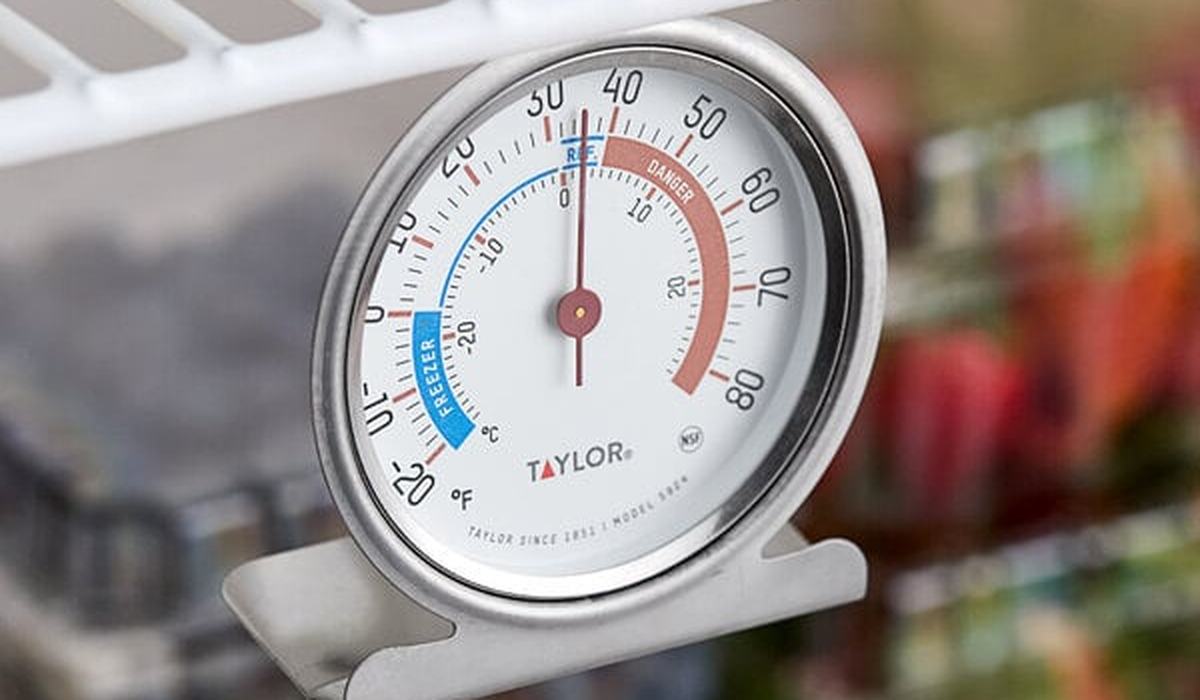
Rubbermaid fridge/freezer thermometer — best value
Two analogue dials, one for the fridge and one for the freezer, with no battery to fail. It is the cheapest way to get a real reading in both compartments.
Check Price on Amazon →
ThermoPro TP50 — best digital
Reads instantly, and the min/max memory tells you whether the compartment has been drifting warm overnight — which a spot reading always misses.
Check Price on Amazon →Govee Bluetooth thermometer — best for monitoring
Check the temperature without opening the door, and see a history rather than a single number. Useful when you are trying to prove an intermittent fault.
Check Price on Amazon →How to measure properly
- Place the thermometer in the middle of the compartment — not against the back wall, not next to the evaporator vent.
- Do not put it in the door. Door shelves are the warmest part and are not representative.
- Leave it for 4–6 hours. The air temperature has to stabilise around it.
- Check both compartments. A fridge reading badly while the freezer is fine points to a different fault than both being warm.
- Note the ambient room temperature too. A 90°F kitchen changes everything.
- Re-check after any change to the dial, gasket or thermostat — give it another 4–6 hours before judging.
Both compartments warm points to a system problem — compressor, condenser or airflow. Fridge warm with a normal freezer usually points to an airflow or defrost issue, since most fridges cool the fridge compartment using air from the freezer. That single distinction narrows the diagnosis considerably.
Setting the temperature correctly
- Start at the manufacturer's recommended dial position — usually mid-range, not maximum.
- Do not turn it to the coldest setting to 'make it colder'. Beyond a point the compressor runs constantly, the fridge ices up and the efficiency drops.
- Adjust one notch at a time and wait six hours before judging the effect.
- In a hot kitchen, expect to need a colder setting; in a cold room, a warmer one.
- Target 37°F in the fridge and 0°F in the freezer. There is no benefit to going colder, and it costs energy.
- Record your final dial setting so you can return to it after cleaning or a power cut.
A $10 dual analogue thermometer tells you what your fridge actually is, which is the first step in every cooling complaint and the only way to verify that a repair worked. Target 35–38°F in the fridge and 0°F in the freezer.
Frequently asked questions
Placement changes the reading
| Placement | Reading accuracy | Verdict |
|---|---|---|
| Middle of the compartment | Representative | Use this |
| Back wall | Falsely cold | Avoid |
| Next to the vent | Falsely cold | Avoid |
| Door shelf | Falsely warm | Not representative |
| Crisper drawer | Slightly warmer | Useful for produce |
| Freezer centre | Representative | Use this |
Air temperature inside a fridge is not uniform, and the difference between the coldest and warmest points can be 10°F or more. The back wall sits next to the evaporator and runs cold; door shelves sit in the warmest air and swing with every opening. Measuring in the middle of the compartment gives you the temperature your food actually experiences.
If you want to know how bad the spread is in your own fridge, put two thermometers in at once — one in the middle, one in a door shelf — and compare after four hours. A large difference is normal, but it tells you where not to store milk and where not to store salad.
Using a thermometer as a diagnostic tool
A refrigerator thermometer is not just for reassurance. It is the cheapest instrument you can use to tell whether a cooling complaint is real, intermittent, or imagined, and it is the first thing to reach for before calling anyone.
| Reading | What it suggests | Next step |
|---|---|---|
| Fridge above 40°F, freezer normal | Air path or damper fault | Check vents and damper |
| Both compartments warm | Compressor or condenser | Clean coils, listen for the compressor |
| Normal on average, spikes after defrost | Defrost or fan fault | Watch across a full cycle |
| Warm only at the front of shelves | Poor circulation | Reorganise and clear vents |
| Readings vary with door use | Normal behaviour | No repair needed |
Read the thermometer over a full cycle, not at a single moment. Freezers have their own defrost cycle that briefly raises the temperature, and a single reading taken during it will look alarming while everything is working correctly.
Placement matters: put the thermometer in the middle of the compartment rather than against a wall or the back, because surfaces near the evaporator read colder than the air the food actually sits in. A reading taken against the back wall can be several degrees off and lead you to chase a fault that does not exist.