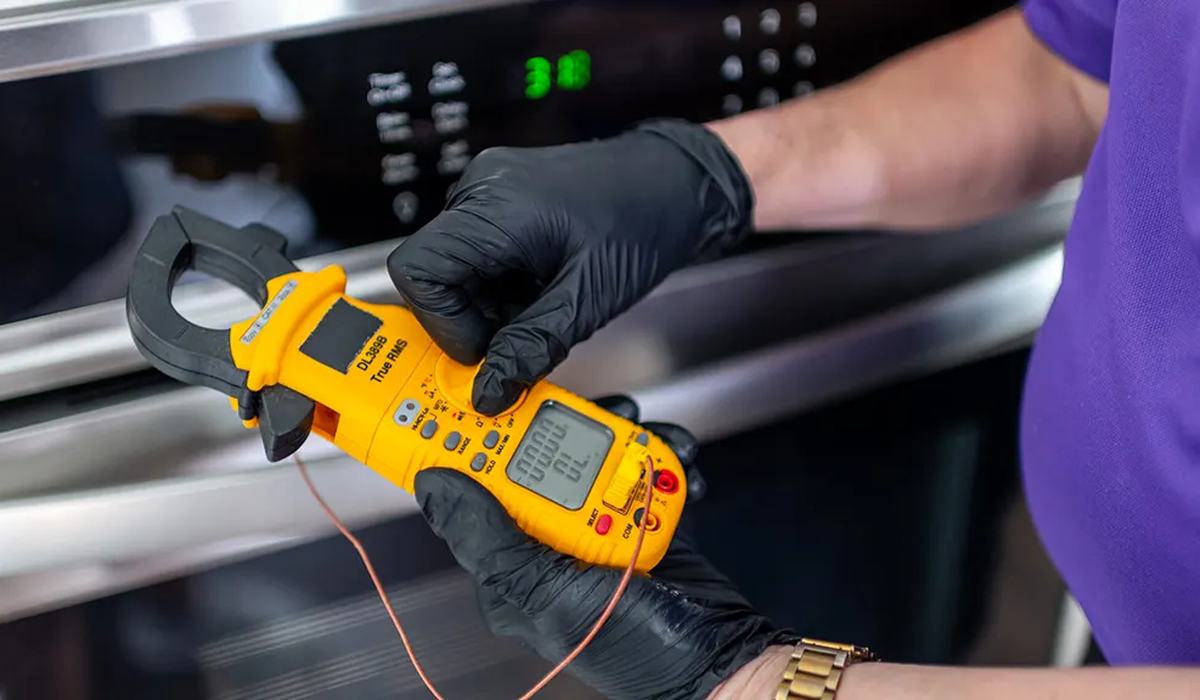
When a refrigerator stops cooling and the compressor is silent, the instinct is to assume the worst. But the compressor is usually the last thing to fail — the start relay and run capacitor are far more common culprits, and they cost a fraction as much to replace.
This guide walks through the tests in the order a technician works: cheapest and most likely first, compressor last. You will need a multimeter with a continuity and resistance setting, and about an hour.
On this page
Safety first
- Unplug the refrigerator and wait five minutes.
- Discharge the capacitor safely before touching it (see below).
- Work on a dry surface with dry hands.
- If you are not confident working around mains voltage, stop and call a technician.
1. Test the start relay
The start relay sits on the side of the compressor and gives it the initial jolt it needs to start. It is the single most common failure in a “compressor won’t run” diagnosis, and it is cheap to replace.
- Unplug the fridge and pull the relay off the compressor terminals.
- Shake it next to your ear. A rattle means the internal contacts have broken — replace it.
- Set the multimeter to continuity. On a PTC relay, the two main terminals should show continuity.
- No continuity, or a rattle, means the relay is bad.
If the relay rattles or reads open, replace it before testing anything else. A new relay is inexpensive and often fixes the problem outright.
2. Test the run capacitor
The run capacitor helps the compressor motor run smoothly. A failed capacitor can stop the compressor starting, or make it hum and trip the overload.
- Discharge the capacitor by bridging its terminals with an insulated screwdriver (you may see a small spark — that is the stored charge).
- Set the multimeter to resistance (the highest range).
- Touch the probes to the terminals. The reading should climb as the capacitor charges.
- Reverse the probes. The reading should climb again in the other direction.
A capacitor that reads zero, reads open, or does not climb is failed. A quick functional check is to set the meter to continuity with the beeper on: touch the probes for a few seconds, then swap them — a short beep means it is storing some charge. That confirms it works but not that the capacitance is correct, so replace it if in doubt.
3. Test the compressor windings
Only now do you test the compressor itself. The compressor has three terminals — commonly labelled C (common), S (start) and R (run). You are checking two things: that the windings have resistance, and that none of them is shorted to the metal body.
- Set the multimeter to the lowest resistance range.
- Measure between C and S, C and R, and S and R. Each pair should show a low but non-zero resistance.
- The two smaller readings should add up to roughly the largest one (C–S plus C–R ≈ S–R).
- Now set the meter to continuity and touch one probe to a terminal and the other to the bare metal compressor body. There should be no continuity.
Reading the results
| Test | Good result | Bad result | Action |
|---|---|---|---|
| Start relay | Continuity, no rattle | Rattle or open | Replace relay |
| Run capacitor | Reading climbs both ways | Zero, open, no climb | Replace capacitor |
| Windings C–S, C–R | Low, non-zero resistance | Open (infinite) | Compressor failed |
| Terminal to body | No continuity | Continuity | Compressor failed |
If the relay and capacitor test good and the windings read normal, the compressor is probably fine and the fault is elsewhere — a thermistor, the control board or the defrost system. If the windings are open or shorted, the compressor is the problem and replacement is usually not economical on a domestic fridge.
When to call a technician instead
Testing the relay, capacitor and windings is within reach for most people. But there are points where the sensible move is to stop and call someone.
- The windings read open or shorted. Replacing a compressor needs refrigerant recovery and recharge equipment, which is regulated in most countries. On a domestic fridge it is rarely economical.
- You are not comfortable with mains voltage. The compressor circuit runs on mains power and the capacitor holds a charge. If that makes you uneasy, stop.
- The fault is intermittent. If the fridge works sometimes and not others, the diagnosis needs more than a static test — a technician can watch it under load.
- You have already replaced the relay and capacitor. If a new relay and capacitor did not fix it, the problem is deeper and the next step is a professional.
There is no shame in stopping. The value of these tests is that they tell you whether the repair is worth doing at all — and often the answer is that a cheap relay fixes it, or that the fridge has reached the end of its life.
Tools for this job
You need a multimeter with a resistance range, and a start relay and capacitor if the test shows they have failed.
Frequently asked questions
How do I know if my refrigerator compressor is bad?
What is the most common reason a compressor won't start?
Can I replace a refrigerator compressor myself?
What resistance should compressor windings read?
Is it safe to test a refrigerator compressor with a multimeter?
Related guides