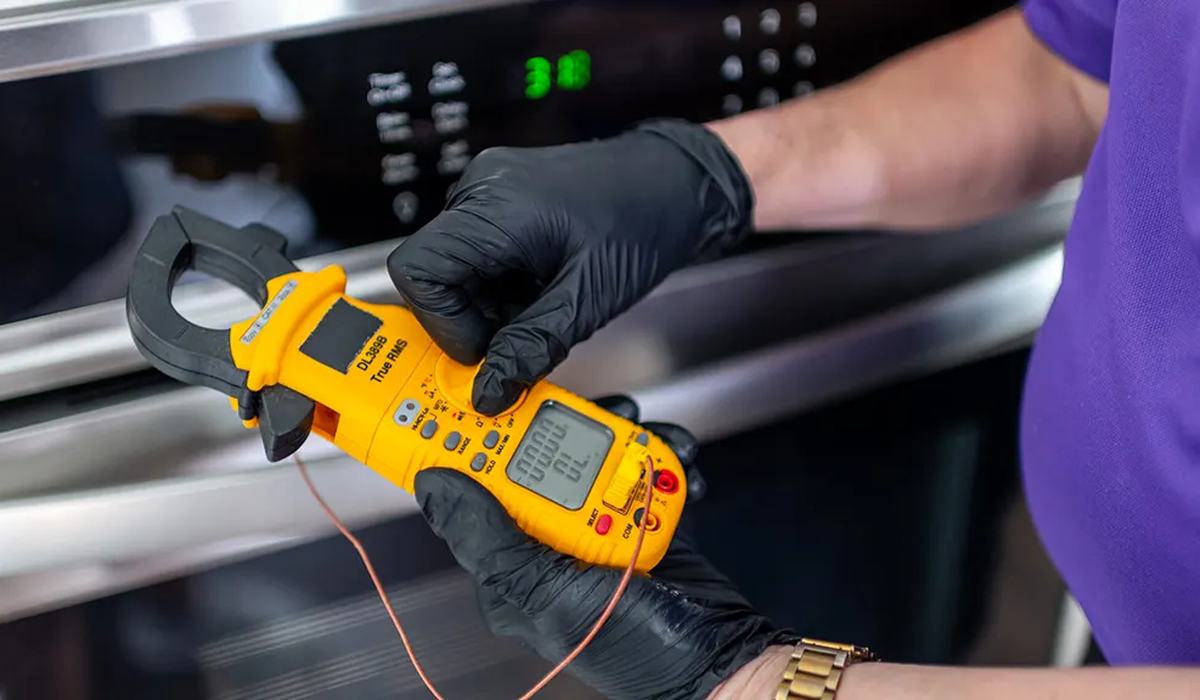
A multimeter is one of the safest tools in a repair kit, because it lets you test without touching live parts. But it is also one of the most dangerous if used carelessly, because it puts you in contact with mains voltage. The difference is entirely in how you use it.
This guide covers the safety rules that matter, in the order you should think about them.
- Rule 1: unplug the appliance for every test except voltage.
- Rule 2: use a CAT III 600V meter for mains work.
- Rule 3: check the leads for cracks before every use.
- Rule 4: discharge capacitors before touching them.
- Rule 5: keep one hand behind your back when probing live voltage.
The five safety rules
| Rule | Why |
|---|---|
| Unplug for all non-voltage tests | Resistance on a live circuit is meaningless and dangerous |
| Use a CAT III 600V meter | Withstands mains voltage spikes |
| Check leads before use | Cracked leads expose you to live voltage |
| Discharge capacitors | They hold a charge after power is cut |
| One hand behind your back | Prevents current crossing your chest |
Electricity is dangerous when it crosses your chest, through your heart. Keeping one hand behind your back means that if you touch a live part, the current goes through your hand and out your feet, not across your heart. It is the single most important habit in electrical work.
Checking your leads
Your test leads are the part most likely to fail. They flex thousands of times and the insulation cracks. Before every use, run your fingers along each lead and look for cracks, cuts or exposed wire. A cracked lead is a direct path to live voltage.
- Flex the leads and look for cracks in the insulation.
- Check the probe tips are not bent or loose.
- Confirm the leads are in the right sockets for the test.
- Replace cracked leads immediately — they are cheap.
- Use fused leads for extra protection on current tests.
- Never use a lead with exposed wire.
Testing live circuits
- Set the meter to the correct function before probing.
- Confirm the range is above the expected voltage.
- Keep one hand behind your back.
- Probe one point at a time, carefully.
- Do not let the probes touch each other — that is a short circuit.
- Withdraw the probes before changing the function.
Common mistakes
- Testing resistance on a live circuit — meaningless and dangerous.
- Using a meter without a CAT rating for mains work.
- Probing with two hands — current can cross your chest.
- Leaving the meter on a current range and then testing voltage.
- Ignoring cracked leads — a direct shock hazard.
- Forgetting to discharge capacitors before touching them.
Use a multimeter safely by unplugging for all non-voltage tests, using a CAT III 600V meter, checking your leads before every use, discharging capacitors, and keeping one hand behind your back when probing live voltage. These five rules prevent almost every electrical accident.
Frequently asked questions
Diagnostic tools
A CAT III rated meter is the safe choice for mains work.