On this page
- The 24 dB on the box is not the 24 dB in your room
- How sound crosses a shared apartment wall
- What a neighbour actually hears through a wall
- Placement that cuts transmitted noise
- Comparison table: noise by speed
- Night mode vs auto mode
- Renter-safe decoupling without drilling
- How to test before you get a complaint
- If the complaint has already happened
The 24 dB on the box is not the 24 dB in your room
Manufacturer noise figures come from a sound-level meter held at a set distance from the unit — usually one metre — in a quiet test chamber. Two things make that number almost meaningless in a real apartment.
First, distance. Sound from a small source spreads and weakens as it travels. In open air, every time you double your distance from the unit, the level drops by roughly 6 dB. A purifier rated 24 dB at one metre is closer to 18 dB at two metres and about 12 dB at four metres. That is a good thing for you and your neighbour — but it also means the "24 dB" you read is measured much closer to the machine than any person ever sits.
Second, the speed it was measured at. Almost every headline noise figure is the lowest fan speed. Medium is typically 8–15 dB higher than low, and high another 8–12 dB above that. A unit advertised as "24 dB" can easily exceed 50 dB on turbo — quieter than a vacuum cleaner, but perfectly audible through a wall at 2 a.m.
How sound crosses a shared apartment wall
Sound reaches your neighbour by two different routes, and the fixes are different for each.
Airborne noise
Airborne noise is the fan hum and the airflow rush travelling through the air of your room, then through the wall structure itself. The relevant property is the wall's Sound Transmission Class (STC) rating. A modern party wall built to code typically lands around STC 50–55, which cuts transmitted speech to near-inaudible. But a great many older apartment buildings have walls that test in the STC 30–40 range, where ordinary conversation is clearly audible next door. You usually have no way to measure your own wall's STC, but if you can hear your neighbour's television through it, it is well below 50.
Structure-borne noise
Structure-borne noise is the part renters forget. The purifier's motor and fan vibrate, those vibrations travel down its feet into the floor, and the floor is rigidly connected to the walls and to the building frame. The wall then radiates that vibration into the next apartment as a low hum. This is why a purifier can sound quiet to you and loud to a neighbour below you: you are hearing the airborne component, they are hearing the structural one. Hard floor plus a vibrating appliance is the worst combination.
| Route | What causes it | What actually fixes it |
|---|---|---|
| Airborne through the wall | Fan hum and airflow reaching the wall surface | More distance from the wall; lower fan speed; mass between unit and wall |
| Airborne through a doorway or duct | Sound leaking into the corridor or shared ventilation | Close your door; keep the unit away from the door; a draft excluder |
| Structure-borne through the floor | Motor vibration coupling into the floor slab | Rug, cork mat or anti-vibration pad under the unit |
| Structure-borne through a lightweight wall | Thin stud wall acting as a drum skin | Do not press the unit against the wall; keep it clear |
| Corner amplification | Two or three reflective surfaces reinforcing the same frequency | Move the unit out of the corner |
What a neighbour actually hears through a wall
Absolute decibel figures only mean something against a reference. Here is the practical scale for a quiet apartment at night, when background is perhaps 25–30 dB.
| Level at the source | Roughly equivalent to | Likely heard through a typical party wall? |
|---|---|---|
| 20–24 dB | Rustling leaves, a very quiet room | No — below most people's threshold in another room |
| 25–30 dB | A whisper | Rarely, and only if you share a genuinely thin wall |
| 31–40 dB | Quiet conversation, a refrigerator | Faint hum through a thin wall; usually ignored |
| 41–50 dB | Normal conversation | Yes — clearly audible in a quiet room next door |
| 51–60 dB | An air conditioner, a dishwasher | Yes — the classic source of a noise complaint |
The practical target follows from this: keep the unit at or below about 30 dB at the speed you use overnight, and the vast majority of neighbours will never know it is running. Above 40 dB, on a thin wall, you are asking for a knock on the door.
There is a public-health dimension here that is worth knowing, because it arms you in a conversation with a landlord. The World Health Organization's guidance for community noise puts the recommended night-time level in bedrooms at around 30 dB LAeq, and its night noise guidelines identify 40 dB as a level associated with adverse sleep effects. A purifier that pushes a neighbour's bedroom above 40 dB at night is not a trivial matter — it is measurably interfering with their sleep.
Placement that cuts transmitted noise
Placement is free and it does more than buying a quieter machine. Four moves, in order of impact.
1. Distance from the shared wall
This is the biggest lever. Because level drops about 6 dB per doubling of distance, moving a unit from 0.5 metres off the shared wall to 2 metres removes roughly 12 dB from what reaches that wall. Do not put a purifier on a shelf fixed to the party wall, and do not stand it against it. Aim for 1–2 metres minimum.
2. Decouple it from the floor
A dense rug, a cork mat, or a purpose-made anti-vibration pad under the feet breaks the rigid path from the motor into the floor slab. This is the single most effective fix for the neighbour below you, and it costs almost nothing. Thick and soft beats thin and hard; a folded towel works better than nothing, though it can block a bottom intake on some designs.
3. Get it out of the corner
Corners reinforce sound because reflections from two or three surfaces arrive together. A unit in a corner sounds louder to you and reflects more energy into the adjacent walls. Pull it out, and face it into the room.
4. Close your door and mind the door gap
Sound takes the easiest path, and a door with a 1–2 cm gap under it is a very easy path into a shared hallway or into the wall cavity of the corridor. A simple draught excluder under the door measurably reduces what leaks out, and it helps with smell and with your heating bill as well.
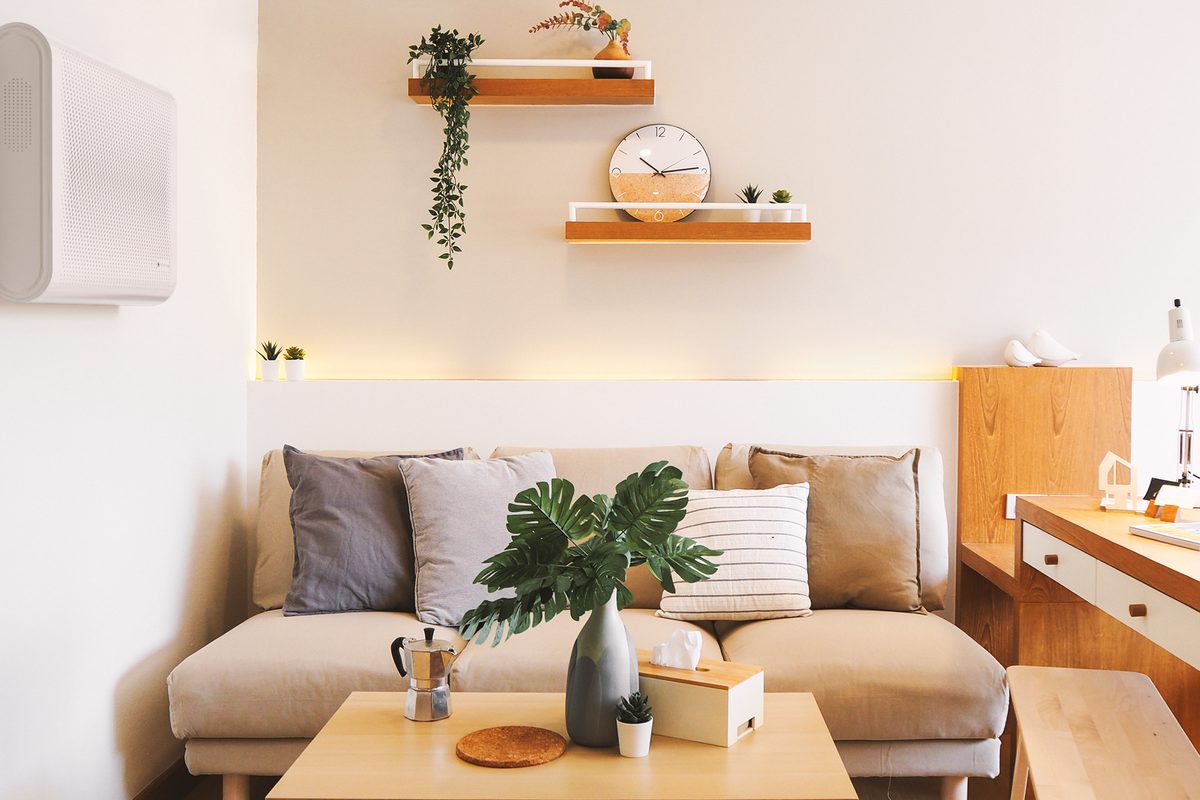
Quietest-First Shortlist
Filter the shortlist by low-speed dB first, then by CADR. A unit rated around 20–24 dB on its lowest setting with a genuine sleep mode is the target; ignore headline numbers that do not say which speed they were measured at.
Check Price on Amazon →Comparison table: noise by speed
Because model names change constantly, this table compares purifier classes by their typical noise across the three speeds you will actually use. Use it to decide what to buy or to sanity-check what you own.
| Class | Low | Medium | High | Thin-wall verdict |
|---|---|---|---|---|
| Small true-HEPA cylinder (budget) | 22–26 dB | 35–40 dB | 48–55 dB | Fine on low; avoid high at night |
| Mid-size tower with sleep mode | 20–24 dB | 33–38 dB | 48–56 dB | Best balance — low overnight, high only by day |
| Large-room HEPA (high CADR) | 24–28 dB | 38–44 dB | 56–62 dB | Oversized for a bedroom; loud on high |
| Wall-mounted flat unit | 21–25 dB | 34–40 dB | 50–58 dB | Good on low; needs a wall fixing (not renter-friendly) |
| Ioniser / "silent" no-fan units | Near 0 dB | Near 0 dB | Near 0 dB | Silent, but produce little airflow and may generate ozone — avoid |
| Small desktop USB unit | 28–34 dB | 40–46 dB | 50–58 dB | Often noisier than it looks and too small to matter |
Notice the pattern: almost every class is acceptable on low and unacceptable on high. That means the practical question is not "which purifier is quiet" but "how much airflow can I get at a speed that stays under about 30 dB". A larger unit run on low usually gives you more clean air at less noise than a small unit run on high — which is why an oversized unit for a small bedroom is often the right answer for a thin-walled flat.
Night mode vs auto mode
These two modes behave in opposite ways, and the difference matters at 2 a.m.
| Behaviour | Sleep / night mode | Auto mode |
|---|---|---|
| Fan speed | Locked to lowest | Rises and falls with sensor readings |
| Noise pattern | Constant, predictable | Can ramp up suddenly — the real complaint trigger |
| Display | Usually off | Often lit, showing air quality |
| Airflow | Low by design | Higher on average |
| Best for thin walls | Yes — predictable and quiet | Only if you cap the maximum speed |
The surprising culprit in many thin-wall complaints is not the steady hum — steady noise is easy to sleep through and easy to ignore. It is auto mode surging. The unit detects particles, spins up for two minutes, then drops back, repeatedly through the night. Intermittent noise is far more annoying than constant noise, which is why auto mode is the wrong choice overnight when a wall is shared. If your unit has a max-speed limit within auto, set it; otherwise switch to sleep mode after you go to bed.
Renter-safe decoupling without drilling
Everything below is removable and leaves no damage. None of it requires a drill, a bracket or landlord permission.
- Cork or felt anti-vibration pads under each foot. Cheap, invisible, and the highest-value fix for a neighbour below you.
- A dense rug or interlocking foam mat under the whole unit. Adds mass, which is what actually stops structure-borne transmission.
- A piece of mass-loaded vinyl or a heavy bookshelf behind it, if light spill and a little airborne noise both bother you. Mass between the source and the wall helps both.
- A draught excluder or rolled towel along the base of your door. Stops noise leaking into shared hallways and corridors.
- Books, a wall of them, on the shared wall. This is an old trick and it works: a full bookshelf adds mass and breaks up the flat radiating surface. It is also free if you already own the books.
How to test before you get a complaint
You can get a good estimate of what your neighbour hears in about ten minutes, with no special equipment.
- Set the unit the way you will run it overnight — sleep mode, low speed, in its final position.
- Go out into the hallway and close your door. Stand quietly for a minute and listen. If you cannot hear it from the hallway, the chance it reaches the flat next door at a level anyone notices is very small.
- If you have a phone with a decibel meter, measure just inside your own door, then estimate. Every metre away and every solid surface between you and the listener removes energy.
- Test the floor route separately by listening in the room below, if you know that neighbour. This is where the corks pads matter most and where people are caught out.
- Use a free decibel-meter app yourself for a rough figure at one metre, but treat it as directional, not calibrated. Phone microphones are not measurement instruments; they are good enough to tell 25 dB from 45 dB, which is the decision you are actually making.
If the complaint has already happened
Getting a note through the door is unpleasant and it is worth handling well, because a purifier complaint is one of the easiest to resolve.
- Drop the unit to sleep mode straight away and move it off the shared wall. This addresses the majority of the problem before any conversation happens.
- Tell them what you changed. A short, non-defensive message does more than any acoustic panel: what you did, and that you will keep it on low at night.
- Explain why it runs at night. People are much more tolerant of a continuously quiet appliance than an intermittent one, and framing it as sleep air quality rather than a hobby usually lands well.
- If it still travels, involve the landlord about the wall, not you. The WHO guidance above is useful here: if a ~30 dB appliance is clearly audible next door, the building's sound insulation is the weak link, not your appliance. That is a building issue and in most jurisdictions it is the landlord's responsibility to address.
The shortlist logic, in one paragraph
Buy a unit whose low-speed figure is genuinely around 20–24 dB, ideally one size larger than your room so you never need high speed. Run it in sleep mode overnight rather than auto. Put it two metres off the shared wall, out of the corner, on a cork or felt pad, with the exhaust facing into the room. Test it from the hallway before you commit to that routine. Almost every thin-wall purifier complaint is solved by those five moves, and none of them costs more than a mat.
Frequently asked questions
What decibel level is quiet enough to not bother neighbours?
Do soundproofing panels work for an air purifier?
How far should an air purifier be from a shared wall?
Is it better to run a big purifier on low or a small one on high?
Why does my air purifier seem quiet to me but loud to my neighbour?
Does sleep mode make an air purifier quieter?
Are wall-mounted air purifiers better for noise?
Related guides
Air Purifier Noise Levels Explained (dB by Speed)
What the decibel figures actually mean, speed by speed.
Best Air Purifier for Sleep: Quiet Picks Rated by dB
Which units stay quiet enough to sleep beside, and why sleep mode beats auto.
Best Air Purifier for a Small Bedroom (2026)
Sizing, noise and CADR picks for a small bedroom.
Where to Place an Air Purifier in a Small Apartment
The placements that work, the ones that waste the filter, and the clearance rules.