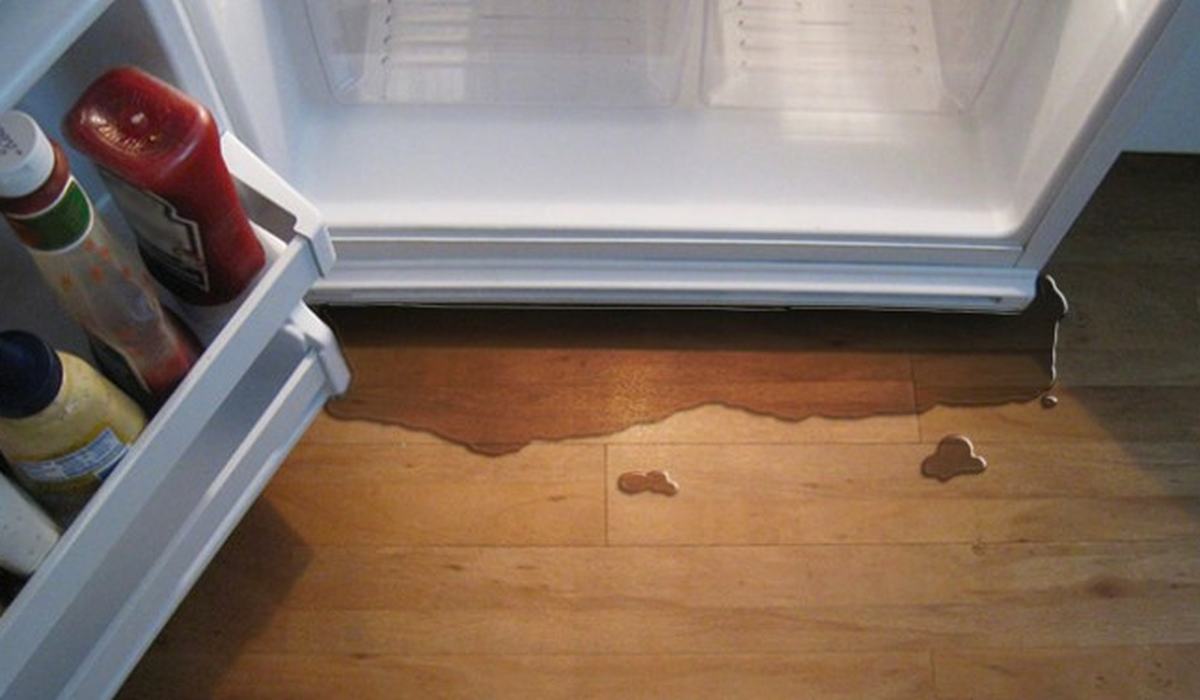
If you find water pooling in the bottom of the fridge, under the crisper drawer, or on the floor beneath the unit, you have almost certainly got a blocked defrost drain. Every automatic-defrost fridge creates meltwater during its defrost cycle, and that water is supposed to run down a channel and out through a tube to a pan under the unit where it evaporates.
When the channel or tube blocks — with food debris, ice, or mould — the water backs up, freezes into a block, and then overflows into the fridge or onto your floor.
- Water under the crisper or in the bottom of the fridge → defrost drain blocked. This page.
- Water on the floor at the back → the drain pan has cracked or come loose.
- Water at the front, near the door → the door gasket is leaking warm air, which is condensing.
- Water from the dispenser area → the water supply line, not the drain.
On this page
Why the drain blocks
- Food debris. Crumbs, bits of packaging and produce fragments wash into the channel and lodge in the trap.
- Ice from a defrost fault. If the defrost heater is failing, meltwater can refreeze in the drain before it drains away — the start of a solid block.
- Mould and biofilm. Warm, wet, dark and full of organic matter. The slime layer narrows the tube over months.
- Animal hair and dust reaching the pan and the tube from the rear.
- Level issues. A fridge leaning the wrong way can stop water reaching the drain at all.
1. Find the drain
Unplug the fridge. In most top-freezer and bottom-freezer models the drain is on the back wall of the freezer, at the lowest point — a small hole, often behind a removable rear panel or under the evaporator cover.
- Top-freezer: look at the back floor of the freezer; the hole is in the centre or slightly off to one side.
- Bottom-freezer: the drain is usually in the freezer, running up the back to the fridge section.
- Look for the ice. If you cannot see a hole, you have found it — it is under the ice block.
- Check the fridge side too. Some models have a channel at the back of the fridge compartment that feeds down.
2. Thaw the ice block
- Unplug the fridge and empty the freezer and the affected fridge shelves.
- Put towels down — you are about to release trapped water.
- Use warm water in a turkey baster or a syringe to dribble warm (not boiling) water onto the ice in the drain.
- Alternatively use a hairdryer on low, keeping it moving and never leaving it unattended. Never use a knife, screwdriver or any metal tool to chip ice — you will puncture the evaporator and write off the unit.
- Wait. Ice in a drain can take 20–30 minutes to clear fully.
The evaporator coil sits millimetres behind the freezer liner. A screwdriver through it means a refrigerant leak, and that is an uneconomic repair on almost any domestic fridge. Warm water and patience only.
3. Clear the channel
- Use a pipe cleaner, a length of flexible wire with a rounded end, or a thin bottle brush. Feed it gently down the drain.
- Do not force it. The tube is plastic and turns sharply; forcing will kink or pierce it.
- Flush with warm water from a baster and watch whether it drains. If water sits, the blockage is still there.
- Repeat until water runs freely and disappears quickly.
- Clean the channel walls with a cloth and warm soapy water — the slime layer is what re-blocks it.
4. Flush the tube from below
If water still will not drain, the blockage is in the tube behind the unit. Pull the fridge out, find the tube that runs from the cabinet down to the drain pan, and disconnect it at the cabinet end if the design allows.
- Push a flexible brush or pipe cleaner through from both directions.
- Flush with warm water and catch what comes out — you will be surprised how much debris accumulates.
- Some tubes have a one-way trap (a grommet or duckbill). Clean it carefully and refit it the right way round; it prevents warm air entering.
- Check the tube for kinks or crushing where it passes the cabinet edge.
5. Check the drain pan
The pan under the unit collects the water and lets it evaporate using heat from the compressor. A cracked, displaced or overflowing pan will put water on your floor.
- Pull the fridge out and remove the pan, usually a shallow plastic tray at the bottom rear.
- Look for cracks and for mineral scale that has made it brittle.
- Check the pan is properly located under the drain tube — if the tube misses the pan, water goes straight to the floor.
- Clean the scale with warm water and vinegar. A pan full of scale evaporates poorly and overflows.
6. Stop it recurring
- Wrap strong-smelling and crumbly food. Debris in the drain almost always starts as food that was not covered.
- Check the drain every six months when you clean the condenser coils — two jobs, one fridge pull-out.
- Fix the defrost system if frost keeps returning. A recurring ice block in the drain is a symptom of a failing defrost heater or thermostat.
- Keep the fridge level or very slightly back-tilted so water flows toward the drain.
- Flush with warm water quarterly as routine maintenance.
A blocked defrost drain is one of the genuinely satisfying refrigerator repairs: no parts, half an hour, warm water and patience. Thaw the ice, clear the channel, flush the tube, check the pan. If it re-blocks within weeks, suspect the defrost heater.
Frequently asked questions
Clearing the drain properly
| Blockage | Cause | Clear with |
|---|---|---|
| Food debris in the trough | Spillage washing down | Warm water and a cloth |
| Ice in the tube | Failed drain heater | Warm water, then replace the heater |
| Sludge in the tube | Biofilm and grease | Warm water with a little dish soap |
| Kinked drain hose | Displaced during cleaning | Reposition and secure |
| Frozen pan outlet | Ice build-up | Defrost and clear the outlet |
The drain is the least glamorous part of a refrigerator and the source of most water-on-the-floor complaints. Meltwater from every defrost cycle has to travel from the trough, down a tube, and into the pan at the bottom, and any restriction at all sends it onto the kitchen floor instead. Because it only misbehaves during a defrost cycle, it is often misdiagnosed as an intermittent leak.
Pour a cup of warm water into the drain trough and watch how long it takes to appear in the pan below. If it drains freely in seconds the tube is clear. If it pools, backs up, or never arrives, you have found the fault — and clearing it usually takes a few minutes.