On this page
What white noise does, and why a purifier produces it
White noise is sound containing equal energy across the audible frequency range. Real fans are not literally white — they are closer to pink or brown noise, with more energy at lower frequencies — but the perceptual effect is the same: a broadband, featureless wash of sound.
That steadiness is the point. Sound that never changes gives the brain nothing to react to, and it masks the sharper, intermittent noises that wake light sleepers: a door latch, a floorboard, traffic, a neighbour's plumbing. Newborns also spend more time in lighter sleep stages than adults, which makes them more easily roused by sudden sound.
A purifier produces this kind of sound as a by-product. Air moving through a fan and a filter housing generates broadband noise with very few distinct tones. It is, incidentally, why a purifier tends to sound more pleasant than a fan-based white-noise machine of the same measured level — there is no motor whine to latch onto.
What the safety guidance actually says
The concern around infant white noise is not that sound is inherently harmful. It is that volume and proximity can push the exposure into a range that risks the auditory system and the sleep architecture.
The two reference points that matter:
- WHO Environmental Noise Guidelines recommend night-time bedroom levels near 30 dB average, with adverse effects on sleep becoming measurable above roughly 40 dB.
- American Academy of Pediatrics safe-sleep guidance is built around a clear, uncluttered sleep space and is widely read alongside the advice that infant sleep machines should be kept at a low volume, placed away from the cot, and not run continuously all day.
| Measured level at the crib | Where a purifier lands | Assessment |
|---|---|---|
| Under 30 dB | Low speed, 3+ ft away | Comfortably within guidance |
| 30–40 dB | Low to medium speed, closer in | Acceptable; at the top of the range |
| 40–50 dB | Medium or high speed | Above night-time guidance; turn it down |
| 50 dB+ | High speed or unit against the cot | Too loud for a cot-side source |
The practical translation: a purifier on its lowest speed, three or more feet from the cot, sits in the lowest band. The same purifier on speed three, two feet from the cot, does not.
Purifier versus white-noise machine
A dedicated white-noise machine and a purifier overlap, but they are not interchangeable.
| Aspect | Air purifier | White-noise machine |
|---|---|---|
| Primary function | Filters particles from the air | Produces sound only |
| Sound character | Broadband, few tones, changes with speed | Usually a looped recording or a fan |
| Volume control | Tied to fan speed, so louder means more airflow | Independent of any other function |
| Maximum useful volume | Loud on high, but you would not want it | Can be pushed far louder than needed |
| Secondary benefit | Cleaner air overnight | None |
| Failure mode | A unit too loud to run overnight | A unit set far too loud |
For most families a purifier covers both jobs at once: it cleans the air and provides a gentle, masking sound. A dedicated machine becomes the better choice only if you need a volume the purifier cannot reach while remaining a useful air cleaner, and in a nursery that volume is usually not the one you want anyway.
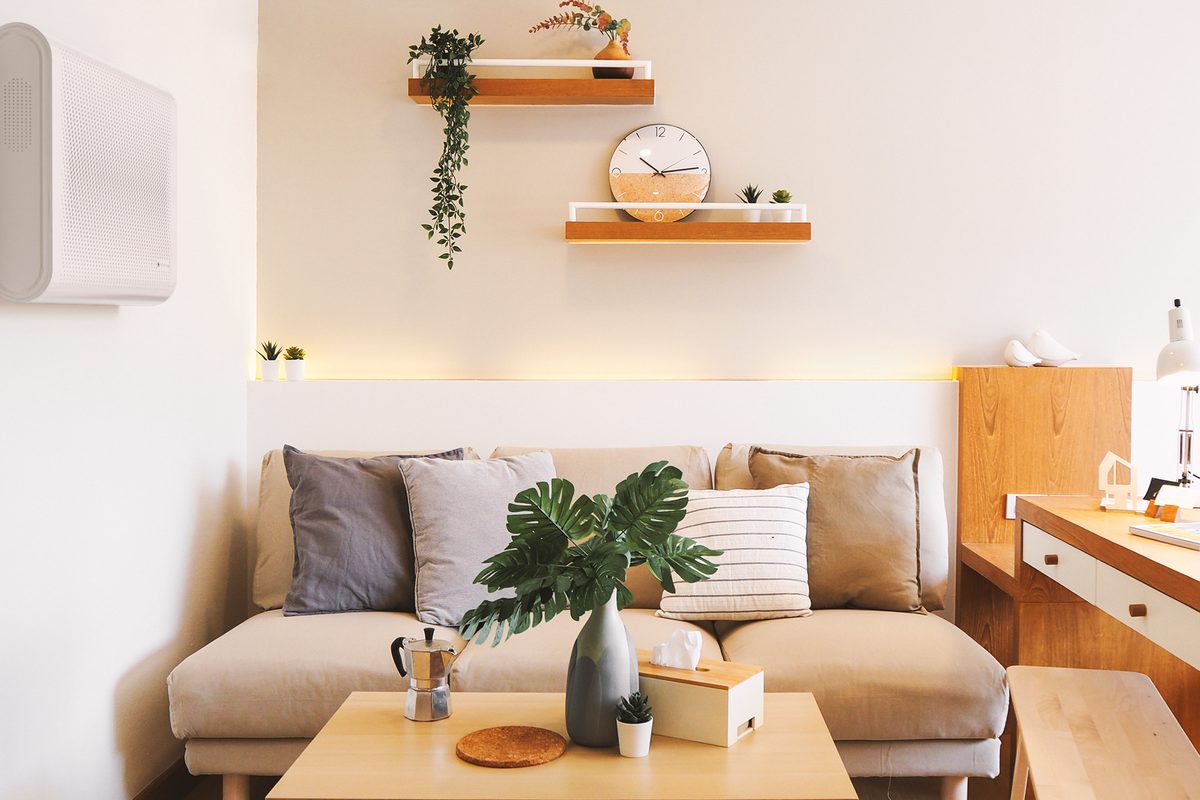
Quiet Purifier for Dual-Use in a Nursery
One machine that both filters and provides soft masking sound. Choose a model with a fixed low night mode — that combination is what makes dual use work.
Check Price on Amazon →Setting the right volume
You do not need a calibrated meter. Three workable tests:
- The arm's-length test. Stand where the cot is, at cot height. If the sound is obviously loud to you — not a faint background wash, but something you would have to raise your voice over — it is too loud for a baby.
- The doorway test. Step to the door. The sound should be faintly audible and no more. If it is clearly audible from the corridor, it is louder than the room needs.
- The phone-app test. A sound-level app is not a calibrated instrument, but it is useful as a comparison. Aim for a reading in the 25–35 dB range at cot height with the room otherwise quiet.
Note that the third test is a rough guide only. Phone microphones vary, and the absolute number may be several decibels out. Used for comparison between settings on the same phone, though, it is reliable enough to pick a fan speed.
How to use a purifier as white noise safely
Six rules cover it:
- Keep it three feet or more from the crib. Distance is the cheapest safety measure you have, and the 6 dB per doubling rule means each step back reduces exposure substantially.
- Run the lowest fixed speed. Not auto mode, which surges and defeats the purpose of steady sound.
- Do not aim the outlet at the crib. Aim it across the room so the airflow is indirect and the sound is diffuse.
- Use it for sleep, not all day. Running it continuously from morning to night raises total exposure with no sleep benefit. Night and naps is the sensible pattern.
- Never place it in or on the crib. AAP safe-sleep guidance is built on a clear sleep surface with nothing else in it.
- Never route the cord across the crib. A cord within reach of a cot is a strangulation risk, and this is the part of the setup people most often overlook.
When to stop or switch off
Turn the sound off — keeping the filtration if the unit allows a fan-only low mode — if any of the following apply:
- The baby seems to be sleeping worse with it on than off, which happens when the sound is too loud rather than too quiet.
- You cannot hear the baby from the next room when the purifier is running. A masking effect that hides genuine distress cries is working against you.
- The unit is audible from the hallway or the neighbouring room.
- Your paediatrician has advised against continuous sound exposure for your child.
As a general principle: white noise at a low level, at a distance, for sleep periods only, is a reasonable tool. It is not a substitute for a quiet room, and it should never be loud.
Sources: AHAM (CADR certification program), U.S. EPA (Residential Air Cleaners guide; ozone generator warning), ASHRAE Standard 62.2 (residential ventilation), WHO Environmental Noise Guidelines (night-time bedroom levels), American Academy of Pediatrics (safe sleep and cord safety).
Frequently asked questions
- how long to run a nursery air purifier — related guide in this cluster.
- baby-safe air purifier — related guide in this cluster.
Is it safe to use an air purifier as white noise for a baby?
What volume of white noise is safe for a baby?
Should I use an air purifier or a white-noise machine for a baby?
Can white noise damage a baby's hearing?
Should white noise run all night or only at bedtime?
Why does my air purifier make a droning sound instead of white noise?
Related guides
Quietest Air Purifier for a Baby Room (Real dB Data)
Decibel bands by speed and what each one sounds like.
Quiet Air Purifier for a Nursery: The Complete Renter's Guide
Sizing, safety and placement in one guide.
Air Purifier Decibels Explained: What the Numbers Mean
How the decibel figure is measured and where it misleads.