On this page
The decibel bands, and what each sounds like
Decibels are logarithmic, which is why the numbers look small and feel large. An increase of 10 dB is roughly a doubling of perceived loudness, and an increase of about 3 dB is the smallest change most people notice at all. That is why the gap between a 24 dB unit and a 30 dB unit is far bigger in practice than the six digits suggest.
| Band | Sounds like | Effect on a sleeping baby |
|---|---|---|
| Under 20 dB | Effectively silent in a quiet room | None |
| 20–24 dB | A faint air movement, quieter than a whisper | None; indistinguishable from room tone |
| 25–29 dB | Soft, steady air; audible only if you listen | Negligible for almost all babies |
| 30–34 dB | A quiet fridge or a low fan | Mild; some light sleepers will stir |
| 35–39 dB | A clear continuous hum | Sleep disruption becomes likely |
| 40 dB+ | Conversation level | Awakening likely; above WHO bedroom guidance |
The WHO Environmental Noise Guidelines place recommended night-time bedroom levels near 30 dB, with adverse sleep effects becoming measurable above roughly 40 dB. A unit running at 22–26 dB is comfortably inside that envelope. A unit running at 45 dB is not, however effective it is at cleaning air.
Why sub-25 dB is the threshold that matters
Twenty-five decibels is not a magic number, but it is the useful dividing line because of the way parents behave when a unit is above it.
Past about 25 dB, parents start doing a calculation: is the filtering worth the noise? Often they conclude no, and switch the machine off at bedtime — which means eight hours of zero filtration in the room where it matters most. Below 25 dB, the unit simply disappears into the room and stays on. The practical filtration you get from a 24 dB unit running 10 hours a night is far greater than from a 38 dB unit running for the two hours before bed.
Noise changes with speed far more than with brand
Within a size class, the difference between two reputable brands at the same fan speed is typically 1–3 dB. The difference between speed 1 and speed 3 on the same unit is typically 12–20 dB. In other words, which speed you run matters several times more than which badge is on the front.
| Fan speed | Typical dB | Typical airflow | Use it for |
|---|---|---|---|
| Sleep / speed 1 | 20–26 dB | 20–30% of max | All night, every night |
| Speed 2 | 30–38 dB | 45–60% of max | Daytime, room occupied |
| Speed 3 | 38–46 dB | 70–85% of max | Airing out an empty room |
| Turbo / max | 46–56 dB | 100% | Ten-minute burst after cooking or smoke |
This is why sizing the unit generously is a noise strategy, not just an air-quality one. A unit with headroom can be run on speed 1 permanently. A unit that is marginal for the room will end up on speed 2 or 3 — exactly where the noise is.
Steady beats quiet: the surge problem
A purifier in auto mode is not quiet or loud — it is both, unpredictably. The particle sensor triggers on a door opening, a duvet being shaken, a pet walking past, or a plume of dust from a shelf. Each trigger is a ramp up to speed 2, and each ramp down follows.
For sleep, an intermittent 34 dB is worse than a constant 28 dB. Habituation is the reason: the brain filters steady sound, but it responds to change. A fan that rises and falls through the night is a series of small alerts.
- Night mode pins the fan at its lowest speed and is the correct overnight setting.
- Fan-only mode is the fallback where a unit has no true night mode — it disables the sensor so the speed stays where you set it.
- Auto mode belongs in an empty room or during the day.
Getting the lowest effective noise from any unit
Placement is free decibels. Four changes, none of which need a screwdriver:
- Move it away from the crib. Sound pressure falls about 6 dB per doubling of distance. Going from two feet to four feet, then to eight, each roughly halves the perceived level. Three to six feet is the sweet spot between quiet and still effective.
- Put a mat underneath. A cork, rubber or thick rug under the unit stops vibration travelling into a shared floor structure. This is the single biggest fix for a neighbour below.
- Avoid corners and hard surfaces. Corners reinforce low-frequency sound, and hard floors reflect it. A unit on a mat in the middle of a wall is quieter than the same unit tucked into a corner.
- Avoid the shared wall. Move the unit to an interior wall or, better, to the wall the crib is not against, and keep it off the party wall entirely.
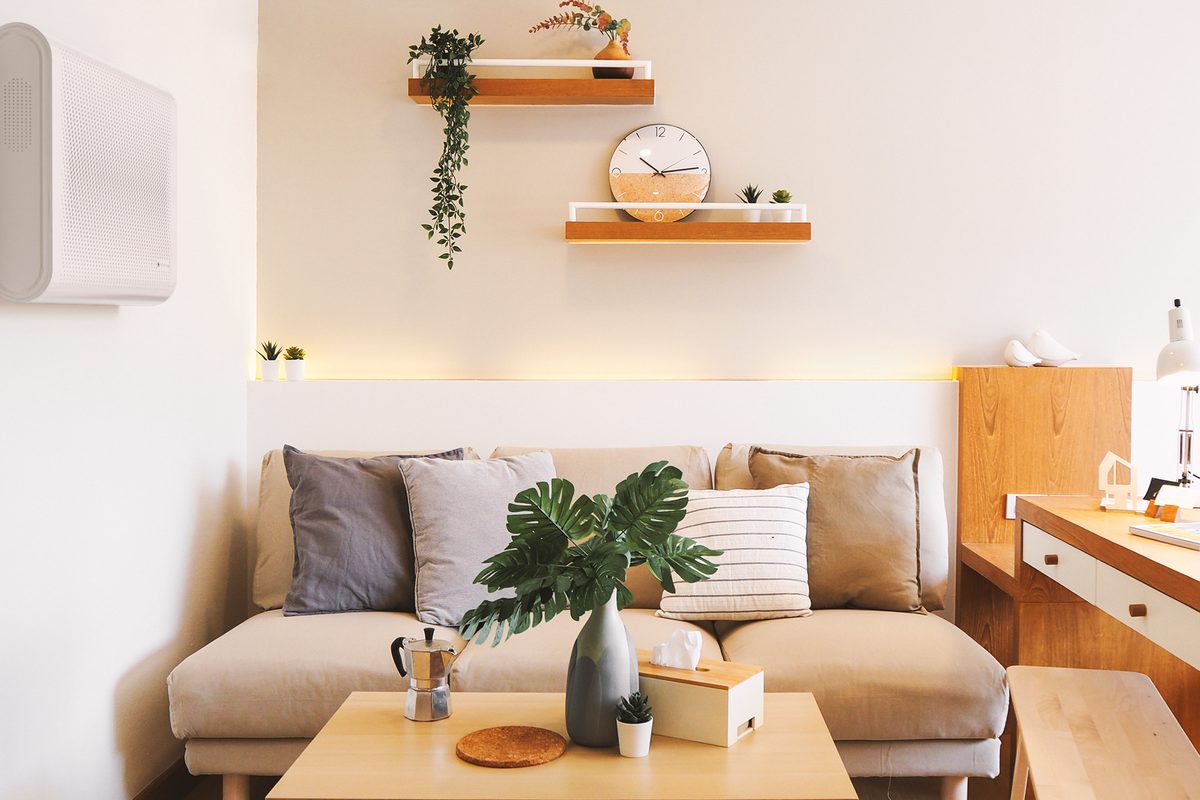
Quiet True-HEPA Unit for a Baby Room
A 24 dB low speed with a genuine display-off night mode. Add a cork or rubber mat for the floor, and a spare filter so replacements are never postponed.
Check Price on Amazon →How to measure your own room honestly
You do not need a lab. A phone sound-level app, held at the crib at the height a baby's head would be, gives a usable reading.
- Measure the room with the purifier off first. That is your baseline — many bedrooms already sit at 28–34 dB from traffic, plumbing or a fridge.
- Switch the purifier on at its overnight setting and measure again from the crib.
- Subtract the baseline from the reading. If the purifier adds less than about 6 dB over ambient, it is effectively inaudible against the room tone.
- Repeat at the door and in the neighbouring room to check transmission.
Phone microphones are not calibrated instruments, and the absolute numbers will be off by a few decibels. Used as a comparison tool in the same room, though, they are perfectly adequate — and far better than trusting a box.
Sources: AHAM (CADR certification program), U.S. EPA (Residential Air Cleaners guide; ozone generator warning), ASHRAE Standard 62.2 (residential ventilation), WHO Environmental Noise Guidelines (night-time bedroom levels), American Academy of Pediatrics (safe sleep and cord safety).
Frequently asked questions
- how long to run an air purifier in a nursery — related guide in this cluster.
- quiet air purifier for an apartment — related guide in this cluster.
What is the quietest dB for a baby room air purifier?
Is 30 dB too loud for a baby to sleep?
Does a quieter air purifier clean less air?
Why does my purifier get louder on its own at night?
Can the neighbour below hear my air purifier?
How far should a purifier be from the crib for the quietest result?
Related guides
Quiet Air Purifier for a Nursery: The Complete Renter's Guide
The full picture: sizing, safety and placement.
How Loud Is a 24 dB Air Purifier? (Real-World Test)
What the headline figure actually sounds like in a room.
Air Purifier White Noise for Baby: Safe or Not?
Volume limits, benefits and the risks to know.