On this page
What 24 dB sounds like
Decibels are logarithmic, so ordinary intuitions about numbers fail. Some landmarks:
| Measured level | Comparable sound | Relationship to 24 dB |
|---|---|---|
| 0 dB | The threshold of hearing | 24 dB is about 250 times the sound energy |
| 10–20 dB | A recording studio, an anechoic room | Quieter |
| 24 dB | A faint air movement; quieter than a whisper | — the figure in question |
| 30 dB | A whisper, a quiet bedroom at night | About twice the sound energy |
| 40 dB | A quiet fridge hum | About 40 times the sound energy |
| 50 dB | A moderate rainfall on a window | About 400 times |
| 60 dB | Normal conversation | About 4000 times |
Two honest observations. First, 24 dB is genuinely quiet — it is at the level where the character of the sound matters more than its loudness. Second, in a normal home you will struggle to identify it, because the room around you is already louder.
Your room is already louder than 24 dB
This is the part that purifier marketing never mentions. A real bedroom at night is not silent. Typical background levels:
| Bedroom situation | Typical background | Can you hear a 24 dB unit? |
|---|---|---|
| Quiet suburban bedroom, windows shut | 28–32 dB | No — it is below the room tone |
| City bedroom, windows shut | 32–38 dB | No |
| Bedroom with a fridge two rooms away | 30–36 dB | No |
| Bedroom above a road, windows shut | 35–42 dB | No |
| Rural bedroom, deep night, windows shut | 22–28 dB | Faintly, if you listen |
| Same room with windows open | 40–50 dB | No |
The conclusion is liberating: in most flats, a 24 dB purifier is not merely quiet, it is inaudible against the ambient level. The unit you notice at night is not the one rated at 24 dB; it is the one you have turned up to speed 2 or 3.
How to verify the claim in your own room
A phone sound-level app is not a calibrated instrument, but as a comparison tool it is entirely adequate. The method:
- Measure the room with the purifier off. Hold the phone where your head or the cot will be, and take a reading when nothing else is running. That is your baseline.
- Switch the purifier on at its lowest setting and measure again from the same spot.
- Subtract. If the increase is under about 6 dB, the unit is effectively inaudible against the room's own tone.
- Repeat at the door and in the neighbouring room if you are worried about neighbours.
Do this once, honestly, and you will know more about your specific room than any review can tell you. Phones underread at very low levels and their microphones are not flat, so treat the absolute numbers as approximate and the differences as reliable.
What 24 dB means at each distance
Manufacturers rarely state the measurement distance, and it changes the answer substantially. Sound pressure falls about 6 dB each time you double the distance.
| Distance from the unit | If the rating is 24 dB at 1 m | Where that is in a bedroom |
|---|---|---|
| 0.5 m | ~30 dB | Beside your head on a nightstand |
| 1 m | 24 dB | The rating distance |
| 2 m | ~18 dB | Across the room |
| 3 m | ~14 dB | The far side of a small bedroom |
| 4 m+ | ~12 dB or less | Below the noise floor of almost any room |
Notice what this means for the worst-case placement. A purifier rated 24 dB at 1 metre, sitting on a nightstand half a metre from your head, is producing roughly 30 dB at your ear — still a whisper, but no longer the number on the box. Move the same unit two metres across the room and it is at about 18 dB, which is genuinely below the ambient level of most bedrooms and therefore effectively silent.
So the honest answer to “how loud is a 24 dB air purifier?” is: at arm's length, a faint whisper; across the room, nothing at all. Where you put it changes the answer more than which model you bought.
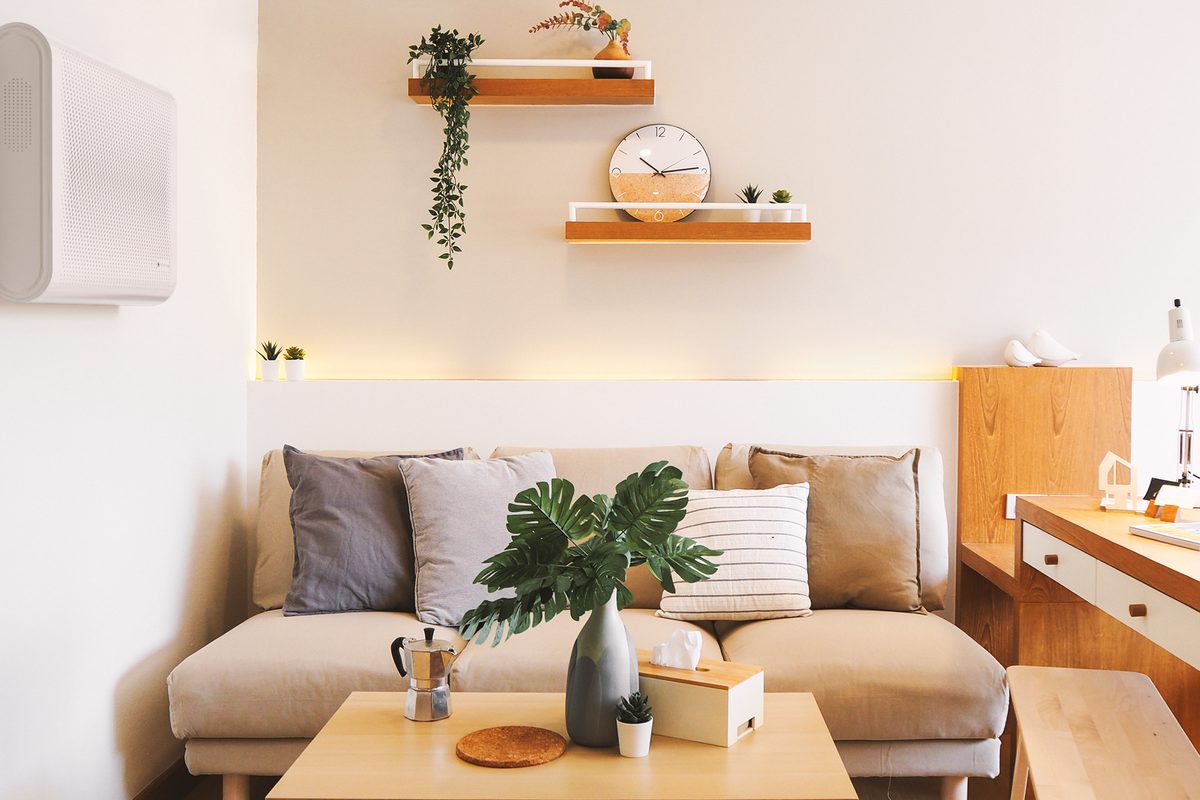
Unit Rated 24 dB at Low Speed
Check that the 24 dB figure belongs to the lowest speed and that the manual states the test distance. Then place it two metres away and you will not hear it at all.
Check Price on Amazon →When the number does not match reality
If a “24 dB” unit sounds obviously loud to you, one of five things is happening:
- It is not on its lowest speed. This is by far the most common cause. Auto mode ramps the fan up; speed 2 is typically 30–38 dB.
- The rating was taken at an unstated distance, possibly 2 or 3 metres, which flatters the figure substantially compared with a 1-metre measurement.
- A tone or rattle is present. A narrow-band whine or a resonance is far more noticeable than broadband noise at the same measured level, and decibel ratings do not capture it.
- Vibration is coupling into the building. A unit on a hard floor above a neighbour transmits energy into the structure. The airborne level can be 24 dB while the floor below hears a thump.
- The room itself is unusually quiet. In a very silent rural bedroom, 24 dB is audible because there is no room tone to hide it.
Four of those five have cheap fixes: set a fixed low speed, check the unit sits level, put a mat underneath, and move it further from the bed. None requires a new machine.
What to check before buying
| Check | Why | Good answer |
|---|---|---|
| Is the dB figure for the lowest speed? | It usually is, but confirm | The manual states it explicitly |
| Is the test distance stated? | Changes the figure by several dB | 1 m, stated on the sheet or manual |
| Is there a full per-speed table? | Tells you the speed you will actually run | Values listed for every speed |
| Does it have a fixed night mode? | Auto mode will surge overnight | A mode that pins the fan low |
| Are there reports of a whine or hum? | Tonal noise is not captured by dB | Owner reviews mention only air noise |
One last reframe. The question is rarely “is 24 dB quiet enough?” — it almost always is. The real question is “will this unit still be at 24 dB after an hour of running, or will its sensor have pushed it up to 35?” A fixed night mode answers that better than any number on a box.
Sources: AHAM (CADR certification program), U.S. EPA (Residential Air Cleaners guide; ozone generator warning), ASHRAE Standard 62.2 (residential ventilation), WHO Environmental Noise Guidelines (night-time bedroom levels), American Academy of Pediatrics (safe sleep and cord safety).
Frequently asked questions
- quiet air purifier for an apartment — related guide in this cluster.
- quiet air purifier for a nursery — related guide in this cluster.
How loud is 24 dB in real terms?
Can you hear a 24 dB air purifier at night?
Why does my 24 dB air purifier sound louder than 24 dB?
Is 24 dB quieter than a refrigerator?
What is the quietest setting on an air purifier?
Does a 24 dB air purifier still clean the air?
Related guides
Air Purifier Decibels Explained: What the Numbers Mean
Weighting, measurement and why one figure misleads.
Quietest Air Purifier for a Baby Room (Real dB Data)
Decibel bands by speed and the sub-25 dB class.
Quiet Air Purifier for a Nursery: The Complete Renter's Guide
Sizing, safety and placement in one guide.