On this page
Why nursery darkness actually matters
Light at night is not a comfort issue for an infant — it is a hormonal one. Light entering the eye signals the suprachiasmatic nucleus to stop producing melatonin, the hormone that drives sleep onset and the circadian rhythm. The effect is not limited to bright light. Research summarised by Harvard Health found that even dim light can interfere with circadian rhythm and melatonin secretion, with measurable effects at levels a night light already exceeds.
Wavelength matters as much as brightness. Blue light suppresses melatonin more powerfully and for longer than other colours — in one Harvard-led comparison, blue light suppressed melatonin for roughly twice as long as green light of comparable brightness, and shifted circadian timing about twice as far. That is why the blue-white LED ring on a cheap air purifier is the worst possible glow to leave in a nursery, and why a dim amber or red indicator is a far smaller problem.
Infants are not small adults in this respect. Their circadian system is still consolidating in the first months, and sleep is when the majority of early development happens. The American Academy of Pediatrics' safe-sleep guidance is rightly famous for the ABC rules — Alone, on their Back, in a Crib — but the environment around the crib matters too, and a persistently lit room works against the sleep the guidance is trying to protect.
The five lights hiding on a purifier
When people say "my purifier has no light", they usually mean they have not looked at it in a dark room yet. There are five distinct light sources on a typical unit, and they behave differently.
| Light source | What it is | Can it be turned off? |
|---|---|---|
| Digital display | PM2.5 readout, humidity, timer digits | Usually yes — a display-off button or long-press |
| Air-quality LED ring | Colour-coded ring (green / orange / red) | Sometimes; often dims but does not fully extinguish |
| "Night light" mode | A deliberate soft lamp for the child | Yes, but it is on by default on some models |
| Power / standby LED | Small constant bulb showing it is plugged in | Rarely — this is the one that catches people out |
| Backlit touch buttons | Glowing icons on the control panel | Often not; may stay lit whenever powered |
The standby LED is the one that ruins the plan. A unit can have a perfectly good display-off function, and still show a small green dot all night because it is receiving power. Test this before you buy, and if you already own the unit, test it tonight: switch off every light in the room, wait two minutes for your eyes to adapt, and look.
How to tell if a unit runs truly dark
Marketing copy is unreliable here, because "display off" and "light off" are not the same claim. Read the manual and the spec sheet for these four things, in this order of importance.
- "Display can be turned off" — the exact phrase, not "auto-dim". Auto-dim means the screen gets fainter in a dark room, not that it goes black.
- "Sleep mode" — on good units sleep mode kills the display, drops the fan to its lowest speed and sometimes switches the ring off too. Check whether it also reduces airflow, because a sleep mode that stops filtering is not much use.
- No standby or power indicator, or a physical way to defeat it. Some units put the power LED under a button cap, which is fine.
- Physical control surface — mechanical buttons and dials cannot glow. A unit with a rotary dial and a push-button power switch has almost nothing that can emit light.
Darkness comparison table
The table below is the decision tool. It ranks purifier types by how close they get to total darkness in a nursery, because individual models change every year but the design patterns do not.
| Purifier type | Display | Standby glow | Night mode | Darkness score |
|---|---|---|---|---|
| Manual dial + push-button switch | None | None | Not needed | Excellent |
| App-controlled with display-off + LED defeat | Off button | Defeatable | Yes | Very good |
| Sleep-mode unit, no standby LED | Off in sleep | None | Yes | Very good |
| Auto-dim display only | Dims, never black | Small LED | No | Poor |
| Always-on colour ring | Colour ring on | Small LED | No | Poor |
| Built-in night-light model | Glows by design | Small LED | Optional lamp | Worst (unless switchable) |
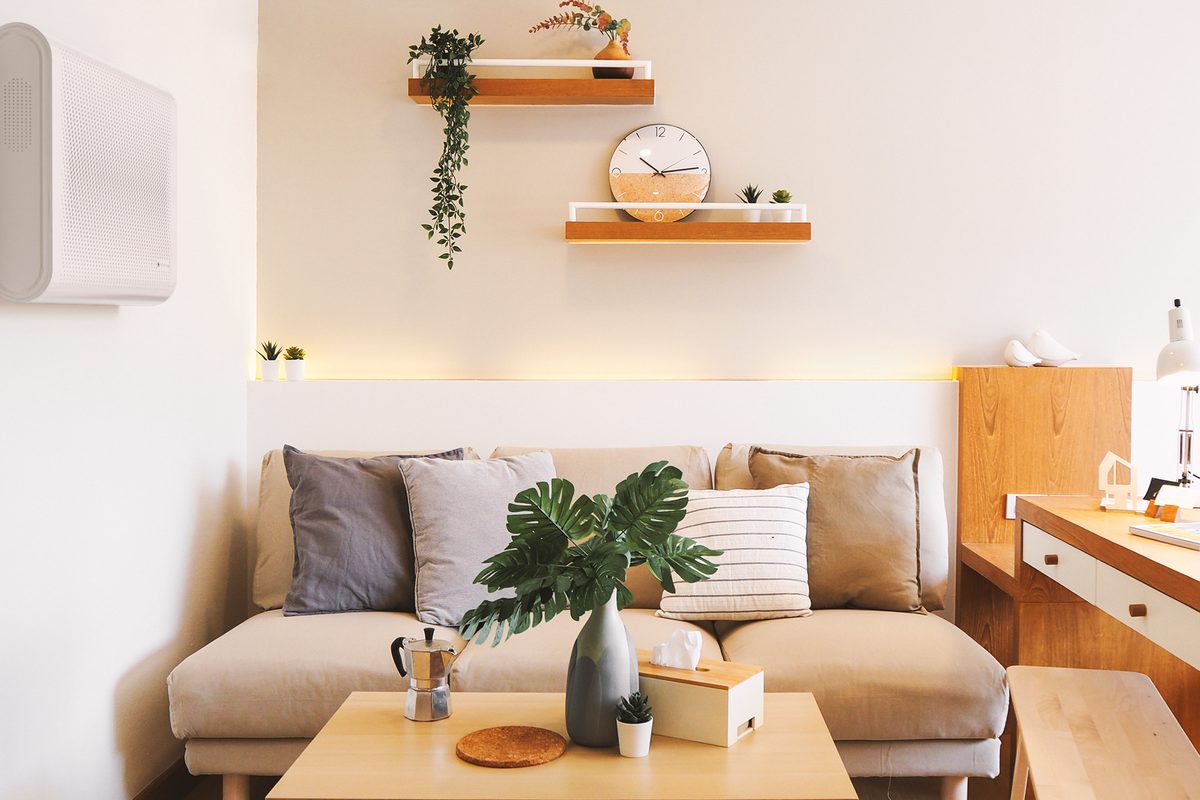
Purifier to Shortlist (Display-Off)
Shortlist units where the spec sheet explicitly says the display can be switched off and the unit has a sleep mode. Check the question-and-answer section for the phrase “does it stay dark” — owners answer that honestly far more often than marketing copy does.
Check Price on Amazon →Renter-safe ways to kill the glow
If you already own a purifier and it glows, you do not need to replace it and you certainly do not need to touch the walls. Every fix below is removable, costs very little, and leaves no trace that would cost you a deposit.
1. Black gaffer tape (the default answer)
Gaffer tape is matte, leaves no residue on most plastics, and peels off cleanly. Cut a strip slightly larger than the LED or the display window, press it on, and it is gone. Do not use duct tape — it leaves adhesive behind on warm plastic. Do not tape over an air intake or an exhaust grille, only over the light itself.
2. A fabric slip-cover over the control panel
A rectangle of dark cotton folded over the top of the unit achieves the same thing and looks less improvised. Make sure it does not cover the intake or the outlet, and that it cannot be pulled into the fan by a curious toddler. If the cover has any chance of being sucked in, do not use it.
3. A removable blackout panel behind the unit
If light spills sideways onto a wall, a piece of black card behind the purifier catches it. Stand it behind the unit leaning against the wall — no fixings, no marks, and it also reflects a little sound back into the room rather than through the wall, which helps with the noise problem too.
4. Reposition instead of modify
Sometimes the cheapest fix is to turn the unit 90 degrees so its control panel faces a wall, or to move it to the far side of the room. This is free, reversible, and works on units that have no off switch at all.
Placement so nothing shines at the crib
Even a purifier that dims rather than extinguishes is usually fine if you position it with intent. Three rules cover it.
- Put the control panel against a wall or a corner. Light that faces a wall does not reach the crib. This is the single highest-value move.
- Get it off the floor beside the crib and onto the far side of the room. Air purifiers are most effective when they are not blocked, so 3–6 feet from the crib works for both air quality and darkness. Never put a purifier inside the crib, on a shelf above it, or anywhere a cord can dangle into it.
- Face the outlet away from the child. Where the unit blows clean air matters less than where the light points, but if you can aim the exhaust across the room rather than directly at the crib, you also avoid a cold draught on the baby.
On cord safety, the AAP's guidance is unambiguous: keep cords well away from the sleep space. A purifier in a nursery is a real strangulation and entanglement risk if it is placed badly, and this is a larger risk than anything to do with light.
Baby-safety rules for a nursery purifier
| Rule | Why it matters |
|---|---|
| No ozone generator, no "ioniser", no UV claiming to purify | Some of these produce ozone as a by-product. EPA guidance is to avoid ozone-generating air cleaners in occupied rooms, and a nursery is the last place to make an exception. |
| Mechanical filtration only (HEPA) | HEPA traps particles in a filter. There are no by-products and nothing to inhale beyond cleaner air. Check for a true HEPA rating rather than "HEPA-type". |
| Certified CADR that matches the room | AHAM-certified CADR tells you the clean-air delivery rate. Choose a unit whose smoke CADR covers the nursery's square footage at the fan speed you will actually use overnight. |
| Carbon filter if there are odours | Activated carbon is what removes VOCs and smells — new-carpet and fresh-paint odours, for instance. HEPA alone will not. |
| Stable, no sharp edges, no accessible screws | Toddlers pull things over. A unit that is bottom-heavy, has a covered cable and no small removable parts is the safe one. |
What it costs to run all night
Parents reasonably worry that keeping a purifier on for ten hours every night will show up on the electricity bill. It will not, in any meaningful way. A typical small-room purifier draws somewhere in the region of 10–30 W on its low or sleep setting. Ten hours at 20 W is about 0.2 kWh — a couple of cents at typical US residential rates. Even at the highest fan speed, a small unit usually stays under 50 W.
That calculation matters because it removes the last reason to compromise. Running the purifier on low all night keeps the air moving and the noise minimal, and the running cost is not a factor worth optimising.
Filter maintenance, briefly
A night-long duty cycle does not change the maintenance schedule much. Pre-filters still want a vacuum every two to four weeks, and the HEPA filter typically lasts six to twelve months depending on how dusty the building is. A carbon layer saturates faster if you are using the unit for odour, which is worth remembering in a nursery near a busy road.
Mistakes parents make
- Trusting "quiet" reviews for the light question. Noise and light are different specs, and reviewers who test one rarely test the other. Look for the dark-room photo.
- Assuming sleep mode means dark. On several popular models sleep mode lowers the fan and dims the display but leaves the ring lit. Verify per model.
- Taping over the particulate sensor. The little grille on the side or back is a sensor, not a light. Cover it and auto mode becomes useless or the unit errors out.
- Buying a night-light model "because it is for a baby". Unless the lamp is separately switchable, you have bought the one design that is guaranteed to glow.
- Running it only when the baby is awake. The point is the air the baby breathes for ten hours. Leaving it off at night misses the window that matters most.
The shortlist logic, in one paragraph
If you are buying new, shortlist units with a display-off control, a sleep mode that keeps filtering, no permanent standby LED, and an AHAM CADR that covers the nursery. If you already own a unit, cover the light with gaffer tape, angle the control panel at a wall, and get the cord away from the crib. Either way, verify the darkness yourself in a dark room tonight rather than trusting a spec sheet — it takes two minutes and it is the only test that reflects your actual room.
Frequently asked questions
Can a baby sleep with an air purifier on all night?
Do all air purifiers have a light?
Does the blue light on an air purifier affect a baby's sleep?
How do I make my air purifier dark without voiding the warranty?
Will covering the display stop the purifier working?
Is a night light in a nursery bad?
Which is more important, darkness or quiet?
Related guides
Air Purifier Noise Levels Explained (dB by Speed)
What the decibel figures actually mean, speed by speed.
Best Air Purifier for Sleep: Quiet Picks Rated by dB
Which units stay quiet enough to sleep beside, and why sleep mode beats auto.
Best Humidifier for a Baby That Is Easy to Clean
Cleanable designs, the humidity target, and the mould risk to avoid.
Where to Place an Air Purifier in a Small Apartment
The placements that work, the ones that waste the filter, and the clearance rules.