On this page
What separates a nursery pick from a bedroom pick
Purifier reviews usually rank by CADR, price and app quality. In a nursery the ranking changes:
- Low-speed noise becomes the top criterion. A unit that cannot be run overnight is not filtering the air your baby breathes for the eight hours that matter most.
- Night mode must be genuinely dark and genuinely steady. An LED ring or a display that stays lit is a separate problem from noise, and it rules some otherwise excellent machines out.
- No ozone, no ionizer. The EPA's warning about ozone generators applies with an infant in the room.
- Filter cost and availability. Over three years, filters often cost more than the unit. If replacements are hard to find, the machine has a short useful life.
- Footprint and stability. It has to sit on a nursery floor without becoming a tipping hazard.
The seven picks compared
These are the shapes worth considering, grouped by room size rather than by brand. Filter prices are typical three-year running costs including two to four replacements a year.
| Pick | Best for | Low-speed noise | Smoke CADR | 3-yr filter cost | Notes |
|---|---|---|---|---|---|
| Compact HEPA tower | Nurseries to 100 sq ft | 22–24 dB | ~120 | $90–140 | Smallest footprint; display-off night mode |
| Mid-size HEPA tower | Nurseries 120–170 sq ft | 24–27 dB | ~135–170 | $120–180 | Runs on speed 1 most of the time |
| Wedge / low-profile unit | Shelves and narrow gaps | 23–26 dB | ~100–135 | $100–150 | Sits low, resists tipping |
| Small true-HEPA (desk class) | Tiny box rooms to 60 sq ft | 20–22 dB | ~60–80 | $60–100 | Quietest group; undersized for big rooms |
| Large-room tower | Open-plan or studio | 27–32 dB | ~200–240 | $150–220 | Loud on high; quiet on low |
| HEPA + carbon combo | Odour and smoke too | 25–29 dB | ~120–160 | $110–170 | Carbon layer is what handles smells |
| Smart / Wi-Fi model | Scheduling and remote control | 24–30 dB | varies | $130–200 | Only useful if you will use the schedule |
One honest note about the table: the “smart” row is not automatically better. In a nursery, a physical night-mode button that stays where you left it beats an app that needs a phone to reach.
The top three, in detail
1. The compact true-HEPA tower
This is the default nursery answer. It covers a small bedroom comfortably, its low speed sits in the 22–24 dB band, and it has a real display-off mode. The trade-off is CADR: it will not turn over an open-plan flat, so if the nursery door stays open, size up.
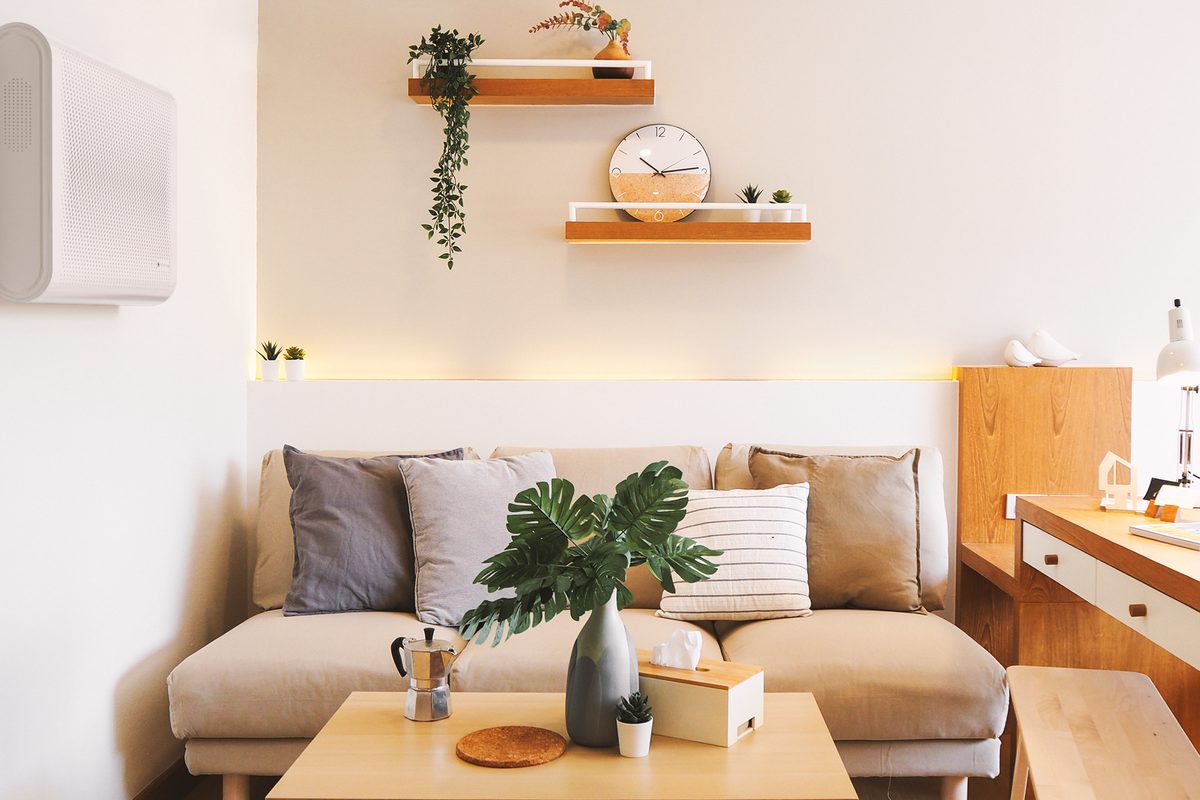
Compact True-HEPA Tower (Nursery Default)
The best all-round nursery pick for a room up to about 100 sq ft. True HEPA plus a carbon layer, a night mode that dims the display, and filters that are easy to buy. Add a spare filter when you order.
Check Price on Amazon →2. The mid-size tower for a nursery that opens onto a living area
If the nursery shares air with the rest of the flat, a mid-size unit is quieter in practice than a compact one, because you can leave it on speed 1 and still get the room turned over. The low-speed figure is a touch higher, but you will rarely need to raise it.
Mid-Size Tower (Open Nurseries)
For a nursery that opens onto a living area. Higher CADR lets you run the lowest speed all night and still get four or more air changes an hour.
Check Price on Amazon →3. The small desk-class true-HEPA unit
In a genuinely tiny box room, a small true-HEPA unit is the quietest option available and still adequate. Buy it only if the room is under about 60 sq ft; in a bigger room you will end up running it on high, which defeats the point.
Small True-HEPA (Tiny Box Rooms)
The quietest class in the group. Right for a nursery under 60 sq ft, and ideal if you also want one for a hallway or a car. Check the CADR before assuming it covers a full bedroom.
Check Price on Amazon →Which size for which nursery
Use the two-thirds rule: look for a smoke CADR at least two-thirds of the floor area in square feet, and higher if allergies or smoke are the reason you are buying.
| Nursery | Floor area | CADR target | Class to buy |
|---|---|---|---|
| Small box room | 50–70 sq ft | 35–60 | Small true-HEPA |
| Standard nursery | 80–110 sq ft | 55–95 | Compact true-HEPA tower |
| Large nursery / shared | 120–170 sq ft | 80–140 | Mid-size tower |
| Nursery open to living room | 200–300 sq ft | 135–235 | Large-room tower |
Features worth paying for — and not
| Feature | Worth it? | Why |
|---|---|---|
| True HEPA (H13/H12) | Always | It is the filtration standard; “HEPA-type” is not a standard |
| Activated carbon layer | Yes, especially for odour and smoke | Carbon removes gases and smells; HEPA alone does not |
| Display-off night mode | Yes | Light disrupts infant sleep just as noise does |
| Child lock | Yes | A toddler will find the buttons |
| Filter-change indicator | Yes | Prevents running a spent filter for months |
| Ionizer / ozone mode | No | EPA warns against ozone generators in occupied rooms |
| Wi-Fi and app | Optional | Convenient, but adds failure points and a bright status LED |
| Air-quality ring light | No in a nursery | An always-on coloured light in a dark room |
How to choose in five minutes
- Measure the nursery and write down the floor area in square feet.
- Pick the class from the size table above.
- Check the low-speed dB figure in the manual. Under 25 dB is the target.
- Confirm true HEPA plus carbon, and that there is no ozone or ionizing mode left on.
- Check filter availability and price for a three-year window before you commit.
- Verify the night mode kills the display, not just the beeps.
Do those six checks and you will land on a unit you can actually leave running. That is the whole test.
Sources: AHAM (CADR certification program), U.S. EPA (Residential Air Cleaners guide; ozone generator warning), ASHRAE Standard 62.2 (residential ventilation), WHO Environmental Noise Guidelines (night-time bedroom levels), American Academy of Pediatrics (safe sleep and cord safety).
Frequently asked questions
- Levoit air purifier for a nursery — related guide in this cluster.
- air purifier for a nursery under $100 — related guide in this cluster.
What is the quietest type of air purifier for a nursery?
Is 24 dB quiet enough for a baby to sleep?
How much should I spend on a nursery air purifier?
Does a nursery air purifier need a carbon filter?
Are smart air purifiers worth it for a nursery?
How often do I need to replace the filter in a nursery purifier?
Related guides
Quiet Air Purifier for a Nursery: The Complete Renter's Guide
Sizing, safety and renter-safe placement in one guide.
Quietest Air Purifier for a Baby Room (Real dB Data)
The sub-25 dB class, and why it matters for infant sleep.
Air Purifier Decibels Explained: What the Numbers Mean
Distance, modes and why the headline figure misleads.