On this page
Safety first
A garbage disposal has sharp blades and a motor that can start without warning. Before you clean it:
- Turn off the power at the wall switch, or better, at the breaker.
- Never put your hand into the disposal. Use long-handled tongs or a flashlight to look inside.
- Do not use chemical drain cleaner in a disposal — it can damage the seals and the motor.
Three methods
Method 1: ice and rock salt (scouring)
This is the method that actually cleans the blades and the grinding chamber. The ice hardens and the salt scours, knocking off the biofilm that causes the smell.
- With the power off, drop 2 cups of ice and 1 cup of rock salt into the disposal.
- Turn the cold water on and run the disposal until the ice is gone.
- Flush with cold water for 30 seconds.
Method 2: baking soda and vinegar (deodorising)
This kills the odour without abrasives. It is the method to use weekly.
- Pour 1/2 cup of baking soda into the disposal.
- Add 1 cup of white vinegar and let it fizz for 5–10 minutes.
- Flush with hot water while running the disposal for 30 seconds.
Method 3: citrus peels (freshening)
Citrus peels deodorise and leave a fresh scent. They are a maintenance step, not a deep clean — use them between the other two methods.
- Drop lemon, orange or lime peels into the disposal.
- Run with cold water for 30 seconds.
- Repeat weekly.
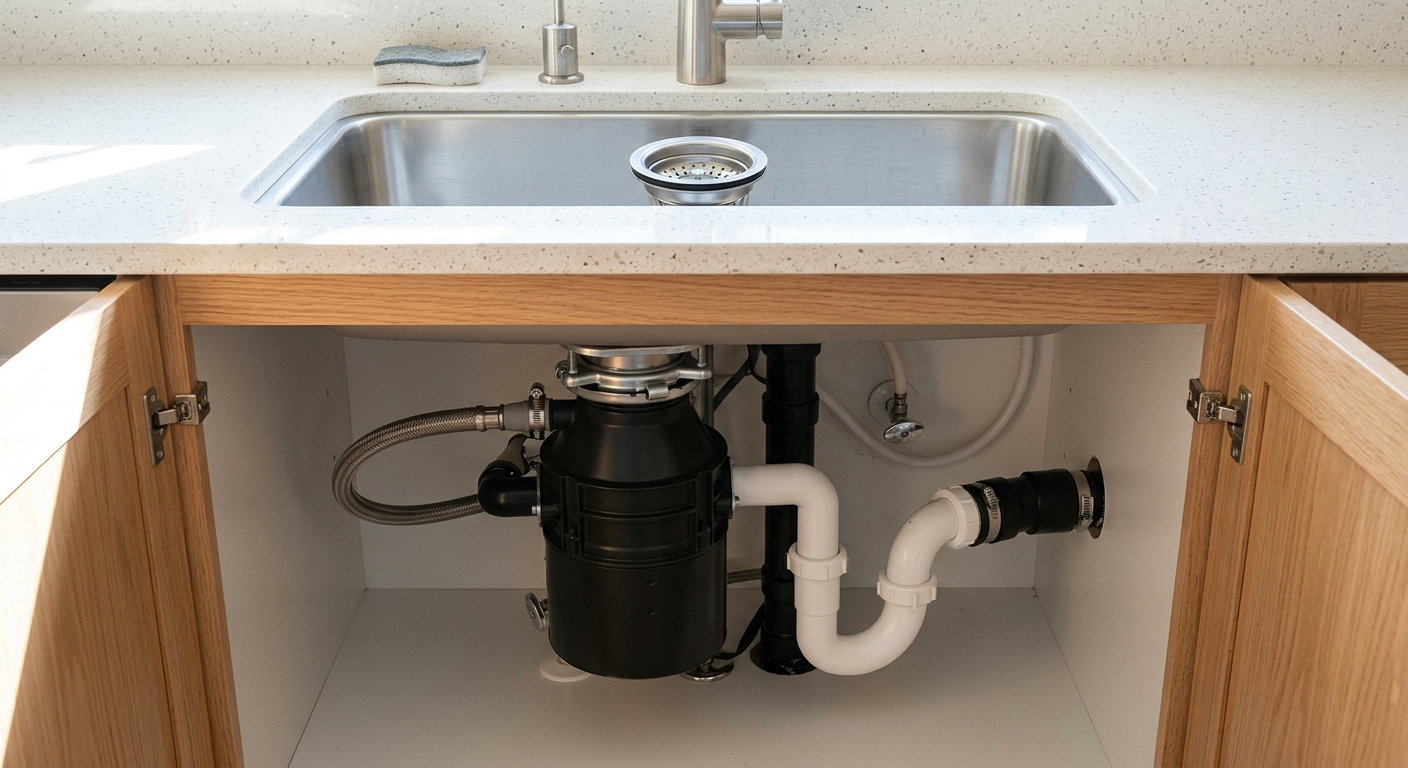
Garbage Disposal Cleaner Tablets
Drop-in foaming tablets that clean the blades and deodorise in one step. The no-effort version of the ice-and-salt method.
Check Price on Amazon →Fixing the smell for good
If the disposal still smells after cleaning, the odour is not in the grinding chamber. Check these three places:
| Source | Symptom | Fix |
|---|---|---|
| Splash guard (rubber flap) | Smell at the sink opening | Lift it out and scrub both sides |
| Drain pipe / P-trap | Smell from the cabinet below | Remove and clean the P-trap |
| Dishwasher drain hose | Smell after a dishwasher cycle | Clean the air gap and hose |
The splash guard is the most common culprit and the most overlooked. Food particles collect on the underside of the rubber flap, where water never reaches. Pull it out, scrub it with dish soap, and the smell usually disappears.
Slow drain vs disposal problem
A slow drain is often not the disposal at all. Diagnose it before you buy anything:
- Disposal runs but water drains slowly: the drain line or P-trap is clogged, not the disposal.
- Disposal hums but does not spin: something is jammed, or the capacitor has failed.
- Disposal is silent: check the reset button, then the wall switch, then the breaker.
- Water backs up into the other sink: the shared drain line is blocked.
Four disposal mistakes that cause clogs
- Putting grease down the drain. Grease solidifies in the pipe and builds up until the drain blocks. Wipe pans into the bin, not the sink.
- Grinding fibrous vegetables. Celery, onion skins and corn husks wrap around the blades and jam the motor.
- Running it without water. The disposal needs a steady flow of cold water to carry waste through. Run the water before, during and after.
- Using chemical drain cleaner. It damages the seals and the motor, and it is dangerous if it splashes back.
If the disposal jams
A jammed disposal hums but does not spin. Here is the safe way to clear it:
- Turn off the power at the wall switch or the breaker.
- Look inside with a flashlight — never with your hand.
- Remove the obstruction with long-handled tongs or pliers.
- Press the red reset button on the bottom of the unit.
- Restore power and run cold water for 30 seconds.
If the disposal trips the reset button again immediately, something is still jammed or the motor has failed. Do not keep resetting it — that is how a motor burns out.
Three cleaning methods
There are three levels of disposal cleaning, and you use them in order depending on how bad the smell is.
| Method | What it does | Frequency |
|---|---|---|
| Ice and rock salt | Scours the grinding chamber | Monthly |
| Baking soda and vinegar | Deodorises the chamber | Weekly |
| Citrus peels | Freshens and lightly cleans | Weekly |
| Splash guard wash | Removes the real odour source | Whenever it smells |
| P-trap and drain hose | Removes deep odour | Twice a year |
The ice-and-salt method is the one that actually scours. Run a cup of ice and a handful of rock salt through with cold water for 30 seconds. The salt acts as an abrasive and the ice knocks the buildup off the walls of the chamber.
Why it still smells after cleaning
If the disposal smells after a full clean, the odour is not in the grinding chamber. It is in one of three places:
- The rubber splash guard. Food and grease collect in the folds. Pull it up and wash both sides.
- The P-trap. Debris settles in the bend and rots. This is the most common cause of a persistent smell.
- The dishwasher drain hose. If the dishwasher drains through the disposal, that hose holds stagnant water.
Clean the splash guard first — it is the easiest and the most common culprit. If the smell persists, the P-trap is next, and that is a job that involves a bucket and a wrench under the sink.
Keeping it clean
Run cold water before, during and after every use, and let it run for 15 seconds after the grinding stops. Never put grease, coffee grounds, eggshells, rice, pasta or fibrous vegetables down a disposal. In an apartment, a clogged shared drain line is a landlord call, not a DIY job — and a disposal that jams repeatedly is usually a sign of a habit, not a fault.
The weekly routine
A disposal that is cleaned weekly never develops a serious smell. The routine takes two minutes.
- Run hot water and a handful of citrus peels through it.
- Follow with a cup of ice and a handful of rock salt.
- Flush with cold water for 30 seconds.
- Wipe the splash guard with a soapy cloth.
The citrus peels freshen, the ice and salt scour, and the cold-water flush carries the debris away. Doing this weekly means the P-trap never accumulates enough debris to rot, which is what causes the smell that cleaning the chamber cannot fix.
What never goes down a disposal
Even a clean disposal clogs if you feed it the wrong things. Grease, coffee grounds, eggshells, rice, pasta, potato peels and fibrous vegetables like celery and corn husks are the usual culprits. In an apartment, a clogged shared drain line is a landlord call, and a disposal that jams repeatedly is usually a habit problem rather than a fault.
Frequently asked questions
How do I clean a smelly garbage disposal?
Can I put my hand in a garbage disposal?
Why does my garbage disposal smell even after cleaning?
How often should I clean my garbage disposal?
Is it safe to use drain cleaner in a garbage disposal?
Related guides