A ground-fault circuit interrupter is the only outlet in your apartment that is designed to protect a person rather than a wire. It watches for current leaking to ground — the signature of a shock — and cuts power in a fraction of a second.
It also has a built-in test, which means you can check it yourself in about ten seconds. This guide covers the button test, a multimeter verification, and the failure modes that mean replacement.
On this page
What a GFCI does
A GFCI compares the current going out on the hot wire with the current coming back on the neutral. In a healthy circuit they are identical. If even a few milliamps go missing — because they are flowing through a person — the GFCI trips.
The National Electrical Code (NEC 210.8) requires GFCI protection for receptacles in bathrooms, kitchens, garages and outdoors. In an apartment, that means the bathroom and kitchen outlets should be GFCI, and often one GFCI protects several downstream outlets on the same circuit.
Method 1 — the button test
This is the test the manufacturer built in, and it is the one NFPA recommends running monthly.
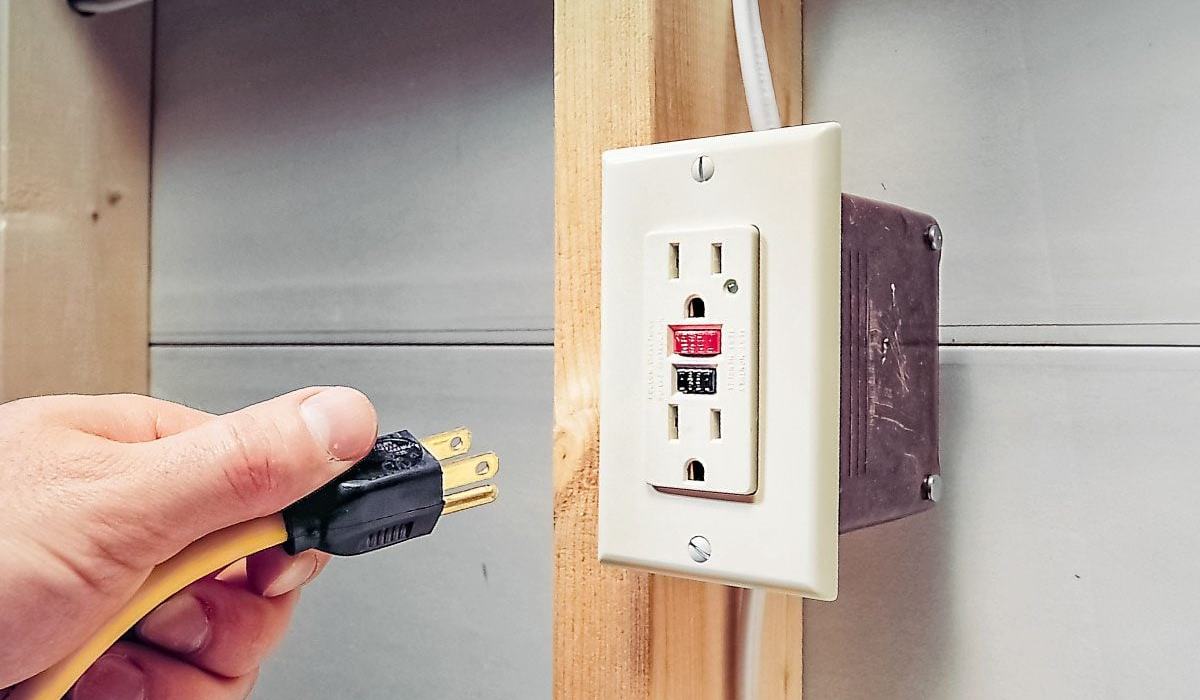
- Plug a lamp or small appliance into the GFCI and switch it on.
- Press the TEST button. You should hear a click and the lamp should go out.
- Press the RESET button. The lamp should come back on.
That is the whole test. If the lamp goes out on TEST and comes back on RESET, the GFCI is protecting the circuit. If it fails either step, the device is faulty.
Method 2 — the multimeter check
The button test tells you the GFCI trips. A multimeter tells you whether it is passing correct voltage when it is reset.
- Set the meter to AC voltage, 200 V or higher.
- With the GFCI reset, insert the black probe into the neutral slot (the taller one) and the red probe into the hot slot (the shorter one).
- Expect about 120 V.
- Move the black probe to the ground slot (the round one) and test hot-to-ground. Expect about 120 V again.
- Test neutral-to-ground. Expect close to 0 V.
If hot-to-neutral and hot-to-ground both read 120 V and neutral-to-ground reads near zero, the outlet is wired correctly and passing power. If hot-to-ground reads zero, the outlet is not grounded — a common problem in older apartments.
GFCI Outlet Tester
Plugs in and lights up to show open ground, reversed polarity, or a dead circuit in one glance. The fastest way to check every outlet in an apartment.
Check Price on Amazon →Method 3 — the plug-in tester
A plug-in outlet tester is the fastest tool for checking a whole apartment. You plug it in and read a pattern of lights that tells you the wiring condition: correct, open ground, reversed polarity, open neutral, and so on.
It does not replace the button test — it cannot tell you whether the GFCI trips — but it is the quickest way to survey every outlet in a new apartment and find the ones that need attention.
Reading the results
| Test | Result | Meaning | Action |
|---|---|---|---|
| TEST button | Lamp goes out | GFCI trips correctly | Good |
| RESET button | Lamp comes back on | GFCI resets correctly | Good |
| TEST button | Lamp stays on | GFCI has failed | Replace |
| RESET button | Will not reset | Fault or failed device | Unplug load, retry, then report |
| Hot-to-neutral | ~120 V | Passing power | Good |
| Hot-to-ground | 0 V | Not grounded | Report to landlord |
| Neutral-to-ground | >0 V | Wiring fault | Report to landlord |
The apartment angle
- One GFCI protects the whole circuit. A dead outlet in a bedroom may be caused by a tripped GFCI in the bathroom. Check there first.
- Older apartments may have no GFCI at all. If the bathroom outlet has no TEST button, it is not protected. That is a code issue and a landlord job.
- You cannot add a GFCI yourself if it means new wiring, but a like-for-like replacement of a failed GFCI is usually acceptable.
- Test monthly. NFPA recommends it, and it takes ten seconds.
Mistakes to avoid
- Assuming a dead outlet is a dead circuit. Check for a tripped GFCI first.
- Forcing a GFCI to reset. If it will not reset, there is a reason. Do not tape the button down.
- Skipping the monthly test. A GFCI can fail silently and still pass power.
- Using a GFCI as a substitute for grounding. It protects people, but it does not create a ground path.
- Ignoring a hot-to-ground reading of zero. That means the outlet is not grounded, which is a real fault.
Types of GFCI
There are three places a GFCI can live, and knowing which one you have changes how you test it.
| Type | Where it is | How to test |
|---|---|---|
| GFCI receptacle | In the wall, with TEST and RESET buttons | Press TEST, then RESET |
| GFCI circuit breaker | In the panel, with a TEST button | Press the breaker's TEST button |
| Portable GFCI | An inline adapter on a cord | Press TEST, then RESET on the adapter |
A GFCI circuit breaker protects the whole circuit from the panel. It has a TEST button on the breaker itself, and pressing it should trip the breaker. If it does not, the breaker's GFCI function has failed and the breaker needs replacing — a landlord job.
A portable GFCI is the one you can add yourself. It plugs into any outlet and provides GFCI protection downstream, which is the accepted remedy for an ungrounded outlet near water. It is not a substitute for a proper GFCI receptacle, but it is a genuine safety improvement and it costs about twenty dollars.
One important limitation: a GFCI does not protect against a line-to-line shock or an overload. It protects against ground faults — current leaking to earth, which is the shock path through a person. That is why it complements a breaker rather than replacing it.
Nuisance tripping
A GFCI that trips repeatedly is usually doing its job, and the cause is usually moisture or a failing appliance.
- Moisture in the outlet — a bathroom GFCI near a shower can trip from humidity alone. A hair dryer or a steamy shower is a common trigger.
- A failing appliance — a heating appliance with a degraded element can leak a few milliamps to ground. Unplug everything and reset; if it holds, plug items back one at a time.
- A shared circuit — one GFCI often protects several downstream outlets. A fault in a different room can trip the bathroom GFCI.
- An old or cheap device — GFCIs have a service life of about 10–15 years and can become sensitive with age.
The isolation test is the useful one. Unplug everything on the circuit, reset the GFCI, and plug items back one at a time. When it trips, you have found the culprit. If it trips with nothing plugged in, the fault is in the wiring or the device itself.
Never respond to nuisance tripping by taping the button down or replacing the GFCI with a plain outlet. That removes a life-safety device. If it trips, there is a reason, and the reason is worth finding.
Frequently asked questions
How do I test a GFCI outlet?
Why will my GFCI not reset?
How often should I test a GFCI?
Can I test a GFCI with a multimeter?
What if my apartment bathroom has no GFCI outlet?
Related guides
How to Test Continuity With a Multimeter
The 30-second beep test behind every electrical diagnosis.