On this page
Calibrate first — every time
The single most common reason a stud finder “doesn’t work” is that it was not calibrated. Calibration tells the device what a normal wall reads like, so it can detect the change a stud causes.
- Place the finder flat against the wall, away from any stud.
- Press and hold the button until it beeps or the light settles — usually 2–3 seconds.
- Keep holding and slide it slowly sideways. Do not lift it off the wall.
- When it beeps, that is the edge of a stud. Mark it with a pencil.
- Approach from the other side to find the other edge, then mark the centre.
Finding a stud reliably
A single beep is not a stud. Use this sequence to be sure:
- Calibrate on a clear part of the wall.
- Slide slowly until the first beep — mark it.
- Continue past the stud until the beep stops — mark that too.
- The stud is between the two marks. Its centre is the midpoint.
- Repeat at a second height to confirm the stud is vertical, not a pipe or a patch.
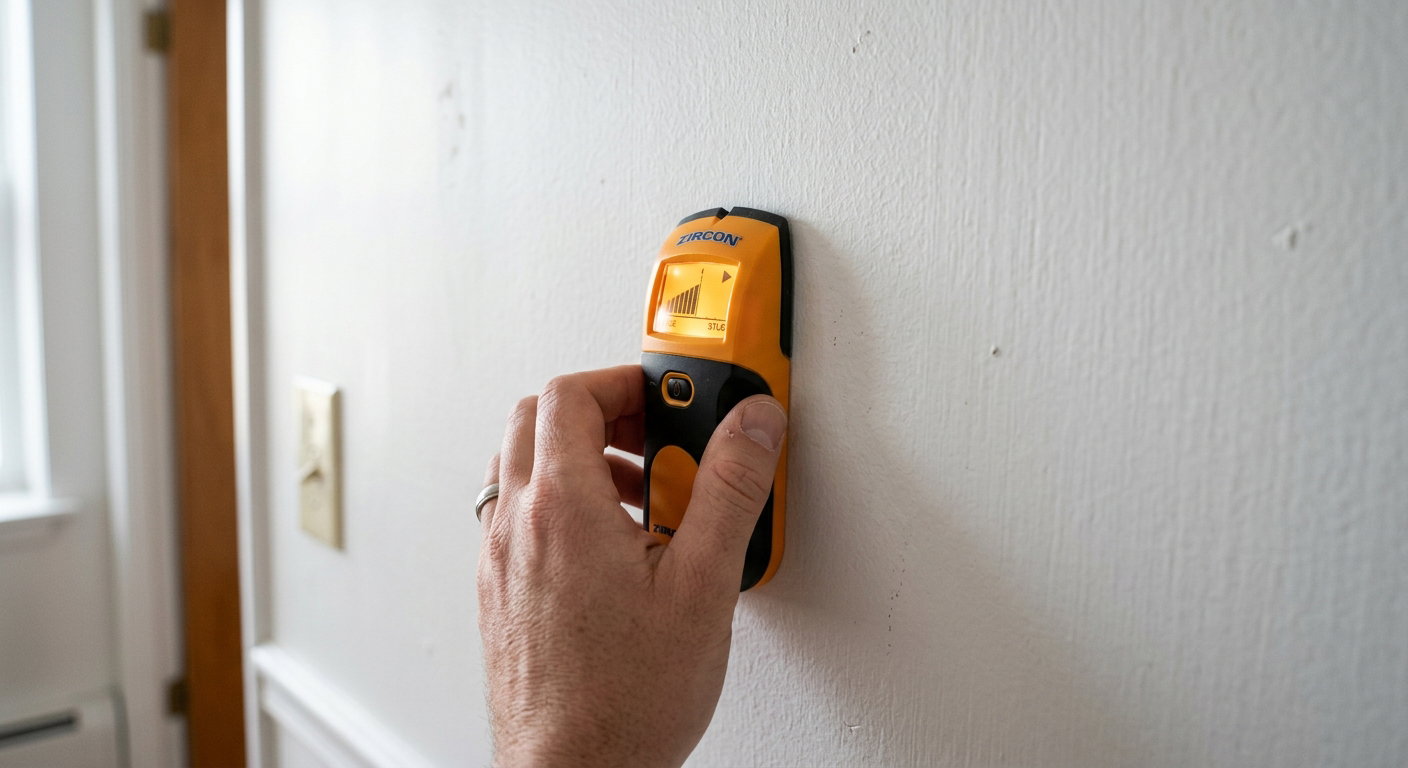
Franklin Sensors M210 Stud Finder
A multi-sensor finder that reads through plaster and lath, which trips up cheaper single-sensor models. The reliable choice for older apartment walls.
Check Price on Amazon →Apartment wall types
This is where apartment walls differ from a house, and where cheap finders fail.
| Wall type | Finder behaviour | What to do |
|---|---|---|
| Standard drywall | Works well | Normal method |
| Plaster and lath | Erratic readings | Use a multi-sensor or magnetic finder |
| Metal studs | Beeps, but no wood | Use a magnetic finder; use self-drilling screws |
| Double drywall | Weaker signal | Press the finder firmly; use a deep-scan mode |
| Concrete / brick | No studs at all | Use a masonry anchor, not a stud finder |
Many apartment buildings use metal studs, not wood. A magnetic stud finder — which finds the screws holding the drywall — is often more reliable than an electronic one on these walls, and it never needs calibrating.
Verify before you drill
A stud finder can also detect pipes and conduit, which is a real risk in an apartment. Before you drill:
- Check both sides of the wall if you can — a bathroom on the other side means pipes.
- Look for outlets and switches nearby; wiring runs vertically and horizontally from them.
- Use a magnetic finder to confirm a screw line, which is a real stud.
- Drill a small pilot hole first, and stop if you hit metal.
Four stud-finder mistakes
- Not calibrating. This is the number one reason a stud finder “does not work”. Calibrate on a clear part of the wall every time.
- Sliding too fast. The sensor needs a moment to detect the change in density. Move at about one inch per second.
- Trusting a single beep. One beep is not a stud. Mark both edges and confirm at a second height.
- Drilling without checking for pipes. A stud finder can detect pipes and conduit. Check the other side of the wall before you drill.
When a stud finder will not work
Some walls defeat electronic stud finders entirely. Here are the alternatives, in order of reliability:
| Method | Works on | Reliability |
|---|---|---|
| Magnetic stud finder | Drywall, plaster, metal studs | High — finds the screws |
| Knock test | Any hollow wall | Medium — takes practice |
| Find an outlet, measure 16 in | Standard framing | Medium — assumes 16 in spacing |
| Small pilot hole | Any wall | High — but leaves a hole |
| Electronic finder | Drywall | Medium — fails on plaster |
A magnetic stud finder is the most reliable tool for apartment walls, because it finds the screws that hold the drywall rather than trying to sense density. It never needs calibrating, and it works on metal studs, which electronic finders handle poorly.
Finding a stud, step by step
A stud finder is only as good as the technique. Follow this order every time.
- Calibrate by holding the button on a clear part of the wall until it beeps.
- Slide slowly across the wall at about one inch per second.
- Mark the first beep with a pencil.
- Keep sliding until the beep stops, and mark that edge too.
- Repeat at a second height to confirm the stud is vertical.
- Mark the centre between the two edges — that is where you drill.
Marking both edges is the step people skip, and it is the step that prevents a mistake. A single beep can be a pipe, a wire or a patch of denser plaster. Two edges that line up at two heights is a stud.
Studs in apartment walls
Apartment walls are not all the same, and the type changes how you find a stud.
| Wall type | Stud material | Best method |
|---|---|---|
| Modern drywall | Wood or metal | Electronic or magnetic finder |
| Older plaster and lath | Wood | Magnetic finder or knock test |
| Metal stud partition | Steel | Magnetic finder |
| Concrete or brick | None | Masonry anchors, no studs |
A magnetic stud finder is the most reliable tool for apartment walls. It finds the screws that hold the drywall, so it works on metal studs and on plaster, and it never needs calibrating. An electronic finder is faster on plain drywall but struggles with plaster and lath.
Before you drill
A stud finder can also detect pipes and conduit, and it is worth checking for both before you drill. In an apartment, drilling into a water pipe or a shared electrical run is an expensive mistake. Check the other side of the wall if you can, keep the hole shallow, and use a small pilot bit first.
Which stud finder to buy
There are two kinds, and they suit different walls.
| Type | How it works | Best wall |
|---|---|---|
| Electronic | Senses density change | Plain drywall |
| Magnetic | Finds the drywall screws | Drywall, plaster, metal studs |
A magnetic stud finder is the better buy for an apartment. It never needs calibrating, it works on metal studs and plaster, and it costs less. An electronic finder is faster on plain drywall but it struggles with the older walls common in apartments.
Hanging things safely
Once you have found the stud, match the fastener to the load. A picture hook in a stud holds far more than one in drywall. For anything heavy — a shelf, a mirror, a TV — always anchor into a stud, or use a proper drywall anchor rated for the weight. In a rental, a small pilot hole in a stud is easy to fill at move-out; a torn-out anchor is not.
Frequently asked questions
Why does my stud finder beep everywhere?
How do I find a stud in a plaster wall?
Do apartments have metal studs?
Can a stud finder detect pipes?
How accurate is a stud finder?
Related guides