On this page
The sizing chart
Start here. This is sized for a bathroom with a shower used by one or two people, in a normally heated flat.
| Bathroom size | Capacity (pints/day) | Typical tank | Run per shower |
|---|---|---|---|
| En-suite, under 35 sq ft | 15–20 | 1–1.5 L | 15–20 min |
| Standard, 35–50 sq ft | 20–22 | 1.5–2 L | 20–25 min |
| Large, 50–80 sq ft | 25–30 | 2–3 L | 25–30 min |
| Windowless internal bathroom | 30 | 2–3 L | 30–40 min |
| Bathroom with a bathtub used often | 30–35 | 3–4 L | 40–60 min |
| Bathroom also used for laundry drying | 35–40 or desiccant | 3–6 L | 2–4 hours |
A bathtub is worth calling out separately. A full bath releases far more water than a shower — a deep bath can put several litres of vapour into the room, and it takes much longer to evaporate from the water surface than from a shower burst. If you take baths rather than showers, move up a row.
Why bathroom sizing is different
Basement sizing assumes a continuous load: groundwater pushing damp through masonry, all day, every day. A bigger unit means the machine runs less of the time and lasts longer.
The EPA recommends a relative humidity band of 30–50% for indoor spaces and treats sustained humidity above 60% as the threshold at which mould becomes likely, while ASHRAE's residential indoor air quality guidance gives a wider acceptable range of roughly 30–60%. Both point the same way for sizing: what matters is not raw capacity but the ability to hold the room inside that band.
A bathroom is the opposite. The load is intermittent and intense — nothing for twenty hours, then a shower that saturates the room in five minutes. What matters is not whether the unit can run continuously, but whether it can knock the room back down inside a 20–30 minute window before the plaster, grout and towels absorb the moisture.
That is why a 22-pint unit and a 50-pint unit both solve a 40 sq ft bathroom. Both can remove the shower's water inside half an hour. The 50-pint unit just costs twice as much, weighs twice as much, and is harder to store in a small flat.
Factor 1: room temperature
This overrides the chart more often than anything else. Compressor dehumidifiers lose most of their capacity below about 15 °C (59 °F), because the coil cannot get cold enough relative to the air to condense efficiently.
| Room temperature | Compressor capacity | Recommendation |
|---|---|---|
| Above 70 °F / 21 °C | Full rated | Use the chart as printed |
| 60–70 °F / 16–21 °C | 70–90% of rated | Add one step of capacity |
| 50–60 °F / 10–16 °C | 40–60% of rated | Add two steps, or buy desiccant |
| Below 50 °F / 10 °C | Near zero | Desiccant only |
An unheated bathroom in a northern winter routinely sits at 12–15 °C. In that room a 22-pint compressor unit behaves roughly like a 10-pint unit, which is why people conclude it is broken. Buy desiccant instead and the capacity stays reasonably flat down to near freezing.
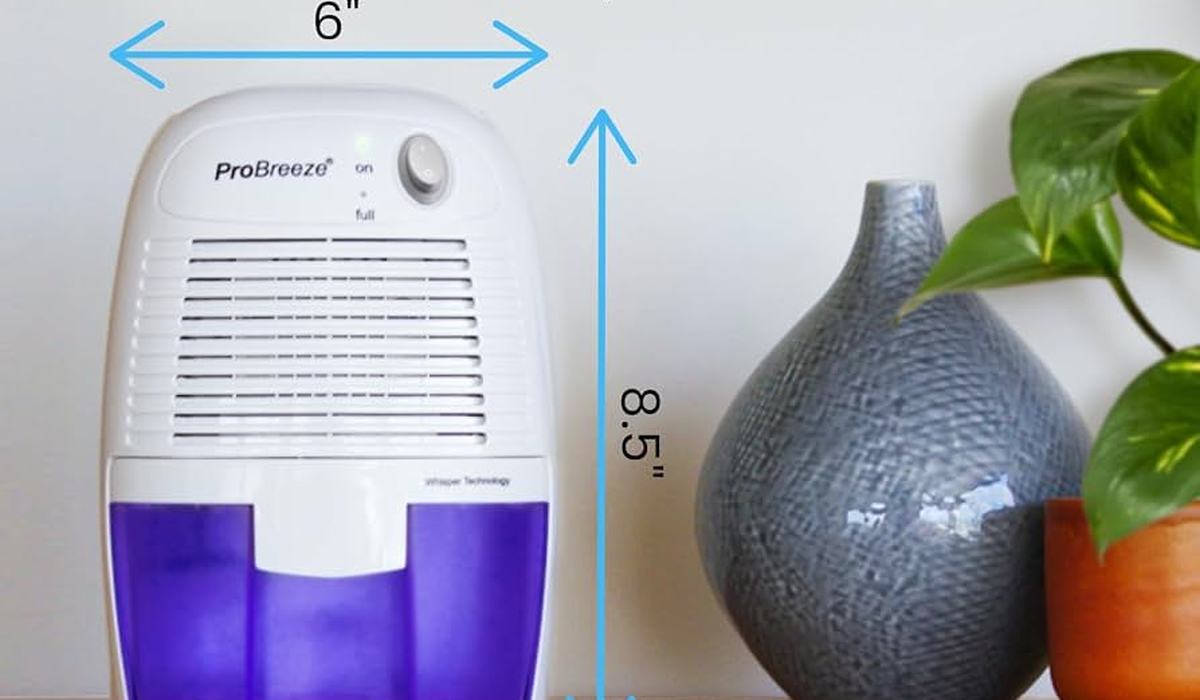
Desiccant Dehumidifier (Cold Bathrooms)
The right answer if your bathroom is unheated or runs below 60°F. It keeps working where a compressor unit's output collapses, at a slightly higher running cost.
Check Price on Amazon →Factor 2: drying laundry indoors
Drying a load of washing inside a bathroom is a much bigger moisture load than any shower. A single wash load holds several litres of water, and it releases them slowly over hours rather than in a five-minute burst.
If you dry laundry in the bathroom — which many apartment dwellers do, especially where there is no balcony — size for that job and not for the shower. That means 35–40 pints, or a desiccant unit, and it means the machine will run for hours at a time rather than thirty minutes.
The alternative is to dry laundry in the largest room of the flat with the dehumidifier running there, and treat the bathroom separately with a smaller unit. For a one-bedroom flat that is usually the better configuration.
Factor 3: is there any ventilation?
A ventilation-free bathroom is much harder to dry, for a reason that has nothing to do with the dehumidifier.
Water that has condensed onto the mirror, tiles, shower screen and walls has to evaporate back into the air before a dehumidifier can remove it. In a room with an extractor or a usable window, some of that moisture leaves the building directly. In a sealed room, it all has to be processed by the dehumidifier, one cycle at a time.
| Ventilation | Capacity adjustment | Extra step |
|---|---|---|
| Working extractor fan | Use the chart as printed | Run the fan during and 15 min after |
| Openable window | Use the chart, minus one step | Air for 5 min after the dehumidifier run |
| Window plus extractor | Chart minus one step | Nothing extra needed |
| No ventilation at all | Add one to two steps | Squeegee every surface before every run |
In a fully sealed bathroom, the squeegee becomes as important as the capacity. Removing 80% of the surface water with a squeegee means the dehumidifier only has to work on the vapour, and that can halve the run time. It is the highest-return $8 you can spend on this problem.
The other specs that matter
Capacity gets all the attention, but in a small bathroom these four specs decide whether the machine is actually usable.
| Spec | Target for a bathroom | Why |
|---|---|---|
| Tank size | 1.5 L or more | Smaller tanks auto-shut mid-run |
| Humidistat | Adjustable, down to 45% | Lets it cycle instead of running flat out |
| Noise | Under 45 dB | Bathrooms are echo chambers |
| Drain option | Hose port (pump if no gravity path) | Turns a daily chore into none |
| Footprint | Under 12 in wide if floor space is tight | Small bathrooms have no spare floor |
Checking your choice after you buy
You will know within a week whether you sized it right. Run the test once, and if it fails, adjust rather than replacing the machine immediately.
- Squeegee every surface, then close the door.
- Run the unit for exactly 30 minutes.
- Read the hygrometer. Under 55% means the size is right.
| Reading after 30 min | What it means | Fix before buying a bigger unit |
|---|---|---|
| Under 50% | Correctly sized | Nothing |
| 50–55% | Correctly sized, tight | Squeegee more thoroughly, keep the door shut |
| 55–65% | Slightly undersized, or cold | Check the room temperature first |
| Over 65% | Undersized or blocked | Check intake clearance, then upsize |
Rule out the cheap causes before spending money: blocked intake, door left open, unit sitting in a wet spot, or a room below 60 °F. All four mimic an undersized machine and all four are free to fix.
Frequently asked questions
What size dehumidifier do I need for a small bathroom?
Is a 50-pint dehumidifier too big for a bathroom?
How many pints do I need for a windowless bathroom?
Do I need a bigger dehumidifier if I dry laundry in the bathroom?
What size dehumidifier for a bathroom in a cold climate?
How do I know if my dehumidifier is the right size?
Related guides
What Size Dehumidifier for 400 Sq Ft? Picks & Chart
The whole-flat sizing problem, if you need to cover more than one room.
Small Dehumidifier for a Bathroom Without a Vent
Compact picks and the setup that beats a full-size machine.
Do Dehumidifiers Work in Bathrooms? Real Numbers
How much water a correctly sized unit actually removes.