On this page
The short answer
Yes, an air purifier can help with dog smell — but only if it has a carbon filter. A HEPA-only purifier will remove dander, hair and dust, and the room will still smell of dog. This is the single most common mistake people make when buying a purifier for pet odor.
Why carbon is the whole answer
Dog smell is caused by volatile organic compounds — ammonia, fatty acids and sulphur compounds. These are gases, not particles. HEPA filters are designed to catch particles, and gas molecules pass straight through them.
Carbon works differently. It is porous, and odor molecules stick to its enormous internal surface area in a process called adsorption. That is what removes the smell from the air.
| Filter type | Removes | Removes dog smell? |
|---|---|---|
| Pre-filter | Hair, large dust | No |
| HEPA | Dander, pollen, fine dust | No |
| Thin carbon pre-filter | A little odor | Barely |
| Thick carbon layer (1–2 kg+) | Odor gases | Yes |
| HEPA + thick carbon | Particles and gases | Yes — the right choice |
When you shop, look at the weight of the carbon, not just the word "carbon". A 200-gram carbon pre-filter will not remove dog smell. A 1–2 kg carbon bed will.
How to size it
Size by CADR (clean air delivery rate). Aim for a CADR at least two-thirds of the room's square footage, and higher if you want faster odor removal.
| Room size | Minimum CADR | For strong odor |
|---|---|---|
| 150 sq ft | 100 | 150+ |
| 300 sq ft | 200 | 300+ |
| 500 sq ft | 330 | 500+ |
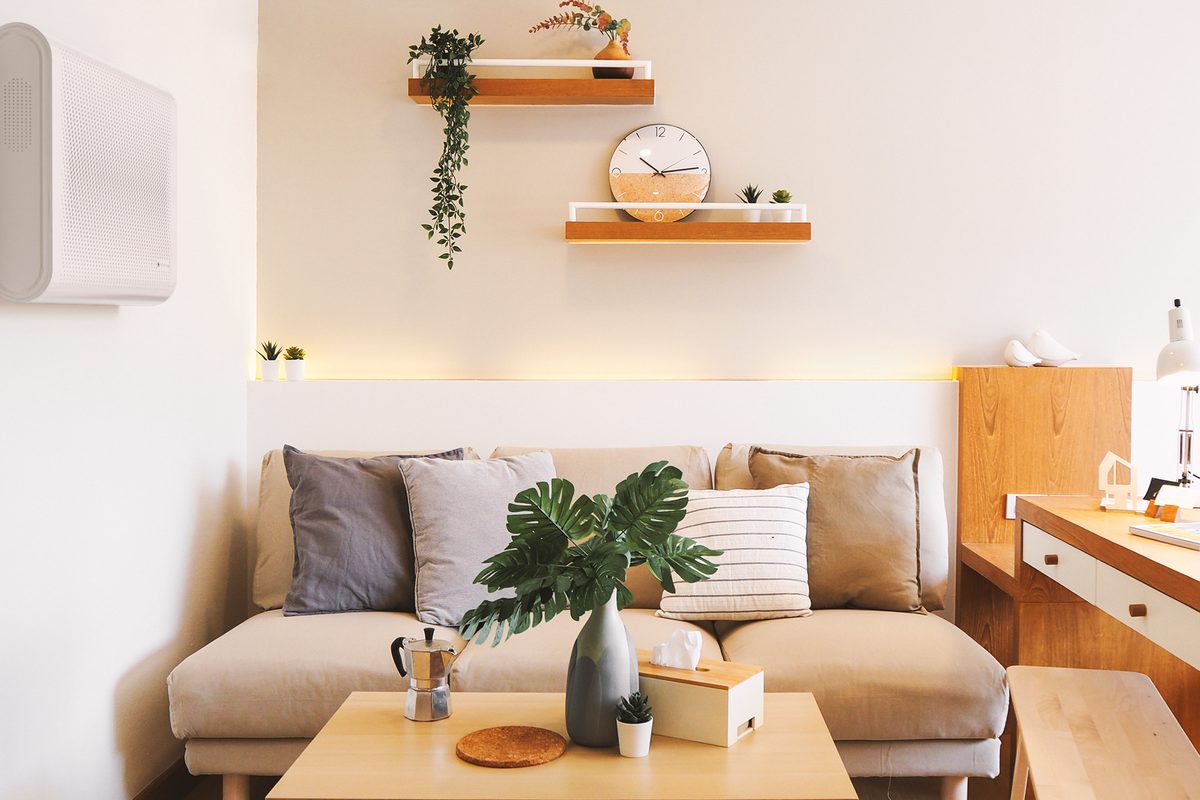
Air Purifier With Carbon Filter
HEPA for dander and hair, plus a thick carbon layer for odor. The combination that actually removes dog smell.
Check Price on Amazon →How to run it
- Run it continuously on medium, not just when the smell is bad. Odor builds up between runs.
- Place it near the dog's favourite spot, not in a corner. It needs to draw the air where the smell is.
- Keep it 2–3 feet from walls so it can pull air properly.
- Replace the carbon filter every 3–6 months — saturated carbon stops working and can release odor back.
- Vacuum the pre-filter monthly to keep airflow up.
What it cannot do
An air purifier cannot remove a smell that is still being produced. If urine has soaked into carpet underlay, or the dog's bedding has not been washed, the purifier is fighting a losing battle. Treat the source first, then let the purifier handle the airborne odor.
It also cannot replace ventilation. Ten minutes of cross-flow twice a day clears odor faster than any purifier, and costs nothing.
How to test whether it is working
- Leave for an hour and come back in — the first breath is the honest one.
- Run it on high for 30 minutes in a closed room, then check the smell.
- Smell the exhaust air — it should be noticeably cleaner than the room.
- Check the carbon — if it is more than 6 months old, it is probably saturated.
What it costs to run
| Speed | Power draw | Monthly cost (24/7) |
|---|---|---|
| Low | 10–20 W | $1–$3 |
| Medium | 30–50 W | $3–$7 |
| High | 60–100 W | $7–$15 |
Running continuously on medium is the sweet spot for odor: low enough to be cheap and quiet, high enough to keep the air turning over.
Filter replacement cost
| Filter | Frequency | Yearly cost |
|---|---|---|
| Pre-filter | Wash monthly | $0 |
| HEPA | Every 6–12 months | $30–$80 |
| Carbon | Every 3–6 months | $40–$120 |
Budget for filters before you buy. A purifier with cheap filters that need replacing every three months costs more over three years than a more expensive unit with longer-lasting ones.
Why carbon is the part that matters
Dog smell is a mixture of particles and gases. HEPA captures the particles — dander, hair, dust. But the smell itself is a gas, and gases pass straight through HEPA. Only activated carbon adsorbs them.
That is why a purifier with a thin carbon pad stops working after a few weeks. The carbon saturates and the odour returns, even though the HEPA filter is still fine.
Placement for dog odour
- Near the dog's bed — where odour concentrates.
- Central to the main room so it serves the whole space.
- Clear of walls and furniture by 30 cm.
- Off the floor if the dog sheds heavily, to reduce hair intake.
- Not behind a sofa — airflow is the whole point.
Features worth paying for
- Heavy carbon filter — the single most important feature for odour.
- Washable pre-filter — catches hair before it reaches the HEPA.
- Auto mode — ramps up when odour or particles rise.
- Filter-life indicator — so you replace carbon on time.
- Quiet low speed — so you can run it 24/7.
The verdict
A purifier helps with dog smell only if it has a substantial carbon filter, and only if you replace that carbon every 3–6 months. Pair it with enzyme cleaning and a dehumidifier, and the smell stops coming back.
The weekly routine
- Vacuum carpets and upholstery, including under furniture.
- Wash pet bedding and throws on hot.
- Check with a UV torch for new spots.
- Treat spots with enzyme cleaner.
- Replace the carbon filter on schedule.
- Ventilate daily with 10 minutes of cross-flow.
Common mistakes
- Buying a purifier with a thin carbon pad. It saturates in weeks.
- Never replacing the carbon. Saturated carbon stops working entirely.
- Using a scented cleaner. It masks the smell; enzyme cleaner removes it.
- Skipping the UV torch. You cannot treat spots you have not found.
- Ignoring humidity. Damp air makes the same smell much stronger.
The verdict
A purifier helps with dog smell only if it has a substantial carbon filter, and only if you replace that carbon every 3–6 months. Pair it with enzyme cleaning and a dehumidifier, and the smell stops coming back.
The one-line summary
A purifier helps with dog smell only if it has a substantial carbon filter, and only if you replace that carbon every 3–6 months. Pair it with enzyme cleaning and a dehumidifier, and the smell stops coming back.
Frequently asked questions
Will an air purifier help with dog smell?
Do I need a carbon filter for pet odor?
What CADR do I need for dog smell?
How often should I replace the carbon filter?
Can an air purifier remove dog smell completely?
Related guides
Do Dehumidifiers Remove Pet Odor? What Actually Works
The full system for removing pet odor.
Does a Dehumidifier Get Rid of Pet Smells? The Truth
The direct answer, and what to do instead.