On this page
What a fan does that a dehumidifier does not
An exhaust fan is a source-removal device. It grabs the humid air at the point it is produced — over the shower — and pushes it down a duct and out of the building. Because the air leaves the room, whatever is dissolved in it leaves too: water vapour, aerosolised soap, the smell of damp towel, and the volatile compounds that make a bathroom smell like a bathroom.
That is why building codes treat ventilation as a requirement and not a nice-to-have. The International Residential Code and the UK's Approved Document F both require a bathroom to have either an openable window or mechanical extract at a defined rate. A dehumidifier appears in neither document, because a dehumidifier is not ventilation.
Two things a fan does that a dehumidifier simply cannot:
- It removes odour and chemical vapours. A dehumidifier condenses water. It has no way to remove the molecules that cause smell unless it also has a carbon filter, which almost none do.
- It clears the room in minutes. A 100 CFM fan exchanges the air in a typical 5 × 8 ft bathroom roughly six times in ten minutes. A dehumidifier takes far longer to reach the same dryness.
What a dehumidifier does that a fan does not
A dehumidifier is a conditioning device. It pulls room air across a cold coil, the water condenses out, and the dried air goes back into the room. Nothing leaves the building. That sounds like a disadvantage, and for odour it is — but for a renter it solves a problem the fan cannot.
An exhaust fan only removes moisture while it is running. The moment it stops, the room is sealed again, and whatever water is still sitting on the walls, the grout, the shower curtain and the towels starts evaporating into the air. A fan does not dry surfaces. A dehumidifier does, because it keeps pulling water out of the air, and the wet surfaces keep releasing more until they are dry too.
| Job | Exhaust fan | Dehumidifier |
|---|---|---|
| Removes water vapour | Yes — by pushing it outside | Yes — by condensing it |
| Removes odour | Yes | No (unless carbon filtered) |
| Dries walls, grout, towels | Only while running | Yes — continuously |
| Clears the room fast | Yes — minutes | Slower |
| Works with the door closed | Yes | Yes, and better closed |
| Needs a duct or wall penetration | Yes | No |
| Renter-friendly | Rarely | Fully |
So can it replace the fan?
For the job that actually matters — keeping the bathroom dry enough that mould and peeling paint never start — yes, a dehumidifier can carry it. Mould needs sustained relative humidity above roughly 70% to establish. If your bathroom sits at 45–55% an hour after a shower, the fan's absence is not going to cost you a deposit.
It cannot replace the fan for three specific jobs, and you should be honest with yourself about which you need:
- Odour control. If the bathroom smells stale, only ventilation or a carbon-filtered purifier fixes it. Add a small carbon air purifier or run a window fan for five minutes.
- Moisture you never let it see. If you shower and leave the door open while you get dressed, the humidity has already spread into the bedroom and your bathroom dehumidifier is now working on a bigger volume than it was sized for.
- A shared/party wall bathroom with no door. Air keeps flowing in from the rest of the flat, bringing its moisture with it.
There is one more situation where the dehumidifier wins outright: a bathroom with no ducting and no external wall. A windowless internal bathroom physically cannot take an exhaust fan without a long, expensive duct run that a landlord will almost never pay for. A dehumidifier is the only solution that fits the constraints.
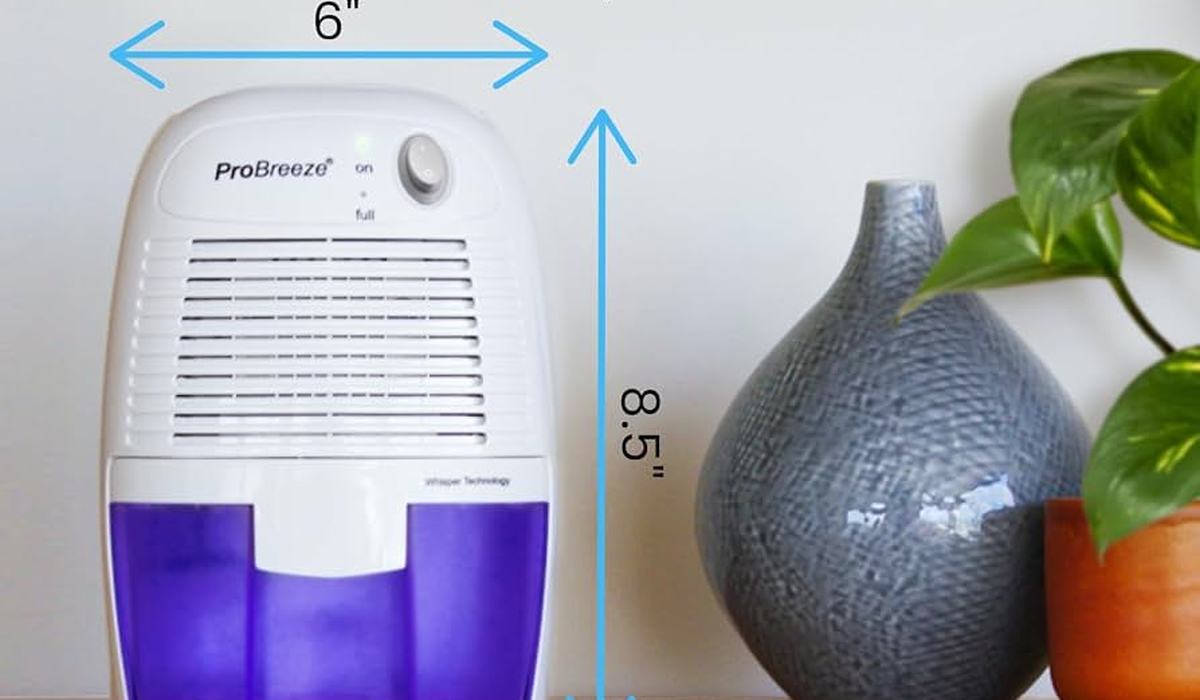
Compact Dehumidifier for a Bathroom
The right size for a single bathroom. Empty it after each shower run; most models this size shut off automatically when the tank fills.
Check Price on Amazon →What size you need for a bathroom
Dehumidifier capacity is quoted in pints per day, using the old 80 °F / 60% RH test condition. A single bathroom with a shower produces roughly 0.5–0.8 L of water per shower, but the unit also has to handle the room's baseline damp and any leakage, so you want headroom.
| Bathroom | Tank capacity to buy | Run time per shower |
|---|---|---|
| En-suite, under 50 sq ft | 20–25 pints/day | 20 minutes |
| Main bathroom, 50–80 sq ft | 25–30 pints/day | 25–30 minutes |
| Windowless internal bathroom | 30 pints/day | 30–40 minutes |
| Also drying laundry indoors | 30–35 pints/day or a desiccant unit | 1–2 hours |
| Whole flat, 400+ sq ft | 35–50 pints/day | Continuous in damp season |
If the room is cold — an unheated bathroom in winter sits at 10–15 °C — prefer a desiccant dehumidifier. Compressor units lose most of their water-removal capacity below about 15 °C because the coil cannot get cold enough for efficient condensation. Desiccant units use a rotating wheel and keep working down to near freezing.
The after-shower routine that actually works
The routine matters more than the machine. Follow it in this order and a single-bathroom dehumidifier will keep up comfortably.
- Squeegee the walls and screen. Thirty seconds. This removes the bulk of the surface water before it ever becomes vapour.
- Close the door. This is the counter-intuitive one. A dehumidifier works on the air in the room it is in. Leaving the door open lets the moisture spread into a larger volume the unit was not sized for.
- Run the dehumidifier for 20–30 minutes. Set a timer. Most units have a built-in timer; use it.
- Then open the door and ventilate. Five minutes of cross-flow clears residual odour and lets fresh air in.
- Dry the towels elsewhere. A damp towel in a sealed bathroom releases its water back into the room over the next several hours.
The best renter setup: both, not either
You do not have to choose. The strongest setup for a bathroom with no working fan costs under $200 and covers every job:
| Piece | What it solves | Roughly |
|---|---|---|
| Portable dehumidifier, 25–30 pints | Drying the room and surfaces | $130–180 |
| Window or clip-on fan | Air exchange and odour | $20–35 |
| Squeegee | Stopping vapour at the source | $8 |
| Hygrometer | Knowing whether it works | $10 |
| Refillable moisture absorber | Backup for a sealed cupboard or closet | $15 |
Total: roughly $185–250. That is less than most deposit deductions for mould remediation, and every piece moves with you to the next flat.

Carbon Air Purifier for Odour
This is the piece that replaces the fan's odour job. A HEPA-only purifier will not do it — you need the carbon layer.
Check Price on Amazon →When to make your landlord fix the fan
A dehumidifier is a workaround, not a substitute for a legal requirement. In most US states and in the UK, a bathroom must have adequate ventilation, and an openable window can satisfy that rule. A fully sealed internal bathroom with no fan and no window is usually a defect the landlord must repair.
Put it in writing rather than mentioning it verbally. A short email that names the problem, states what happens without ventilation (mould growth on the ceiling and grout, damage to the paint), and asks for a date is far more effective than a conversation. Keep using your own setup in the meantime — do not let the room go damp while you wait.
Mistakes that make it fail
- Buying too small. A 10-pint unit in a 60 sq ft bathroom will run all day and never catch up. Size to the table above, then add a step.
- Leaving the door open. The single most common reason a correct-sized unit appears not to work.
- Running it only while you shower. The moisture peaks after you get out. Start it when you finish, not when you start.
- Forgetting to empty the tank. Most units cut off when full. A cut-off unit is doing nothing.
- Using it in a cold room without checking the operating range. Compressor units stop being effective below about 15 °C.
- Expecting it to fix a leak. A dripping pipe or a failed grout line is a water source a dehumidifier cannot win against.
Frequently asked questions
Can I use a dehumidifier instead of a bathroom fan?
Is it OK to run a dehumidifier in a bathroom with no fan?
Should I leave the bathroom door open when the dehumidifier runs?
Can a dehumidifier remove bathroom smells?
Do I still need a fan if I have a dehumidifier?
What size dehumidifier do I need for one bathroom?
Related guides
Dehumidifier for a Bathroom Without a Vent: What Works
Sizing, placement and the routine that keeps a sealed bathroom dry.
Where to Place a Dehumidifier in a Bathroom
The three spots that work, the two that do not, and why.
No Exhaust Fan in Your Bathroom? What to Do
Seven renter-friendly fixes ranked by cost and effort.