On this page
The three placements that work
A dehumidifier pulls air in through the back or sides and blows dried air out of the front. Everything about placement follows from that one fact: air has to be able to reach it, and the air it produces has to be able to mix with the room.
1. The floor corner nearest the shower
This is the default answer. Humidity peaks at the shower and falls away from it, so a unit in the same corner starts working on the dampest air first. Keep it out of the direct spray path and off the immediate splash zone so you are not running a mains appliance next to standing water.
2. Beside the door, facing into the room
This is the better choice in a very small en-suite where the shower corner has no free floor. Placing it beside the door and aiming the outlet into the room sets up a circular flow: dry air goes out across the room, picks up moisture, and comes back to the intake. Small rooms behave well with this arrangement because the loop is short.
3. Centred on the floor of a windowless bathroom
In an internal bathroom with no window and no trickle vent, the air has nowhere to go. A unit in the middle of the floor reaches every wall at roughly the same distance, which dries grout lines and ceiling-adjacent paint more evenly than a corner unit does. It looks odd, and you will move it when you use the room, but for a 30-minute run after a shower it is the most effective position.
| Placement | Works well when | Watch out for |
|---|---|---|
| Floor corner nearest the shower | Bathroom over 40 sq ft | Direct spray, water on the floor |
| Beside the door, outlet facing in | Small or awkward en-suites | Cable run across the doorway |
| Centre of the floor | Windowless internal bathroom | You will need to move it to use the room |
The two placements that waste it
Inside a closed cupboard or vanity unit
It removes moisture from the cupboard, not the room. You will empty a tank of water every day and still have mould on the ceiling. The exception is a genuine cabinet dry-out, where you deliberately want to dry one enclosed space — that is a different job with a different product (a small rechargeable unit or a moisture absorber).
Right next to the shower head, under the spray
Two problems. First, it is a mains appliance sitting in the wettest possible spot. Second, water landing on the coil and the housing adds water faster than the unit can remove it, so the tank fills with near-zero net progress. Manufacturers usually specify a minimum distance from a water source; treat the splash zone as off-limits.
Clearance and the number that matters
Manufacturers specify minimum clearances because the airflow path is the machine's whole function. A unit pushed flat against a wall pulls almost no air and will overheat.
| Side | Minimum clearance | Why |
|---|---|---|
| Intake (back / sides) | 12–18 in (30–45 cm) | Starved intake kills capacity |
| Outlet (front) | 18–24 in (45–60 cm) | Dried air must be able to leave |
| Above | 12 in (30 cm) | Heat escape, and most units vent upward |
| Below | Flat, hard, dry surface | Avoid carpet and wet tile |
If the unit is running but producing very little water, clearance is the first thing to check, before you suspect a fault. A blocked intake is the most common cause of an apparently under-performing dehumidifier.
ASHRAE guidance on residential indoor air quality recommends holding relative humidity between roughly 30% and 60%, and treats stability rather than the absolute number as the goal — which is why a unit that sits in one place with proper clearance outperforms one that is moved around the room every day.
Door open or closed?
Closed. For a single-room dehumidifier, closed is almost always right, and it surprises people because it feels like you are sealing the damp in.
The logic is arithmetic. A unit rated for a 40 sq ft bathroom has to dry 40 sq ft of air. Leave the door open and the same unit is now fighting the hallway, the bedroom and everything in them. Capacity is per unit of volume, so opening the door does not help the bathroom, it dilutes the machine.
There is one exception: if you are drying the whole flat rather than one room, place the unit centrally and leave internal doors open so it can work across all of it. That is a different configuration, and it needs a bigger unit.
Does height matter?
Mostly no, with one caveat. Water vapour mixes fairly evenly in a small bathroom, so a floor unit and a shelf unit sample similar air. But three practical points push toward the floor:
- Stability. Tank-based units fill up and get heavy. A shelf that was fine empty can be a hazard full. The floor is safer.
- Drainage. If you use a hose rather than a tank, the drain has to run downhill. A floor unit can reach a tub, a shower tray or a bucket. A high unit cannot.
- Clearance. Shelves and vanity tops rarely give you the 12–18 inches of unrestricted space the intake needs.
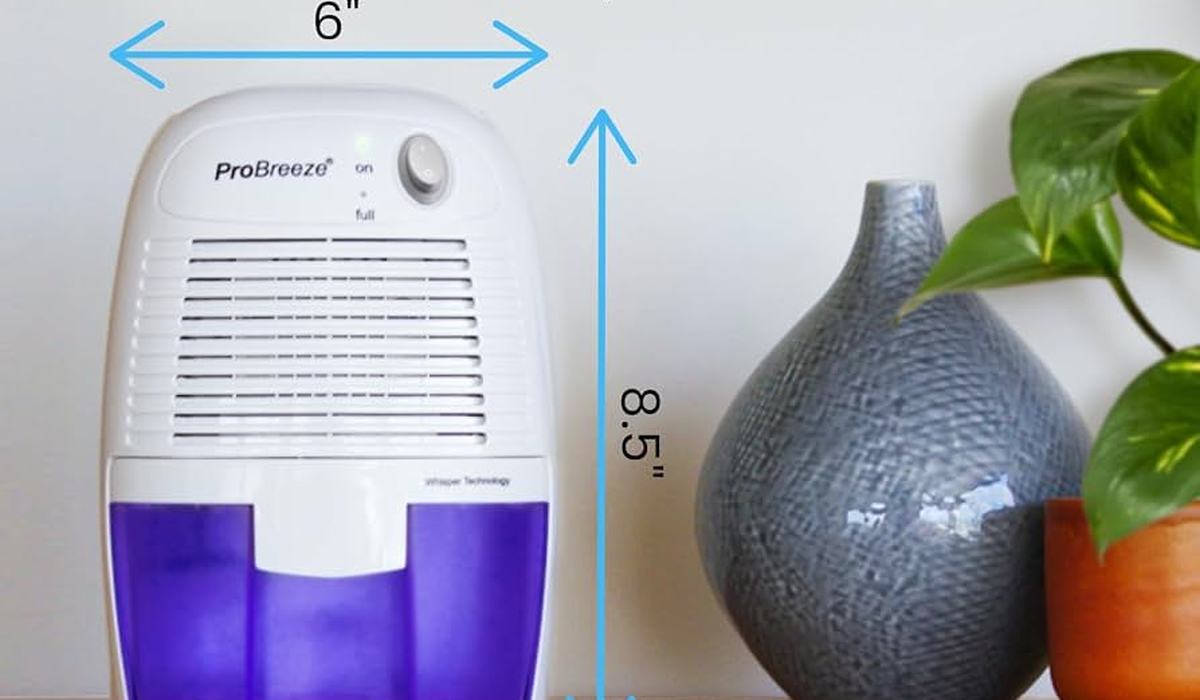
Dehumidifier With a Hose Option
If the unit will live beside a tub or shower tray, buy one that accepts a drain hose. Then you never have to empty a tank, and the unit can run unattended for hours.
Check Price on Amazon →Placing it near a drain or tub
The best long-term placement is wherever you can gravity-drain the unit. Most models accept a hose in place of the tank, and if the bathroom has a tub, a shower tray or a floor drain close by, you can run it continuously without ever emptying a tank.
Three rules for a gravity drain:
- The hose must run downhill the whole way. Any uphill section traps water and stops drainage.
- Keep it short. Under about 6 feet is safe; longer runs reduce flow and can back up.
- Check the outlet is below the unit's drain port. A shower tray on the same floor level often is not, in which case use a condensate pump or keep using the tank.
If you cannot gravity drain and you do not want to empty a tank twice a day, a unit with a built-in pump is worth the extra cost — it can push water upward into a sink or a drain that sits higher than the unit.
Placement checklist
| Check | Target |
|---|---|
| Distance from the shower | Outside the splash zone |
| Clearance, back and sides | 12–18 in |
| Clearance, front | 18–24 in |
| Above the unit | 12 in free |
| Surface | Flat, hard, dry (use a tray) |
| Power | Socket outside the splash zone |
| Door while running | Closed |
| Drain | Hose downhill, under 6 ft, or use the tank |
Frequently asked questions
Where should I put a dehumidifier in a bathroom?
Should the bathroom door be open or closed when the dehumidifier runs?
Can I put a dehumidifier in a cupboard?
Does a dehumidifier work better on the floor or on a shelf?
How much space does a dehumidifier need around it?
Can I run a dehumidifier next to a bathtub or shower?
Related guides
Can I Use a Dehumidifier Instead of a Bathroom Fan?
What each device actually does, and when one can cover for the other.
Do Dehumidifiers Work in Bathrooms? Real Numbers
How much water a bathroom unit really pulls, and when it is not enough.