On this page
The one rule that decides if a fan works
A fan does not remove moisture. It moves air. If that air has somewhere to go — a window, a doorway to a better-ventilated room — the fan helps. If the room is sealed, the fan just stirs the damp air and the humidity stays exactly where it was.
So before buying any fan, answer this: where will the air go? If the answer is "nowhere", a fan is the wrong purchase and a dehumidifier is the right one.
Fan types compared
| Fan type | Air path needed | Effectiveness | Cost |
|---|---|---|---|
| Twin window fan (exhaust) | Window | High | $25–$70 |
| Single window fan | Window | Medium | $20–$45 |
| Portable floor/desk fan | Open door or window | Low–medium | $15–$40 |
| Clip-on fan | Open door | Low | $12–$30 |
| Ductless recirculating fan | None | Odour only | $40–$120 |
Window fans
If the bathroom has a window, a twin window fan is the best choice. Set it to exhaust so it pulls air out of the room, and leave the door slightly ajar so replacement air can flow in. A twin fan moves more air than a single and usually has reversible blades for summer.
Measure the window opening before buying. Most twin fans fit windows 24–37 inches wide, and the expandable side panels seal the gap.
Portable and floor fans
Without a window, a portable fan can still help if you aim it through an open door toward a room with better airflow. It is a weak fix — it moves air rather than removing moisture — but it is better than nothing and costs very little.
Place it low, near the floor, and angle it slightly upward. Damp air is not heavier than dry air, but the floor is where the water pools, so a low fan picks up the moistest air first.
Placement that actually works
- Exhaust, not intake. Point the fan out of the room, not into it.
- Leave an air path. Crack the door or another window so replacement air can enter.
- Run it for 20–30 minutes after a shower, not for five.
- Combine with a squeegee. Remove the water on the walls first, then let the fan clear the air.
What a fan cannot do
A fan cannot lower humidity in a sealed room, cannot remove water that has already soaked into the walls, and cannot stop mould on its own. If the bathroom is windowless and the walls stay damp, the fan is not the answer — a dehumidifier is.
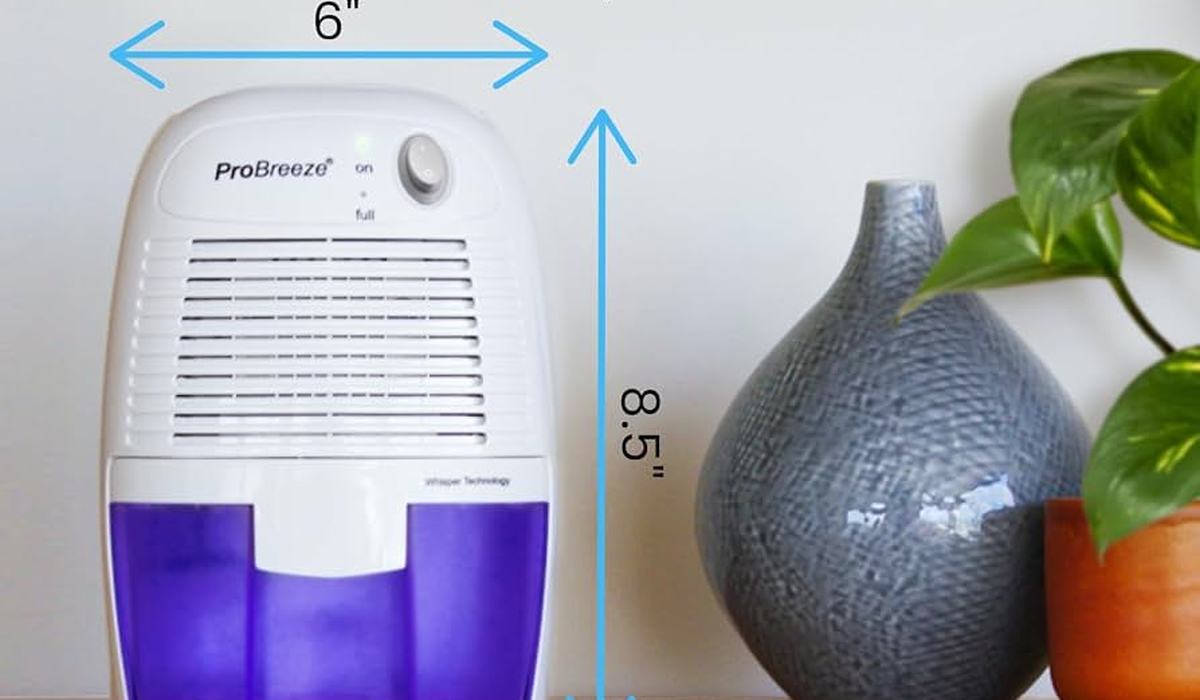
Dehumidifier for Windowless Bathrooms
When there is no window for a fan, this removes the moisture directly. Compact, quiet, and easy to empty.
Check Price on Amazon →Use a fan where you have an air path, and a dehumidifier where you do not. That single distinction solves most fanless bathrooms.
How much airflow a bathroom needs
If you are choosing a fan, size it to the room. The rule of thumb is 1 CFM per square foot, with a 50 CFM minimum.
| Bathroom size | Airflow needed | Typical fan type |
|---|---|---|
| 40 sq ft | 50 CFM | Single window fan |
| 60 sq ft | 60–80 CFM | Twin window fan |
| 80 sq ft | 80–100 CFM | Twin window fan, high setting |
| 100 sq ft | 100+ CFM | Twin window fan plus a dehumidifier |
Noise and why it matters
A fan you do not run is a fan that does not work. If the noise is annoying, you will switch it off after two minutes and the moisture stays. Choose a fan you can tolerate for 20–30 minutes, and place it away from where you stand.
Electrical safety in a bathroom
- Use a GFCI outlet. Bathrooms are wet locations and a GFCI cuts power if there is a fault.
- Keep fans away from the shower and off wet floors.
- Never run a cord across a wet floor. Route it along a wall.
- Unplug before cleaning. Water and electricity do not mix.
Pairing a fan with a dehumidifier
In a windowless bathroom, a fan alone cannot help. The combination that works is a portable fan for air movement plus a dehumidifier for the moisture. Together they cost under $150 and handle a room with no duct at all.
The fan types, and what each can do
| Type | Exhausts outside? | Needs a duct? | Renter-friendly? |
|---|---|---|---|
| Window fan | Yes | No — uses the window | Yes |
| Ducted ceiling fan | Yes | Yes | No |
| Through-wall fan | Yes | Short duct | No |
| Recirculating fan | No | No | Yes |
| Portable fan | Only via a door | No | Yes |
Run it long enough
The most common mistake is running a fan for two minutes. Moisture keeps leaving the walls for 20–30 minutes after a shower, so a fan needs to run for at least that long. If your fan is on the light switch, replace the switch with a timer, or just leave the fan running after you leave.
Where to put a portable fan
- Low, near the floor. Moist air is not always at the ceiling; a fan at floor level moves the damp layer out.
- Aimed at the door or window. The goal is to push air out, not to stir it.
- Door ajar. Replacement air has to come from somewhere.
- Not in the shower. Keep it clear of spray and wet floors.
If a fan cannot exhaust, what works
A fan only helps if the air it moves has somewhere to go. Without a vent or a window, that path does not exist, and the fan just stirs damp air around the room.
In that situation, the working options are:
- Dehumidifier — removes the water without needing an air path.
- Window fan — if there is any window, this is the best fan-based fix.
- Portable fan plus a dehumidifier — the fan moves air, the dehumidifier removes water.
- Moisture absorber — a baseline tool for closets, not a shower fix.
What each option costs
| Option | Upfront | Yearly running |
|---|---|---|
| Window fan | $20–$70 | $5–$15 |
| Portable fan | $15–$40 | $3–$10 |
| Dehumidifier | $60–$200 | $20–$60 |
| Moisture absorber | $10–$25 | $20–$40 |
The dehumidifier costs the most to buy and the most to run, but it is the only one that solves a sealed room. Everything else is a partial measure.
Frequently asked questions
What kind of fan works in a bathroom with no vent?
Do bathroom fans need to be vented outside?
Can I use a regular fan in the bathroom?
How long should I run a fan after a shower?
Is a fan or a dehumidifier better for a windowless bathroom?
Related guides

Exhaust Fan for a Bathroom Without a Vent: 6 Options
What is possible when there is no duct at all.
Renter-Friendly Bathroom Fans You Can Install Today
No-drill fans and their honest limits.