A circuit breaker is a safety device, and most of the time a tripping breaker is working exactly as designed — it has detected an overload or a short and cut the power. The failure you are looking for is the opposite: a breaker that has stopped protecting, or one that trips with no load on the circuit.
This guide covers the safe sequence: reset once, observe, then test voltage and continuity. It also covers the point where a renter must stop, because a breaker panel is the one place in an apartment where the risk is genuinely high.
On this page
Tripped, or failed?
A breaker has three states, and telling them apart is the first job. A tripped breaker sits in a middle position — not fully on, not fully off. You have to push it fully off before you can reset it.
| Symptom | Likely cause | What to do |
|---|---|---|
| Trips when a big appliance starts | Overload — too much on one circuit | Move the appliance to another circuit |
| Trips instantly, every time | Short circuit or ground fault downstream | Stop resetting; find the fault |
| Trips with nothing plugged in | Faulty breaker or wiring fault | Test the breaker; call an electrician |
| Will not reset at all | Failed breaker mechanism | Replace the breaker |
| Warm or buzzing, never trips | Breaker has failed closed | Stop using the circuit; replace |
The dangerous case is the last one. A breaker that is warm, smells of hot plastic, or buzzes but never trips has stopped protecting the circuit. That is a fire risk, not a nuisance.
Safety first
A breaker panel has live conductors at all times, even with the main switch off — the incoming service lugs stay energized. NFPA 70E classifies panel work as high-risk, and OSHA requires a qualified person for anything beyond removing a cover. This is the one job in this guide where the honest answer is often “call someone.”
- Wear safety glasses and use a CAT III meter — a panel is exactly where a cheap meter fails.
- Stand on a dry surface, keep one hand free, and never touch the bus bar or the service lugs.
- If the panel is sealed, painted shut, or labelled “do not open,” it is the landlord's.
Step 1 — reset once
Before any testing, do the simple thing. Push the breaker fully to OFF, then firmly to ON. If it holds and the circuit works, the trip was a one-off overload and there is nothing to fix.
If it trips again immediately, do not keep resetting it. Repeated resetting into a dead short can weld the contacts and turn a cheap fix into a panel replacement. Unplug everything on that circuit and try once more. If it still trips with nothing connected, the fault is in the wiring.
Step 2 — the voltage test
This test checks whether the breaker is passing power. It is done with the panel live, so follow the safety rules above.
- Set the meter to AC voltage, 200 V or higher.
- Remove the panel cover.
- Put the black probe on the ground bar (the row of bare copper or green wires).
- Touch the red probe to the breaker's terminal screw (where the black circuit wire lands).
- With the breaker on, expect about 120 V.
- Switch the breaker off and test again — expect 0 V.
Step 3 — the continuity test
The continuity test is definitive but requires the breaker to be isolated. On a modern plug-on breaker you can often test at the terminal and the bus clip without removing it, but the cleanest result comes from removing the breaker with the main off.
- Turn the main breaker off and confirm the panel is dead with a non-contact tester.
- Set the meter to continuity and confirm the beep by touching the probes together.
- With the breaker on, touch one probe to the terminal screw and the other to the bus clip. You should hear a beep.
- Switch the breaker off and repeat. The beep should stop.
A breaker that beeps in both positions is welded closed. One that never beeps is open. Both need replacing — and a replacement breaker must match the panel's brand and model exactly. Mixing brands is a real fire risk and voids the panel's UL listing.
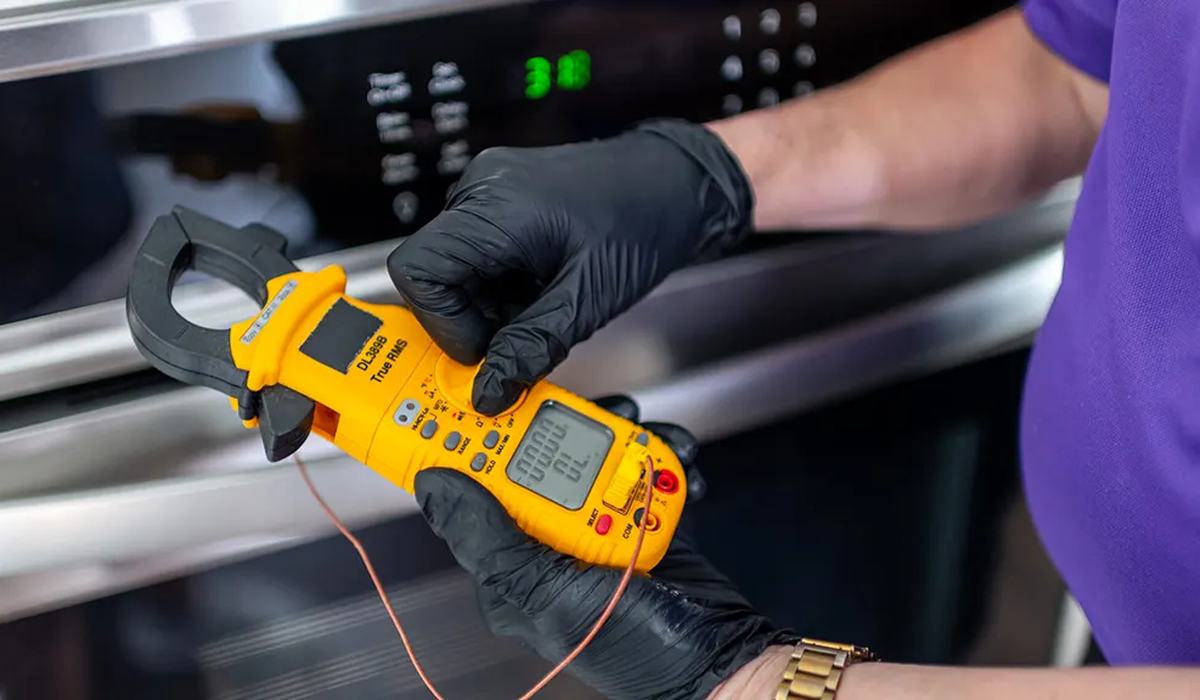
CAT III Digital Multimeter
Rated for panel work, with a loud continuity beeper and true-RMS AC voltage. The safe choice for breaker testing.
Check Price on Amazon →Reading the results
| Test | Reading | Meaning | Action |
|---|---|---|---|
| Voltage, breaker on | ~120 V | Passing power | Good |
| Voltage, breaker off | 0 V | Breaking the circuit | Good |
| Voltage, both positions | ~120 V | Failed closed | Replace now |
| Voltage, both positions | 0 V | Failed open | Replace |
| Continuity, on | Beep | Contacts closed | Good |
| Continuity, off | No beep | Contacts open | Good |
| Continuity, both | Beep / beep | Welded closed | Replace now |
The apartment angle
Breaker panels in apartments are shared infrastructure, and that changes the rules.
- You may not have access. In many buildings the panel is in a locked utility room. If you cannot reach it, you cannot test it.
- You may not be allowed to open it. Many leases prohibit tenant access to the panel beyond resetting a tripped breaker.
- Labelling is often wrong. Before you trust a label, verify by turning the breaker off and confirming the circuit is dead.
- Replacing a breaker is a landlord job. It is a panel modification, not a tenant repair.
Mistakes to avoid
- Resetting a breaker repeatedly. If it trips twice, stop. The third reset can weld the contacts.
- Testing with a non-CAT meter. A panel is the highest-energy point in the apartment.
- Assuming the label is right. Verify every circuit before working on it.
- Fitting a bigger breaker to stop the tripping. That removes the protection and creates a fire risk. Never do this.
- Mixing breaker brands. A replacement must match the panel brand and model.
Reading the panel
Before you test anything, spend two minutes reading the panel. It tells you more than any meter will.
- Find the main breaker. It is the large double-pole breaker at the top, usually rated 100–200 A. Everything below it is a branch circuit.
- Read the labels. They are often wrong, but they are a starting point. Verify by turning a breaker off and confirming the circuit is dead.
- Look for a double-pole breaker. A 240 V circuit (dryer, range, AC) uses two breakers tied together. One can trip while the other holds, which produces a half-dead circuit.
- Note the brand. A replacement breaker must match the panel brand and model exactly. Mixing brands voids the UL listing and is a fire risk.
Two panel brands deserve a specific warning. Federal Pacific Stab-Lok and Zinsco panels have a documented history of failing to trip on overload. If your apartment has one, the honest advice is to treat every circuit as unprotected and report it to the landlord — these panels are a known fire risk and many insurers will not cover them.
If the panel is sealed, painted shut, or labelled as off-limits, that is the end of the job. A sealed panel is a landlord's panel.
When to stop and call an electrician
There is a clear line in this job, and it is worth stating plainly. Testing voltage at a breaker terminal is a diagnostic task. Removing a breaker from the bus bar is electrical work.
- Stop if the panel is warm or smells of hot plastic. That is a fault in progress.
- Stop if you see scorching, melted insulation, or a burnt smell anywhere in the panel.
- Stop if the panel is a Federal Pacific or Zinsco — these have known failure modes.
- Stop if you cannot find the main disconnect or the panel is fed from an unknown source.
- Stop if the breaker will not seat firmly on the bus bar. A loose breaker arcs.
An arc flash at a panel can cause serious burns and is fatal in the worst case. NFPA 70E exists because of exactly this hazard. There is no apartment repair worth that risk, and a landlord is legally required to maintain the electrical system in a safe condition.
The practical version: reset once, test voltage if you are confident, and hand the rest to a professional. A written report with a specific symptom — “breaker trips with nothing connected, panel is a Zinsco” — is far more effective than a vague complaint.
Frequently asked questions
How do I test a circuit breaker with a multimeter?
Why does my breaker keep tripping?
Can I replace a circuit breaker myself in a rental?
How many times can I reset a tripped breaker?
What does it mean if a breaker has voltage in both positions?
Related guides
How to Test Continuity With a Multimeter
The 30-second beep test behind every electrical diagnosis.
How to Use a Multimeter Safely
The safety habits that keep a live test from going wrong.