On this page
Fuse types you will meet
The test is the same for all of them, but you need to know what you are looking at.
| Type | Where it is | Looks like |
|---|---|---|
| Glass cartridge | Inside appliances, older electronics | Clear glass tube with a wire |
| Ceramic cartridge | High-current appliances | Opaque white/ceramic tube |
| Blade fuse | Cars, some appliances | Coloured plastic with two blades |
| Control-board fuse | On the appliance circuit board | Small, often soldered or in a holder |
| Plug fuse | UK-style plugs | Ceramic with a screw cap |
The continuity test
- Unplug the appliance and remove the fuse from its holder.
- Set the multimeter to the continuity setting (the sound-wave icon) or the lowest resistance range.
- Touch one probe to each metal end of the fuse.
- Listen for the beep and read the display. A beep (or a reading near 0 Ω) means the fuse is intact.
- If there is no beep and the display shows OL or 1, the fuse is blown.
Reading the result
| Reading | Meaning | Action |
|---|---|---|
| Beep / ~0 Ω | Fuse is good | Look elsewhere for the fault |
| OL / 1 / no beep | Fuse is blown | Replace with the same rating |
| Intermittent beep | Fuse is failing | Replace it |
| Blackened glass | Fuse blew hard | Check for a short before replacing |
A fuse that has blown hard — blackened glass, a scorched holder — usually means something downstream shorted. Replacing the fuse without finding the short will just blow the new one.
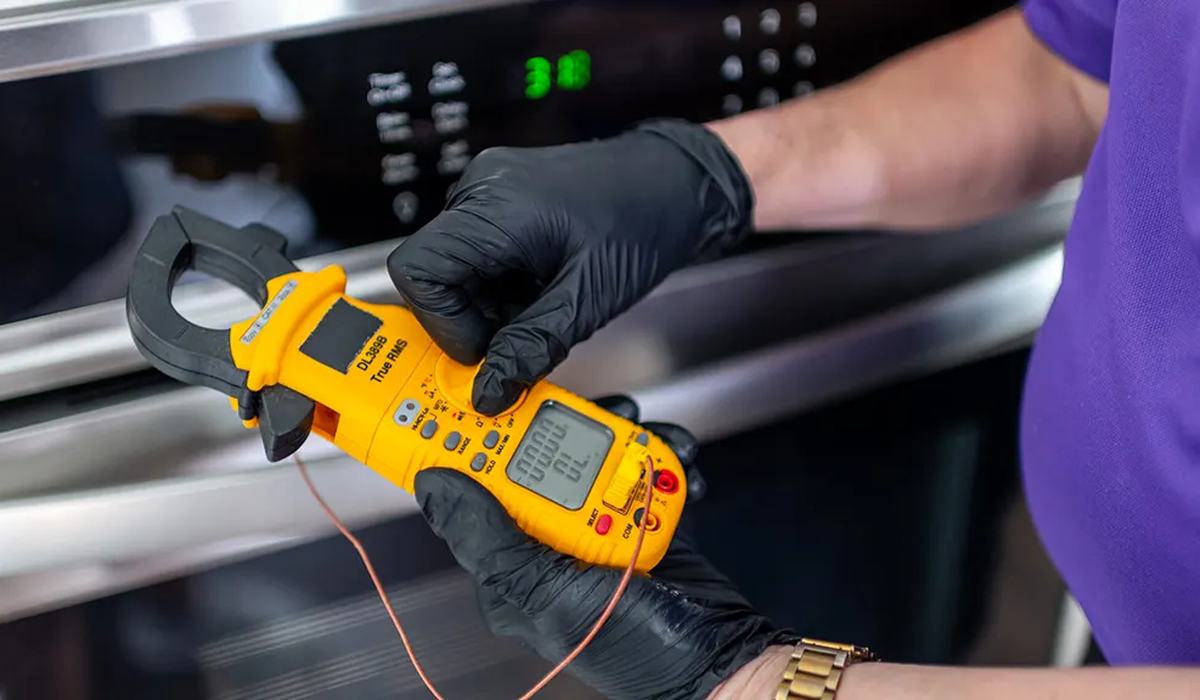
Multimeter with Continuity Beeper
A continuity beeper turns fuse testing into a two-second job. Auto-ranging and a clear display make it easy in tight spaces.
Check Price on Amazon →Appliance fuses
This is where a generic electronics guide stops. In an appliance, the fuse you are looking for is usually not the obvious one:
- Control-board fuse: a small fuse on the main board, often soldered. It protects the electronics, not the motor. If the board is dead but the appliance has power, test this first.
- Thermal fuse: a one-shot fuse that opens when the appliance overheats. Common in dryers and microwaves. It looks like a small cylinder with two leads.
- In-line fuse: a fuse in the power cord or harness, hidden under a cover.
- Plug fuse: in UK-style plugs, the easiest one to check and replace.
Four fuse-testing mistakes
- Testing in circuit. The meter can find a path around the fuse through the rest of the circuit. Remove the fuse and test it on its own.
- Using the wrong setting. Continuity is the fast test; resistance works too. Voltage will not tell you whether a fuse is blown.
- Replacing with a higher rating. A higher-rated fuse will not protect the appliance and can cause a fire. Always match the rating.
- Replacing without finding the fault. A fuse that blew hard means something downstream shorted. The new fuse will blow too.
Finding the fuse in an appliance
In an appliance, the fuse is often not where you expect. Work through these locations:
| Location | What it protects | How to find it |
|---|---|---|
| Control board | The electronics | Small fuse on the board, often soldered |
| Power cord / harness | The whole appliance | In-line fuse under a cover |
| Thermal fuse | Overheat protection | Cylinder with two leads, near the heater |
| Plug (UK) | The whole appliance | Inside the plug, behind the fuse cover |
If the appliance is completely dead — no lights, no sound — the control-board fuse or the in-line fuse is the first thing to check. If it powers on but will not heat or run, the thermal fuse is the likely culprit.
Testing a fuse, step by step
A fuse test is the fastest diagnostic in appliance repair. It takes under a minute.
- Unplug the appliance and remove the fuse from its holder.
- Set the meter to continuity (the beep symbol) or the lowest resistance range.
- Touch the probes together to confirm the meter beeps.
- Touch one probe to each end of the fuse.
- Listen and read. A beep and near-zero ohms means the fuse is good.
If the meter does not beep and the reading stays at infinity, the fuse is blown. There is no middle ground with a fuse — it either conducts or it does not.
Fuse types you will meet
| Type | Looks like | Where |
|---|---|---|
| Glass cartridge | Clear tube with a wire | Older appliances, plugs |
| Ceramic cartridge | White tube | High-current appliances |
| Blade fuse | Coloured plastic | Cars, some appliances |
| Thermal fuse | Small cylinder, two leads | Near heaters and motors |
| SMD fuse | Tiny chip on a board | Control boards |
A thermal fuse is different from the others: it opens permanently when the appliance overheats, and it cannot be reset. If a thermal fuse has blown, the appliance overheated for a reason — usually a blocked vent or a failed fan. Fix that before replacing the fuse, or the new one will blow too.
Replacing a fuse correctly
Always match the rating exactly. A fuse is rated in amps and volts, and both matter. A higher-rated fuse will not protect the appliance and can cause a fire; a lower-rated one will blow immediately. If the replacement blows straight away, stop — there is a short circuit downstream, and replacing fuses will not fix it.
Why a fuse blows
A fuse is a deliberate weak point. It melts to protect the rest of the circuit, so a blown fuse is a symptom, not the disease.
| Blown how | Likely cause |
|---|---|
| Clean break, no blackening | Age or a brief overload |
| Blackened glass, heavy deposit | A short circuit downstream |
| Blown immediately on replacement | A persistent short — stop and find it |
| Thermal fuse open | Overheating — blocked vent or failed fan |
A fuse that blows the instant you replace it is telling you there is a short circuit. Replacing it again will not help. Find the short first — a pinched wire, a failed component, or a burnt connector — then replace the fuse.
What you need
A basic multimeter with a continuity setting is all you need, plus a set of replacement fuses in the right ratings. Buy an assortment box so you have the correct value on hand, and never substitute a higher rating — a fuse that does not blow is a fire risk, not a fix.
Frequently asked questions
How do I test a fuse with a multimeter?
What reading means a fuse is blown?
Can I test a fuse without removing it?
Why does my appliance keep blowing fuses?
Can I replace a fuse with a higher-rated one?
Related guides
How to Test Continuity With a Multimeter
The one skill behind every electrical diagnosis.