A power strip is the most common electrical accessory in an apartment, and the one most likely to be overloaded. It is also easy to test, because electrically it is just a cord with several sockets on the end.
This guide covers the continuity test for each socket, the short test, and the surge indicator — the one part of a power strip that fails silently and leaves you unprotected.
On this page
Why power strips fail
A power strip fails in four ways, and only one of them is obvious.
- Broken conductor — the cord fractures at the plug or where it enters the strip. One or more sockets go dead.
- Lost ground — the ground connection inside the strip fails, so the sockets still work but are no longer grounded. This is invisible without a test.
- Spent surge protection — the metal-oxide varistor that absorbs surges has done its job and failed open. The strip still passes power, but it no longer protects anything.
- Overheated contacts — a socket that has carried too much current for too long. It will be warm, discoloured, or loose.
The lost ground and the spent surge protection are the dangerous ones, because the strip looks and works normally. Both are caught by a test.
Safety first
The test is done dead, so the risk is low. The real risk is the strip you keep using after it fails.
- Never test a plugged-in strip.
- Do not use a strip with a warm, discoloured or loose socket.
- Check for a UL 1363 listing — that is the standard for relocatable power taps.
The continuity test
Test each socket individually, because a strip can have one dead socket and several good ones.
- Unplug the strip from every power source.
- Set the meter to continuity and confirm the beep.
- For each socket: touch one probe to the strip's plug hot prong and the other to that socket's hot slot. Expect a beep.
- Repeat for neutral (plug neutral prong to socket neutral slot) and ground (plug ground prong to socket ground hole).
- Then test hot-to-neutral and hot-to-ground at the plug. Neither should beep.
A socket that fails the hot or neutral test is dead. A strip that fails the ground test on every socket has lost its ground — and that is the failure that matters most, because it removes the protection without any visible sign.
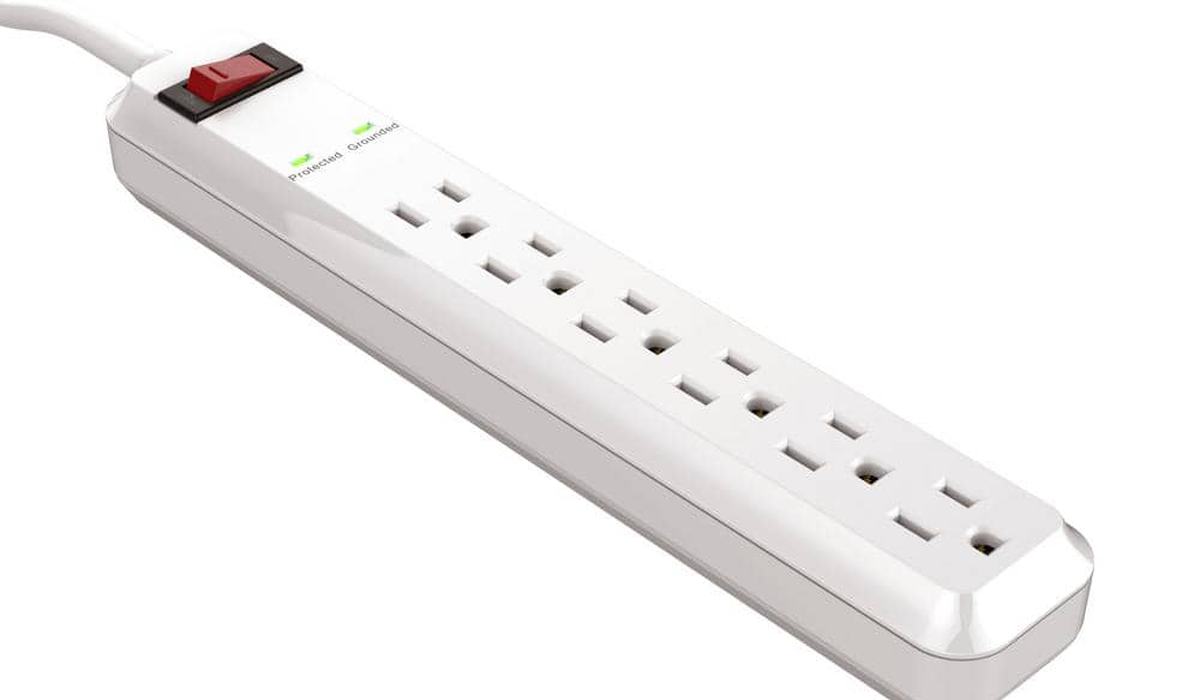
Surge Protector Power Strip (UL 1363)
A grounded strip with a protected indicator light, so you can see when the surge protection has been used up.
Check Price on Amazon →The surge indicator
Most surge protectors have a small indicator light labelled “protected” or “surge.” That light is not decoration — it tells you whether the surge protection is still working.
- Light on — the surge protection is intact.
- Light off — the protection has been used up. The strip still passes power, but it is now just an extension cord.
- No indicator at all — the strip may be a plain power strip with no surge protection, or the indicator has failed.
Reading the results
| Test | Expected | If it fails |
|---|---|---|
| Hot to hot (each socket) | Beep | Dead socket — replace the strip |
| Neutral to neutral | Beep | Dead socket — replace the strip |
| Ground to ground | Beep | Lost ground — replace the strip |
| Hot to neutral | No beep | Short — discard immediately |
| Hot to ground | No beep | Short — discard immediately |
| Surge indicator | Lit | Unlit = protection spent, replace |
The apartment angle
- Outlets are scarce. Apartments have fewer receptacles, which is why strips get used and overloaded.
- Never daisy-chain strips. Plugging one strip into another is the most common cause of an overloaded circuit in a rental.
- Do not run a space heater on a strip. Heaters draw 12–15 amps and will overheat a strip's contacts.
- Check the UL listing. A strip without a UL 1363 mark is an unknown quantity.
Mistakes to avoid
- Testing a plugged-in strip. Unplug it from every source first.
- Daisy-chaining strips. It is the fastest way to overload a circuit.
- Running a heater on a strip. High-current appliances need a wall outlet.
- Ignoring a dead surge light. The strip still works, but it no longer protects.
- Using a strip with a warm socket. Heat means the contacts are failing.
Load and capacity
Most power strip failures are overload failures, and the arithmetic is worth knowing.
A standard 15 A circuit delivers 1,800 W at 120 V. The 80% rule — the continuous-load guideline in the National Electrical Code — means you should keep a sustained load under about 1,440 W on a 15 A circuit. A single space heater at 1,500 W is already at the limit on its own.
| Appliance | Typical draw | Notes |
|---|---|---|
| Space heater | 1,500 W | At the limit of a 15 A circuit by itself |
| Hair dryer | 1,200–1,875 W | Often the highest-draw item in an apartment |
| Microwave | 1,000–1,500 W | High draw, short duration |
| Vacuum | 800–1,200 W | High draw, motor start surge |
| TV + console + router | 200–400 W | Fine on a strip |
| Phone chargers, lamps | Under 100 W | Fine on a strip |
The rule that follows is simple: a power strip is for electronics, not for heat. Anything that produces heat — a heater, a hair dryer, a kettle, a toaster — should go directly into a wall outlet. A strip's contacts are small, and a sustained 12–15 A load will heat them.
Daisy-chaining makes it worse. Two strips in series do not increase capacity; they just add more contact points to heat up. It is the single most common cause of an overloaded circuit in an apartment, and it is worth being firm about: never plug one strip into another.
When to replace a strip
A power strip is a consumable, not a permanent fixture. It has a service life, and there are clear signals that it is over.
- Any failed continuity test — a dead socket or a lost ground means replace.
- A warm or discoloured socket — the contacts are failing. Replace immediately.
- A loose socket — if a plug falls out or feels loose, the contacts have lost their spring.
- A dead surge indicator — the protection is spent. Replace if you are using it for electronics.
- A cracked or damaged housing — replace, regardless of what the meter says.
- Age over about five years — surge protection degrades even without a major event.
The replacement is cheap, and the upgrade is worth making. Look for a strip with a UL 1363 listing, a grounded plug, a resettable circuit breaker, and a protected indicator light. A strip with its own breaker is a genuine improvement over a plain one, because it protects the strip's own contacts from an overload.
For an apartment, a strip with a flat plug and a right-angle cord is worth the extra few dollars. It sits flush against the wall, which means it does not get knocked, and the cord does not develop a hard bend at the plug — which is where most strip failures start.
Frequently asked questions
How do I test a power strip with a multimeter?
How do I know if my surge protector is still working?
Can a power strip lose its ground?
Is it safe to plug a space heater into a power strip?
Can I daisy-chain power strips?
Related guides
How to Test Continuity With a Multimeter
The 30-second beep test behind every electrical diagnosis.