A thermostat looks like a computer, but electrically it is a set of switches. When the room is too cold, it closes the contact between the power terminal and the heat terminal. When it is too warm, it closes the contact to the cooling terminal.
That makes it easy to test: you check whether the right contacts close in the right mode. This guide covers the terminal codes, the continuity test, and the low-voltage safety rules that make this one of the safer jobs in the apartment.
On this page
How a thermostat works
A thermostat runs on low-voltage control power, usually 24 V AC, supplied by a transformer in the air handler or furnace. It does not switch the main power to the equipment — it switches the control signal that tells a relay or contactor to do that.
That is why the test is a continuity test rather than a voltage test. You are checking whether the thermostat closes the right contact, not whether it handles current.
Safety first
The control circuit is low voltage, but the air handler it connects to is not. Turn the system off at the thermostat and, for anything beyond the thermostat itself, at the breaker.
- Turn the system off at the thermostat before removing the faceplate.
- Photograph the wiring before you touch it — terminal order matters.
- Do not let the wires touch each other or the metal box; a short can blow the low-voltage fuse.
- If the thermostat controls a gas furnace, do not open the furnace itself.
The terminal codes
Thermostat terminals follow a standard letter code. You only need a few of them for a basic test.
| Terminal | Function | Wire colour (typical) |
|---|---|---|
| R / Rh / Rc | 24 V power (heating / cooling) | Red |
| W | Heat call | White |
| Y | Cool call | Yellow |
| G | Fan call | Green |
| C | Common (24 V return) | Blue or black |
| O / B | Reversing valve (heat pump) | Orange / blue |
For a basic test you need R, W, Y and G. If your thermostat has separate Rh and Rc terminals, they are usually jumpered together on a conventional system.
The continuity test
- Turn the system off at the thermostat, then remove the faceplate from the backplate.
- Set the meter to continuity and confirm the beep by touching the probes together.
- Heat test: set the thermostat to heat and raise the setpoint above room temperature. Touch one probe to R and the other to W. Expect a beep.
- Cool test: set it to cool and lower the setpoint below room temperature. Test R to Y. Expect a beep.
- Fan test: set the fan to on. Test R to G. Expect a beep.
- Set the system to off and test R to W again. The beep should stop.
If the thermostat beeps where it should and stays silent where it should, it is working. If it never beeps, the internal contacts have failed. If it always beeps, the contacts are stuck closed and the equipment will run continuously.
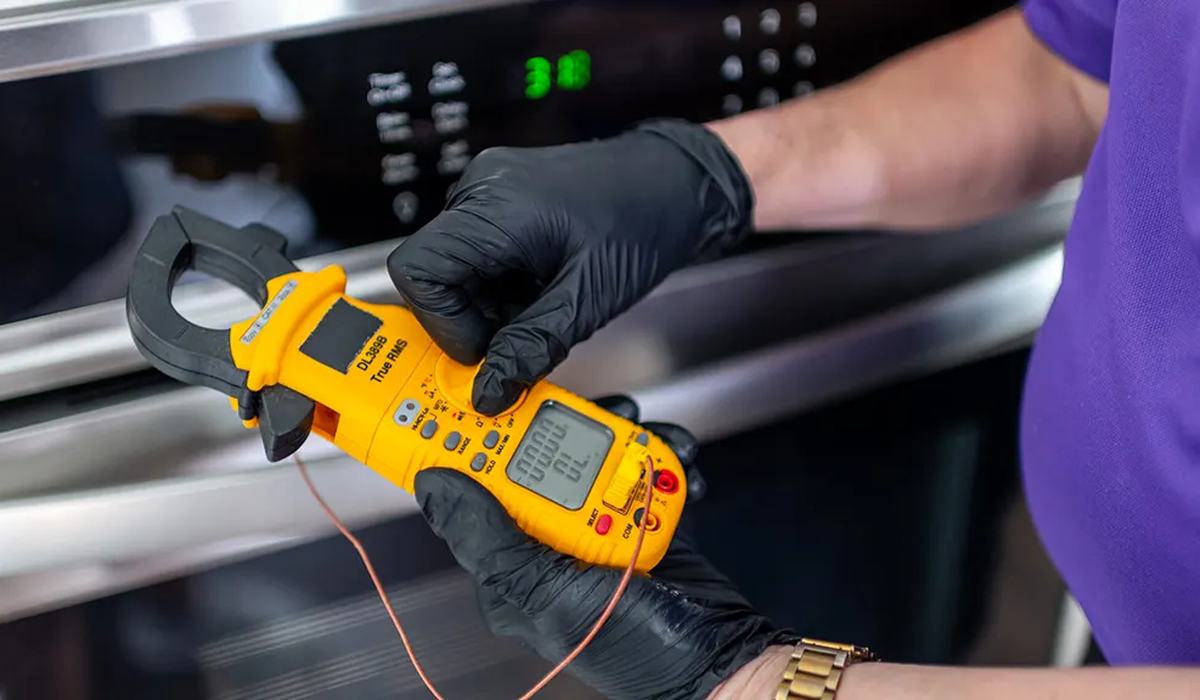
Digital Multimeter with Continuity Beeper
Auto-ranging with a loud beeper. Ideal for low-voltage control testing where a clear audible signal matters.
Check Price on Amazon →Reading the results
| Mode | Test | Expected | If it fails |
|---|---|---|---|
| Heat | R to W | Beep | No beep = thermostat not calling for heat |
| Cool | R to Y | Beep | No beep = thermostat not calling for cool |
| Fan on | R to G | Beep | No beep = fan circuit failed |
| Off | R to W | No beep | Beep = stuck contact, runs continuously |
| Any | R to C | ~24 V AC (voltage test) | No voltage = no control power |
If the thermostat tests good but the equipment does not run, the fault is downstream — the control wiring, the relay, or the equipment itself. That is beyond a tenant repair.
The apartment angle
- Window and portable AC units often have their own thermostat, which is not serviceable. Test the outlet instead.
- Baseboard heaters use a line-voltage thermostat, not 24 V. That is a mains-voltage device and a landlord repair.
- Central systems in apartments are usually building-managed. You can test the thermostat, but the equipment is not yours.
- Batteries first. Half of “dead thermostat” calls are dead batteries. Replace them before you test anything.
Mistakes to avoid
- Not replacing the batteries first. It is the most common cause and the cheapest fix.
- Letting the wires touch. A short can blow the low-voltage fuse on the control board.
- Testing a line-voltage thermostat the same way. Baseboard and some wall heaters use mains voltage — that is a different, dangerous test.
- Assuming the thermostat is the fault. If it tests good, the problem is downstream.
- Pulling wires off without a photo. Terminal order matters, and a miswire can damage the equipment.
Testing the control voltage
The continuity test tells you whether the thermostat closes its contacts. The voltage test tells you whether the control power is even reaching it. You need both to diagnose a system that will not run.
- Set the meter to AC voltage, 200 V or higher.
- Touch one probe to R and the other to C (common).
- Expect about 24 V AC.
If you read 24 V, the transformer is supplying control power and the thermostat has what it needs. If you read 0 V, the problem is upstream: the transformer, the low-voltage fuse on the control board, or the wiring between them.
A blown low-voltage fuse is a common cause, and it is usually caused by a shorted thermostat wire — often a wire pinched behind the thermostat when it was pushed back onto the wall. If you replace the fuse and it blows again immediately, look for a pinched or shorted wire before replacing anything else.
On a heat pump, there is an additional terminal: O or B, the reversing valve. It determines whether the system heats or cools. Testing it is the same idea — continuity from R to O or B when the system calls for the opposite mode — but the logic is more involved, and a heat pump fault is usually a professional job.
Smart and programmable thermostats
A smart thermostat is a small computer with relays, and it fails differently from a mechanical one. The continuity test still works, but there are extra things to check first.
- Power. A smart thermostat needs a C wire or a power-stealing circuit. Without a C wire, some models misbehave or drop offline. Check the display first.
- Batteries. Many models still use batteries for backup. A weak battery causes erratic behaviour.
- Wi-Fi. A thermostat that is offline may not run its schedule. Check the app.
- Firmware. A failed update can leave a thermostat in a strange state. A factory reset often fixes it.
The most common smart-thermostat problem in an apartment is a missing C wire. If the thermostat works but the display dims or it drops offline, that is the likely cause. The fix is either a C-wire adapter or a model designed to work without one — and in a rental, an adapter is the right choice because it does not modify the building's wiring.
If you are replacing a thermostat in a rental, keep the original. A smart thermostat is a tenant improvement, and you will want to take it with you and restore the original unit when you leave. Photograph the original wiring before you change anything.
Frequently asked questions
How do I test a thermostat with a multimeter?
What do the letters on a thermostat mean?
Why is my thermostat not turning on the heat?
Can I test a thermostat without removing it?
Is it safe to test a thermostat myself?
Related guides
How to Test Continuity With a Multimeter
The 30-second beep test behind every electrical diagnosis.
How to Test an Appliance With a Multimeter
The full diagnostic sequence, start to finish.