On this page
What non-toxic actually means
"Non-toxic" is not a regulated term for air purifiers, so it can mean anything a marketer wants. In practice, it should mean three things: the unit does not produce ozone, it does not off-gas harmful chemicals, and its filter does not shed fibres or additives into the air. Each of those is checkable.
Ozone: the main risk
Ozone is a lung irritant, and the US EPA advises against ozone generators in occupied spaces. Some purifiers produce ozone deliberately, as an "air freshening" feature, and some produce it as a by-product of an ionizer or a "plasma" or "photocatalytic" stage. A purifier that only uses a mechanical fan and a HEPA filter produces no ozone at all — the same principle behind a washable-filter nursery unit.
The rule is simple: if a unit advertises "ion", "plasma", "bipolar", "photocatalytic" or "UV" as a cleaning method, check whether it can be switched off, and prefer a unit that does not need it.
CARB certification explained
The California Air Resources Board runs a certification programme for air purifiers sold in California — the same check behind our ozone-free purifier guide. A CARB-certified unit has been tested and confirmed to produce ozone below the regulated limit. The certification is a useful, independent signal, and the CARB list is public. If a manufacturer claims "ozone-free", check the CARB listing rather than taking the claim at face value.
Filter materials and off-gassing
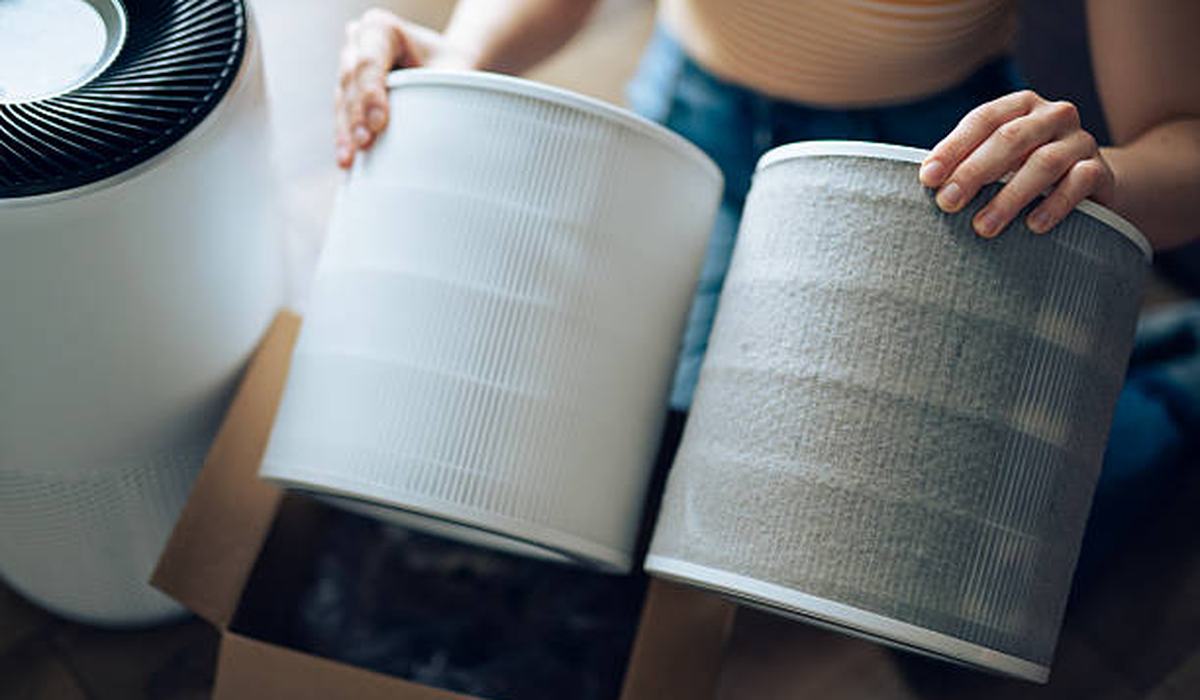
A true HEPA filter is a mat of fine fibres that traps particles mechanically — and it is the airborne fraction, not settled dust, that it removes, as we explain in dust in a nursery. It does not need chemicals to work, so a HEPA-only unit has little to off-gas. The activated-carbon layer is where odour and gas removal happens, and the quality of that carbon matters: a thin carbon dusting does little, while a substantial carbon bed removes more. Some cheap filters use adhesives or binders that can smell when new; a brief "new filter" smell that fades in a day is normal, a persistent chemical smell is not.
Ionizers and plasma stages
Ionizers charge particles so they clump and settle. They can be effective, but they are also the most common source of ozone in a purifier. If your unit has one, look for a switch to turn it off, and turn it off for nursery and bedroom use — and weigh the running cost before you buy, as in buying a purifier on Black Friday. A unit that forces the ionizer on with no off switch is not a good choice for a room where people sleep.
A five-point buying check
- Is it CARB-certified? Check the public list.
- Does it use true HEPA, not "HEPA-type" or "HEPA-like"?
- Does it have a real activated-carbon layer, not a carbon dusting?
- Can the ionizer or plasma stage be switched off, or is there none?
- Do owner reviews mention a persistent chemical smell, or only a brief new-filter smell?
Pass all five and you have a purifier that cleans the air without adding anything to it. That is what non-toxic should mean, and it is checkable before you spend a cent.
Sources: AHAM (CADR certification program), U.S. EPA (Residential Air Cleaners guide; ozone generator warning), ASHRAE Standard 62.2 (residential ventilation), WHO Environmental Noise Guidelines (night-time bedroom levels), American Academy of Pediatrics (safe sleep and cord safety).
Why carbon quality matters
Activated carbon is what removes odour and many gases, and its quality varies more than any other part of a purifier. A thin carbon dusting on a mesh does little; a substantial carbon bed does real work. If odour removal matters to you — pets, cooking, a musty flat — look for a unit with a genuinely thick carbon layer, and expect to replace it more often than the HEPA layer in a smelly environment.
Verifying a non-toxic claim
Claims are easy; verification is not. Check the CARB list for the model, read the filter specification for true HEPA and real carbon, and look for an ionizer switch. If a manufacturer will not state whether the unit is CARB-certified, treat that as a no — the same standard we apply to a baby-safe purifier. The whole point of a non-toxic purifier is that it adds nothing to the air, and that is a claim you can check before buying.
Frequently asked questions
What makes an air purifier non-toxic?
Do air purifiers produce ozone?
What is CARB certification?
Is a HEPA filter toxic?
Should I turn off the ionizer?
Related guides
Air Purifier for a Nursery With a Washable Filter
The trade-offs of washable versus replaceable.