On this page
What ozone-free means
Ozone is a gas made of three oxygen atoms. At ground level it is a respiratory irritant, and short-term exposure can reduce lung function and aggravate asthma. Its distinctive smell is sometimes mistaken for “fresh air”, which is precisely the marketing problem: some devices generate ozone on purpose and sell the smell as a benefit.
An ozone-free air purifier is one that cleans air without generating that gas at all. The only design that reliably does this is mechanical filtration: a fan drawing room air through a physical particle filter and a carbon layer.
Where ozone actually comes from
| Technology | How it cleans | Ozone risk |
|---|---|---|
| True HEPA + carbon | Physically traps particles and adsorbs gases | None — nothing is generated |
| Ozone generator | Releases ozone deliberately | High — this is the product |
| Electrostatic precipitator | Charges particles and plates them out | Can produce ozone as a by-product |
| Bipolar ioniser / plasma | Releases charged ions into the room | Small but real by-product |
| UV-C lamp | Irradiates air passing the lamp | Minimal, if the chamber is sealed |
| HEPA + ioniser combined | Mechanical filtration plus ions | Depends entirely on whether the ioniser can be switched off |
Reading the label in three places
You do not need a laboratory. Check three fields on the product listing.
- The features list. Search the page for “ozone”, “activated oxygen”, “ion”, “plasma” and “sterilisation”. A deliberate ozone mode is a hard no. An ioniser is acceptable only if the page says it can be switched off.
- The filter spec. It should read “true HEPA” or “HEPA H13”, not “HEPA-type”. The filter is what does the work; the ioniser is decoration.
- The certification line. Look for a California Air Resources Board (CARB) certification number, or an ozone output figure with a test reference. No certification and no figure means no evidence.
What CARB certification covers
The California Air Resources Board operates the only widely used ozone-emission certification for air cleaning devices in the US. A certified unit has been tested and its ozone output capped at 0.05 ppm over the test cycle.
| Claim | What it actually tells you | Weight |
|---|---|---|
| CARB certification number listed | Independently tested, output capped at 0.05 ppm | Strong evidence |
| “Ozone output <0.05 ppm” with a test reference | Capped to the same limit, self-reported | Reasonable evidence |
| “Ozone free” in the headline copy | Marketing only | No evidence |
| “Ozone safe” / “low ozone” | Undefined — low compared with what? | No evidence |
| “Ozone mode” offered | Deliberate generation, on demand | Disqualifying |
Note what CARB does not mean. It is not a filter-quality rating and not a CADR figure. A CARB certificate tells you about ozone only. For cleaning power you want an AHAM-verified CADR, which our CADR explainer covers.
Ionisers, plasma and UV
These three get bundled into purifiers and each deserves its own line.
- Bipolar ionisers (sold as PlasmaWave, Vital Ion, Ion Boost and similar names) release charged ions into the room. They can produce ozone as a by-product. Buy a unit whose ioniser has a separate switch, and leave it off in a small flat or a bedroom.
- Electrostatic precipitators charge particles and collect them on plates. Effective on particles, but the corona discharge can generate ozone. In an apartment, prefer a filter over a plate.
- UV-C lamps are extremely common now and cause little concern when the lamp sits inside a sealed chamber and the light cannot escape. Their actual benefit in a domestic room is modest.
Ozone-free vs everything else
| Criterion | True HEPA + carbon (ozone-free) | Ozone generator | Ioniser / precipitator |
|---|---|---|---|
| Removes particles | Yes, 99.97% at 0.3 microns | No, not its job | Yes, with cleaning plates |
| Removes VOCs and odours | Yes, via carbon | No | No |
| Adds ozone to the room | No | Yes, deliberately | Possibly, as a by-product |
| Safe around an infant | Yes | No | Only with the ioniser off |
| Needs filter replacement | Yes, 6–12 months | No | Plates need wiping |
In a small flat the ozone point is amplified. A 400 sq ft apartment has proportionally little air volume to dilute anything a device emits, and the windows may rarely open. What a generator releases in a living room ends up in the bedroom.
Why renters should care more
- Smaller air volume. A studio flat holds far less air than a house, so any airborne by-product concentrates faster.
- Shared ventilation. Flats often share ducts and corridors, so what you generate does not stay in your room.
- Windows that do not open well. The dilution route you would rely on in a house may be a sash that opens two inches.
- No landlord to fix it. Choosing mechanically filtered air is something you can control without asking anyone's permission.
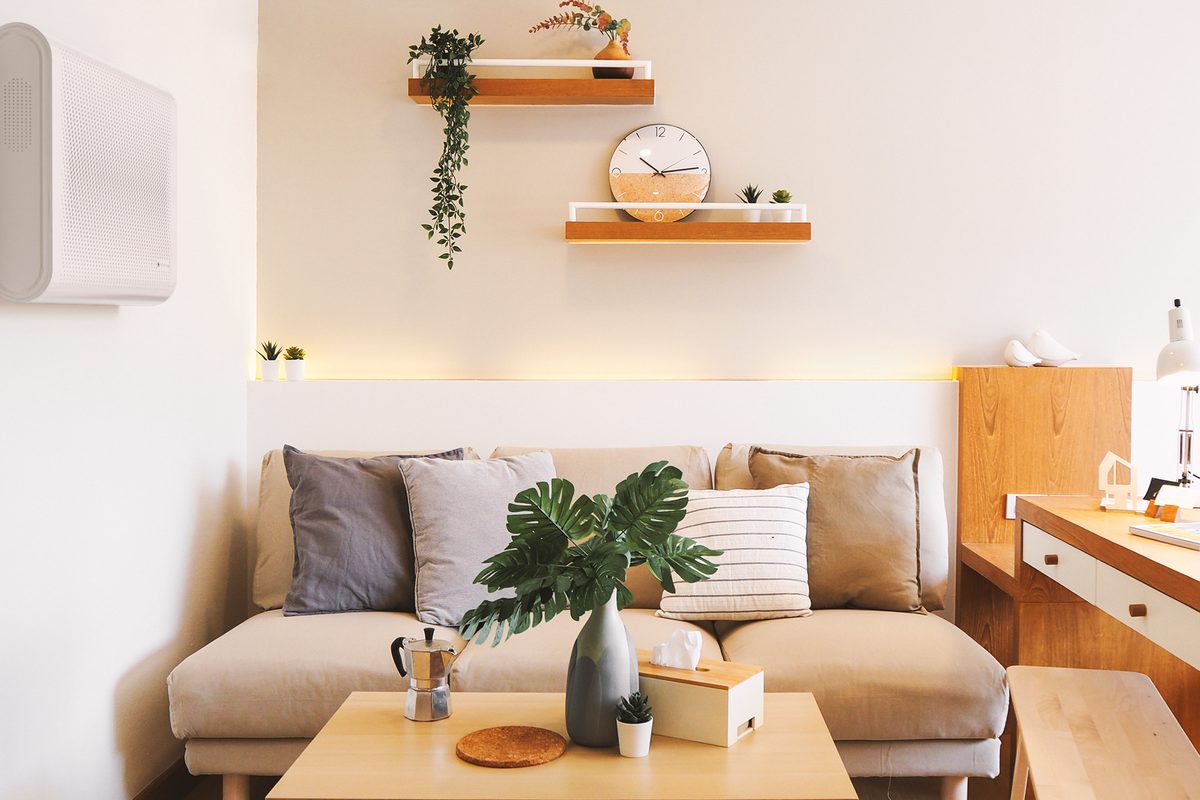
Ozone-Free True-HEPA Purifier
Mechanical filtration only: true HEPA plus activated carbon, no ozone mode, and an ioniser you can switch off. Sized for a bedroom or small living room in a flat.
Check Price on Amazon →Where to go next
- Baby-safe air purifier — the full safety checklist.
- Air purifier for a baby — safety-first selection.
- What CADR means — the number that measures cleaning power.
- Best air purifier for a nursery — units that pass both the ozone and CADR checks.
- Quiet air purifier for an apartment — silence without ozone.
- Quiet air purifier for a nursery — the pillar guide on silence and safety.
- Air purifier vs dehumidifier — which problem you are actually solving.
Sources: U.S. EPA (Residential Air Cleaners guide; ozone generator warning), California Air Resources Board (ozone emission certification programme), AHAM (CADR certification program), ASHRAE Standard 62.2 (residential ventilation), WHO (air quality guidance on ozone).
Frequently asked questions
How do I know if an air purifier is ozone free?
Is a HEPA air purifier automatically ozone free?
What does CARB certification mean on an air purifier?
Are ionizers safe in a small apartment?
Do ozone generators remove odours and mould?
Is UV-C safe in a home air purifier?
Related guides