On this page
What actually matters in a nursery
A nursery purifier has a harder job than a living-room one. It runs continuously while a baby sleeps, it sits in the smallest room in the flat, and the person breathing the air cannot tell you if it is working. That makes four criteria far more useful than any marketing claim.
- Verified cleaning power (CADR). Clean Air Delivery Rate is the only independent measure of how fast a unit actually cleans air. It is certified by AHAM, tested for smoke, dust and pollen, and quoted in cubic feet per minute. A box that lists a “coverage” number without a CADR is telling you nothing you can check.
- True HEPA, not “HEPA-type”. True HEPA captures 99.97% of particles at 0.3 microns. “HEPA-type” and “HEPA-like” have no standard behind them.
- No ozone, no always-on ioniser. The EPA is explicit that ozone generators are not effective air cleaners and add a lung irritant. In a room with an infant this is not a preference, it is a filter on your shortlist.
- Filter cost per year. A £150 unit with a £60 annual filter costs more over three years than a £250 unit with a £25 filter. Nursery units run 24/7, so the filter bill arrives faster than you expect.
The picks at a glance
Three tiers cover almost every nursery. Match the tier to the room, not to the brand.
| Tier | Best for | Smoke CADR to look for | Footprint | Filter cadence | Noise on low |
|---|---|---|---|---|---|
| Compact tower | Nursery 60–120 sq ft | 55–90 | About 8 × 8 in | Every 6–12 months | 20–26 dB |
| Mid-size unit | Nursery that opens onto a living area | 110–160 | About 10 × 10 in | Every 9–12 months | 24–28 dB |
| Budget compact | Budget-constrained nursery 60–100 sq ft | 50–75 | About 7 × 7 in | Every 6–9 months | 22–28 dB |
| Large-room unit | Open-plan flat; nursery shares space | 200+ | 12 in and up | Every 12 months | 26–32 dB |
The trade-off is real and it is arithmetic: a bigger unit running on speed 1 is often quieter and cleaner than a small unit running on speed 3. If the nursery is open to the rest of the flat, buy one tier up and never leave low speed.
Best overall for a small nursery
A compact true-HEPA tower is the default answer for a rented nursery. It fits between a wardrobe and a wall, it clears a 100 sq ft room several times an hour, and its low speed is quiet enough to leave on.
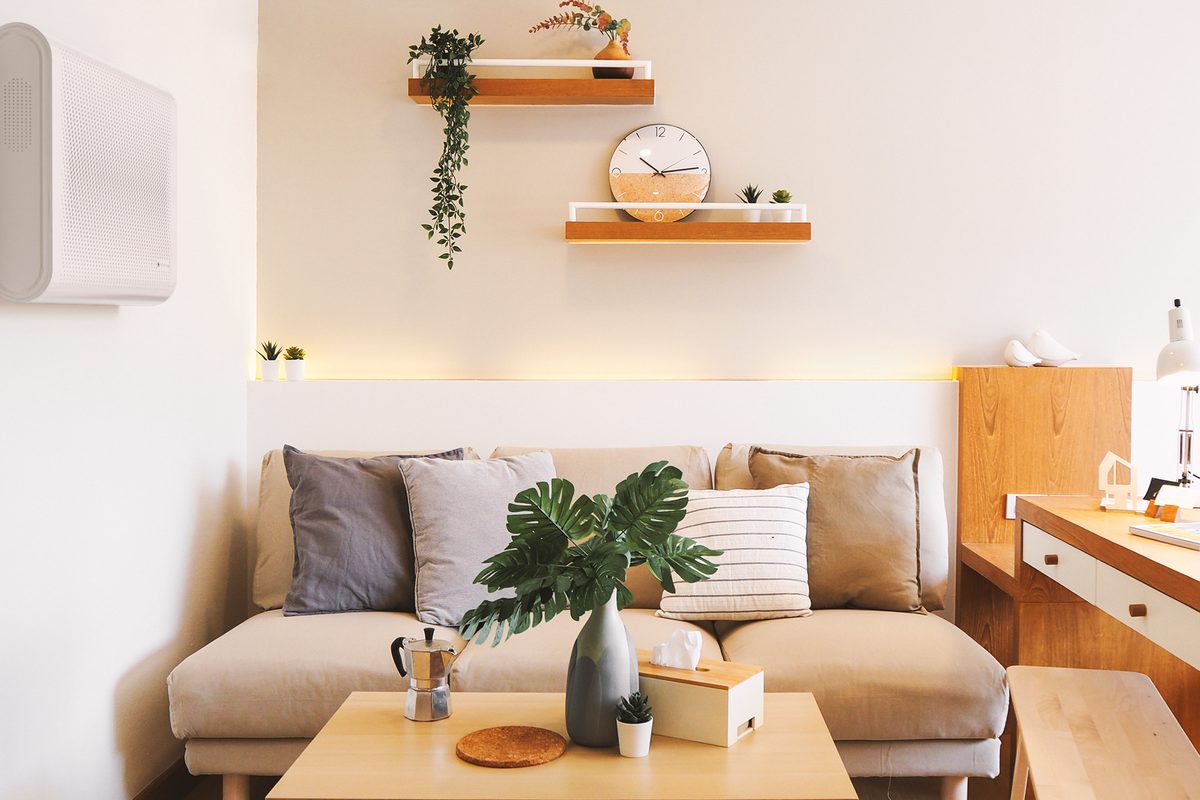
Compact True-HEPA Tower for a Nursery
The size most nurseries actually need. True HEPA plus a carbon pre-filter, a display that can be switched off, and a replacement filter that stays under most of its rivals. Fits a footprint smaller than a bedside table.
Check Price on Amazon →Why it wins here: it is the smallest unit that still carries a meaningful certified CADR, and the display can be fully darkened — important in a room where a status LED can keep a light-sleeping baby awake.
Who should skip it: if the nursery opens directly onto the kitchen, a compact unit will be running flat out for most of the day. Move up a tier.
Best for a studio or shared room
In a studio flat the nursery is a corner, not a room. Air from the kitchen, the hallway and the street is effectively in the same volume, so the unit has to clean more air than the crib's square footage suggests.
Mid-Size Unit for an Open Nursery
Higher CADR means it can sit on speed 1 — the quietest setting — and still turn over a shared space. Look for a unit rated for 200+ sq ft and confirm the sleep-mode decibel figure before buying.
Check Price on Amazon →Why it wins here: buying cleaning power you rarely use is how you get a quiet night. A larger unit at 24 dB outperforms a small unit at 40 dB, and it is the larger unit that lets you stay at 24.
Best budget pick
A tight budget does not force you into a bad purifier. It forces you to accept a smaller clean-air footprint and a more frequent filter change.
Budget Compact Purifier
The cheapest way into a true-HEPA nursery unit. Smaller CADR, so it suits a room under about 100 sq ft, and the filter is best changed every six to nine months. Confirm it has no ozone mode before you buy.
Check Price on Amazon →Why it wins here: at this price the correct strategy is one small unit placed well rather than one large unit bought badly. Put it 3–6 ft from the crib, on the floor, with nothing blocking the intake.
Safety screen: ozone, ionisers, CARB
Run the shortlist past this table before you order anything.
| Feature | Safe in a nursery? | Why |
|---|---|---|
| Mechanical true HEPA | Yes | Traps particles; adds nothing to the air |
| Activated carbon | Yes | Adsorbs odours and VOCs; no by-product |
| Ozone generator / “ozone mode” | No | EPA: does not remove most indoor pollutants and adds a lung irritant |
| Always-on bipolar ioniser | Avoid, or switch off | Some units emit ozone as a by-product; CARB sets a 0.05 ppm ceiling |
| UV-C lamp | Optional | Marginal benefit in a domestic room; needs the chamber shielded |
| Washable pre-filter | Yes | Extends the HEPA life and cuts the annual filter bill |
If a unit carries a CARB certification, that is your proof its ozone output has been tested and capped. If a listing advertises “activated oxygen” or “ionising sterilisation”, close the tab.
Sizing in one minute
The rule that matters is the AHAM two-thirds rule: the smoke CADR should be at least two-thirds of the room's floor area in square feet. The full maths, with air changes per hour, is worked through in our nursery sizing guide.
| Nursery size | Smoke CADR to look for | Typical tier |
|---|---|---|
| 6 × 8 ft (48 sq ft) | 32–48 | Compact tower |
| 8 × 10 ft (80 sq ft) | 55–80 | Compact tower |
| 10 × 12 ft (120 sq ft) | 80–120 | Compact to mid-size |
| 12 × 12 ft (144 sq ft) | 96–144 | Mid-size |
| Studio, crib in the living area | Two-thirds of the total floor area | Large-room unit |
Renter reality check
- No drilling. Every unit here is free-standing. Wall-mounted purifiers are an owner's product.
- Shared walls. If a neighbour shares the nursery wall, put a cork or rubber mat under the unit and pull it 6–12 in away from the partition. It is the cheapest noise upgrade there is.
- Small footprint. Measure the gap between the wardrobe and the wall before you buy. A unit that does not fit ends up in the hallway, where it does nothing for the nursery.
- Storage. Buy two spare filters at once and stack them flat under the crib base. Nursery filters are the part people forget until the unit starts smelling.
- Deposit-safe. Nothing sticks, nothing screws and nothing has to be removed at move-out.
Where to go next
If your shortlist is about silence rather than overall balance, start with the noise-first guides instead:
- Quiet air purifier for a nursery — the pillar guide, with real per-speed decibel figures.
- Best quiet air purifier for a nursery — the same shortlist ranked purely by low-speed noise.
- Air purifier for a baby — safety-first selection when the baby is newborn.
- Baby-safe air purifier — the ozone and certification screen, in full.
- Air purifier for a nursery under $100 — the budget tier, ranked.
- Small air purifier for a nursery — footprint-first picks for tight rooms.
- Where to put an air purifier in a nursery — the placement decision tree.
- What CADR means — the one number worth trusting.
Sources: AHAM (CADR certification program), U.S. EPA (Residential Air Cleaners guide; ozone generator warning), California Air Resources Board (ozone certification), ASHRAE Standard 62.2 (residential ventilation), American Academy of Pediatrics (safe sleep).
Frequently asked questions
What is the best air purifier for a nursery?
How big should a nursery air purifier be?
Is a cheap air purifier good enough for a baby?
Do air purifiers need to run all night in a nursery?
Which air purifiers should I avoid for a nursery?
Can I put an air purifier in the crib?
Related guides