On this page
Why placement beats specs
A purifier's CADR is measured in a test chamber under ideal airflow conditions. In a real nursery two things routinely destroy that number: a blocked intake, and a machine tucked into a corner where it recirculates its own exhaust.
Placement also decides two other outcomes that have nothing to do with air: whether the unit is audible at the cot, and whether its cable is within reach of a standing toddler.
The five placement rules
- Floor level, not a shelf. Heavy particles concentrate low. A floor-standing unit also cannot fall.
- Three to six feet from the cot. Close enough to clean the sleep zone, far enough to be quiet and out of reach.
- Not against a shared wall. In a flat, wall choice is a noise decision as much as an airflow one.
- Clearance on all sides. 12–18 in of open air around the intake, and never fabric touching the grille.
- Outlet along the room. Aim for circulation, not a draught across the sleep space.
The six-step method
| Step | What to do | Why |
|---|---|---|
| 1. Measure | Floor area in sq ft, plus ceiling height | Sets the smoke CADR you need: two-thirds of floor area |
| 2. Choose the wall | Furthest from the cot and from any party wall | Buy airflow and quiet with distance |
| 3. Set the clearance | 12–18 in of open air on every side | Blocked intakes are the top cause of poor performance |
| 4. Decouple the floor | Cork or dense-rubber mat underneath | Stops vibration travelling into the floor slab |
| 5. Aim the airflow | Outlet along the room, not at the cot | Circulates air instead of creating a draught |
| 6. Route the cable | Behind furniture, adhesive clip on the skirting | AAP safe sleep: nothing within the cot's reach |
Distance from the cot
The three-to-six-foot band is not arbitrary. It satisfies three constraints at once.
- Airflow. At one foot, the unit is blowing a jet of air at the sleep space. At three feet and beyond, it is circulating room air.
- Noise. Sound pressure falls about 6 dB each time you double the distance. A unit rated at 24 dB at three feet is closer to 18 dB at six.
- Safety. A crawler or toddler cannot reach a unit six feet away, and the cable can be routed behind furniture in the gap.
| Distance from cot | Noise at the cot (from a 24 dB unit) | Airflow effect | Verdict |
|---|---|---|---|
| Under 1 ft | About 24 dB | Direct draught | Too close |
| 1–3 ft | 21–24 dB | Still a local jet | Reachable by a toddler |
| 3–6 ft | 18–21 dB | Room circulation | The right band |
| 6–10 ft | 15–18 dB | Room circulation | Fine in a large nursery |
| Over 10 ft | Effectively silent | May under-clean the sleep zone | Only in a big room |
Spot-by-spot comparison
| Spot | Airflow | Noise at cot | Renter-safe | Score |
|---|---|---|---|---|
| Floor, 4 ft from cot, interior wall | Excellent | Very low | Yes | Best |
| Floor, beside the wardrobe | Good if clipped clear | Low | Yes | Good |
| Corner against the party wall | Poor — recirculates | Higher than needed | Yes | Avoid |
| On a dresser at cot height | Good | Moderate | Yes | Only if out of reach |
| On a wall shelf above the cot | N/A | N/A | No | Never |
| Under the cot | Blocked | Very low | No | Never |
Tight nurseries and studios
Two difficult shapes come up constantly in rented flats.
The tiny nursery. When the room is 6 × 8 ft, every wall is close to the cot. Put the unit at the foot of the cot rather than the side, keep it on the floor, and accept a slightly closer distance in exchange for clearance around the intake. A compact tower footprint helps here — our small-nursery guide covers the size classes.
The crib corner in a studio. Here the purifier is cleaning the whole flat's air volume, so it needs to be sized to the total floor area, and placement should aim at the middle of the room rather than the corner. The crib corner gets the benefit without a unit sitting in it.
Five placement mistakes
- Pushed flat against a wall. The single most common cause of a purifier that “does nothing”.
- Placed on the shared wall. Maximum vibration transmission into the neighbour's flat, for no airflow benefit.
- Auto mode overnight. The unit surges whenever the sensor fires, which is more disruptive at the cot than a steady low fan.
- Cable left loose on the floor. The one genuinely dangerous mistake on this list.
- Behind a curtain. Fabric against the intake starves the fan and can be drawn into the grille.
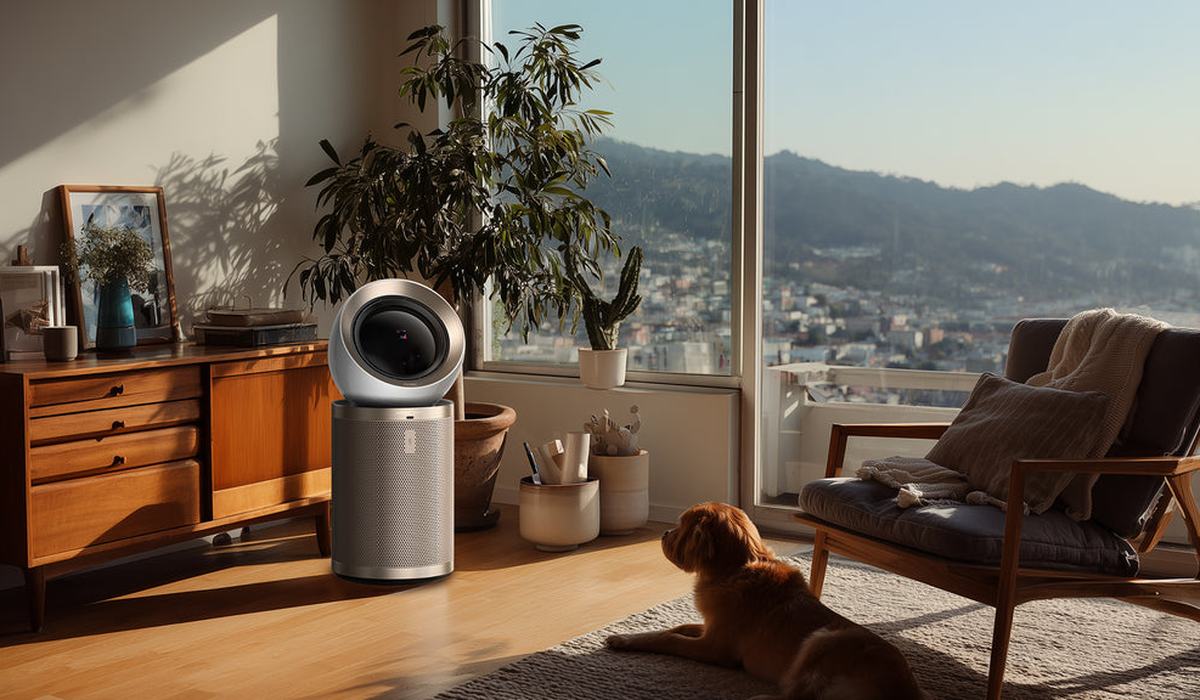
Free-Standing Unit That Suits a Nursery Corner
A small-footprint true-HEPA tower that fits beside a cot without dominating the room, with a low speed that stays usable at close range and a display you can switch off.
Check Price on Amazon →Where to go next
- How long to run an air purifier in a nursery — runtime and energy cost.
- What size air purifier for a nursery — the CADR and ACH maths.
- Best air purifier for a nursery — the three-tier shortlist.
- Air purifier without light for a nursery — total-darkness options.
- Quiet air purifier for a nursery — the pillar guide.
- Where to place an air purifier in an apartment — the wider-rooms version.
Sources: American Academy of Pediatrics (safe sleep guidance; cot clearance), AHAM (CADR certification program; airflow conditions), WHO Environmental Noise Guidelines (night-time bedroom levels), U.S. EPA (Residential Air Cleaners guide), ASHRAE Standard 62.2 (residential ventilation).
Frequently asked questions
Where should I put an air purifier in a nursery?
Should an air purifier be high or low in a nursery?
How far should an air purifier be from a crib?
Can I put an air purifier right against the wall?
Where should I put an air purifier in a small nursery?
Do I need to drill to place an air purifier in a nursery?
Related guides