On this page
Why small rooms are easier
Air cleaning is a volume problem. A nursery of 8 × 10 ft with an 8 ft ceiling holds about 640 cubic feet of air. The same room's living-room equivalent in a house might hold four times that.
Four benefits follow directly from less volume:
- Less CADR is needed, so you buy a smaller and cheaper unit.
- Less airflow means less noise, so the same cleaning result arrives at a lower fan speed.
- Turnover is faster, so the room recovers quickly after a door opens or a nappy change.
- A weaker unit is enough, which opens up the budget tier without a performance penalty.
The one thing a small room does not fix is placement. A compact unit in a corner behind a wardrobe is a compact unit doing nothing.
Sizing by room volume
The AHAM rule is the fastest route: smoke CADR at least two-thirds of the floor area in square feet. The second route, if you want air changes, is:
CADR = room volume × air changes per hour ÷ 60
For a nursery, four to five air changes per hour is a sensible target. Worked example: 8 × 10 ft room, 8 ft ceiling = 640 ft³. At five air changes that is 640 × 5 ÷ 60 = about 53 CFM. The two-thirds rule gives 80 × 2/3 = about 53. The two methods agree, which is why the shortcut works.
| Room | Floor area | Smoke CADR (two-thirds rule) | Air changes at that CADR |
|---|---|---|---|
| 5 × 6 ft | 30 sq ft | 20–30 | About 5–7 ACH |
| 6 × 8 ft | 48 sq ft | 32–48 | About 4–6 ACH |
| 7 × 9 ft | 63 sq ft | 42–63 | About 4–5 ACH |
| 8 × 10 ft | 80 sq ft | 55–80 | About 4–5 ACH |
| 9 × 11 ft | 99 sq ft | 66–99 | About 4–5 ACH |
Our nursery sizing guide goes further, including how to handle a cot corner in a studio where the room is effectively the whole flat.
Footprint: what actually fits
In a small nursery, footprint is a real constraint because the room is doing double duty as storage. Measure before you buy.
| Footprint | Fits where | Typical CADR class |
|---|---|---|
| Under 7 × 7 in | On a nightstand, dresser top or windowsill | 30–50 |
| 7–8 × 7–8 in | Floor beside the cot, gap beside a wardrobe | 50–90 |
| 9–10 × 9–10 in | Floor space at the foot of the cot | 90–140 |
| Over 11 in | Needs its own floor space | 140+ |
Height matters too. A tall narrow tower occupies less floor than a broad low unit with the same CADR, which is usually the right trade in a small room.
Compact units compared
| Class | Best for | Smoke CADR | Footprint | Low-speed noise | Filter cadence |
|---|---|---|---|---|---|
| Mini | Cot corner, room under 50 sq ft | 30–50 | Under 7 × 7 in | About 24–28 dB | 6 months |
| Compact core | Nursery 50–100 sq ft | 50–90 | 7–8 in square | About 24–26 dB | 6–12 months |
| Compact tall tower | Same, when floor space is tight | 70–110 | Under 8 in square, tall | About 25–28 dB | 6–12 months |
| Mid-size | Room over 120 sq ft | 110–160 | 10 in square | About 27–30 dB | 9–12 months |
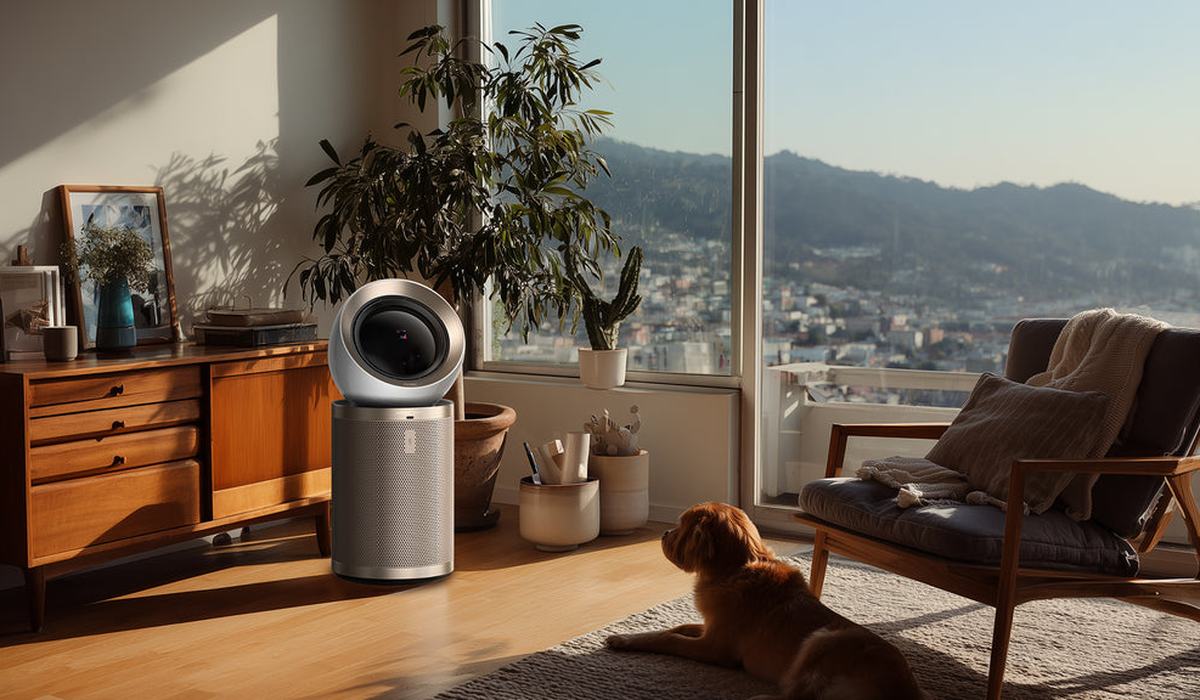
Compact Core Unit for a Small Nursery
The size that fits most small nurseries: true HEPA plus carbon, under an 8-inch footprint, a sleep mode with the display dark, and a filter that is cheap enough to change twice a year.
Check Price on Amazon →Placement in a tight room
In a small room, placement is the difference between the rated CADR and the real one. A unit with its intake against a wall can lose a large fraction of its airflow.
| Do | Do not |
|---|---|
| Leave 12–18 in of clearance on all sides | Push it flush against a wall or into a corner |
| Stand it on the floor 3–6 ft from the cot | Place it in, on or above the cot |
| Aim the outlet along the room, not at the cot | Blow the airstream directly at the sleep space |
| Use a mat on hard floors | Sit it directly on laminate above a neighbour |
| Keep it clear of curtains | Let fabric touch the intake grille |
| Choose the spot with the most open air around it | Tuck it behind the door or under a shelf |
Noise in a small room
Small rooms amplify the perception of noise for one reason: you are closer. Sound pressure drops about 6 dB each time you double your distance from the source. In a large room you might be ten feet away; in a small nursery you might be four.
The compensation is that a small room needs less airflow, so you can run the unit lower. A compact unit sized to two-thirds of the floor area will hold the room at four-plus air changes on speed 1, which is where the quiet is.
For the full decibel picture, including what each speed sounds like, see our quiet-nursery pillar and the apartment noise guide.
The compact picks
Mini Unit for a Cot Corner
For rooms under 50 sq ft, or a cot corner where nothing larger will fit. Lower CADR, so it is a small-room solution only. Confirm it is true HEPA and has no ozone mode.
Check Price on Amazon →Where to go next
- What size air purifier for a nursery — the sizing maths, worked.
- Best air purifier for a nursery — the three-tier shortlist.
- Air purifier for a nursery under $100 — the budget route.
- Where to put an air purifier in a nursery — the placement decision tree.
- Levoit air purifier for a nursery — model tiers explained.
- Quiet air purifier for a nursery — the pillar guide.
Sources: AHAM (CADR certification program; two-thirds rule), U.S. EPA (Residential Air Cleaners guide), ASHRAE Standard 62.2 (residential ventilation), WHO Environmental Noise Guidelines (night-time bedroom levels), American Academy of Pediatrics (safe sleep).
Frequently asked questions
What size air purifier do I need for a small nursery?
Can a small air purifier clean a whole nursery?
How much clearance does an air purifier need?
Is a small air purifier quieter than a large one?
Where should I put a small air purifier in a nursery?
Do I need a bigger purifier if the nursery is open to the flat?
Related guides