On this page
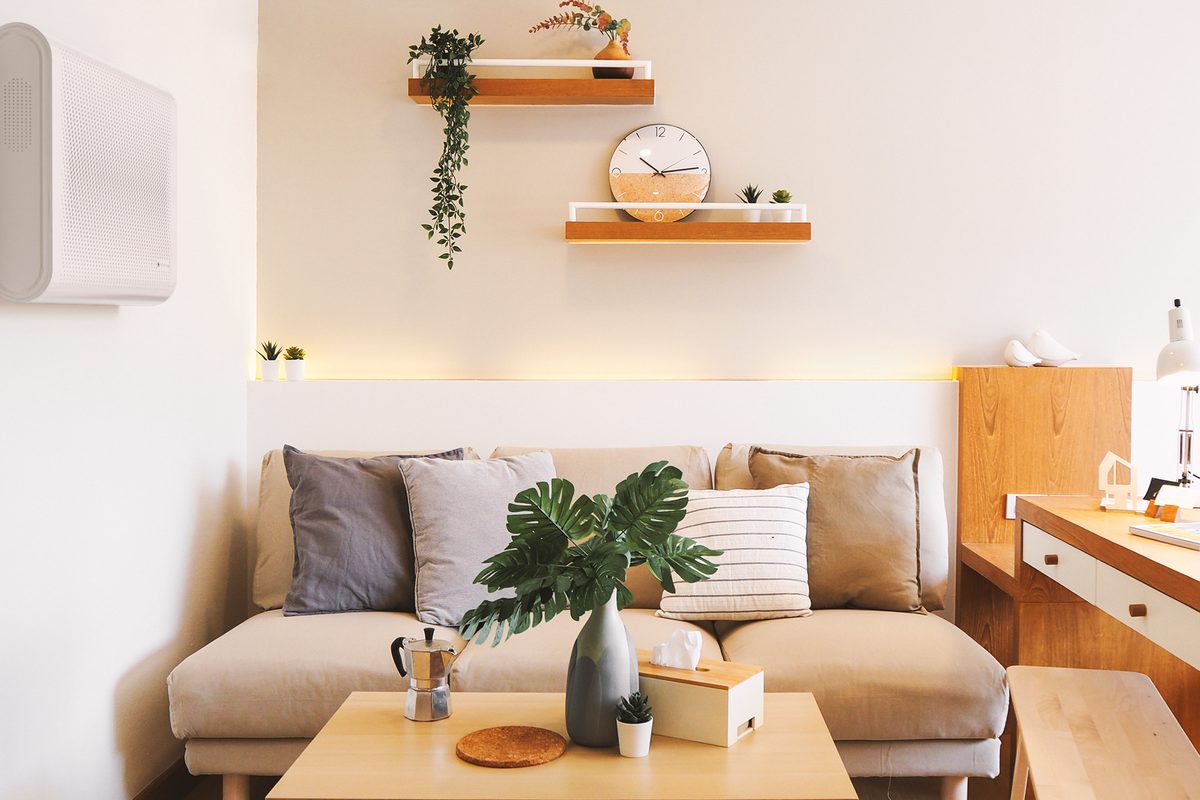
Why free-standing beats mounted anyway
For renters, “mounted” is usually presented as the premium option and it is actually the worse one. Three reasons:
- Noise. A wall-mounted unit transmits vibration directly into the wall structure — which in a flat is a party wall. A free-standing unit on a decoupling mat is quieter for you and for the neighbour.
- Airflow. Wall brackets hold units close to the surface they are fixed to, which means less clearance for the intake than a floor unit placed with 12–18 inches around it.
- Mobility. A purifier is at its most useful in whichever room has the problem today. A mounted unit is stuck where you put it, and it leaves a hole when you move out.
There is one genuine exception: an in-duct or HVAC-integrated filter, which some landlords will agree to and install themselves. That is a negotiation with the owner, not a DIY job, and it should be in writing before anyone picks up a drill.
Positioning without fixings
Every good placement for a purifier is a floor placement, and a floor placement needs no fixing at all.
| Position | Fixings needed | Renter suitability |
|---|---|---|
| Floor, against an interior wall | None | Ideal |
| Floor, beside the door, outlet facing in | None | Ideal for small rooms |
| Floor corner, clear of curtains | None | Good |
| On a low side table or bench | None, but stability to check | Acceptable if the base is wide |
| On a shelf | None, but tipping and clearance risk | Not recommended |
| Wall-mounted on a bracket | Screws and wall plugs | Avoid in a rental |
| In-duct / HVAC filter | Professional installation | Only with written landlord consent |
Note the ordering: the zero-fixing options are also the good options. This is one of the few areas where the renter-friendly answer and the technically correct answer are the same.
Cord management with no holes
A loose cord is both a trip hazard and, with a crawling baby, a real safety issue. You can manage it entirely with adhesive products.
| Product | Use it for | Removal |
|---|---|---|
| Adhesive cable clips | Pinning a cord along skirting | Peel off; light residue possible |
| Self-adhesive cable trunking | Running a cord neatly along a wall base | Pulls off; marketed as removable |
| Hook-and-loop cable ties | Coiling excess cord | Reusable |
| Cord cover (floor channel) | A cable crossing a walkway | Lifts off the floor |
| Command-style hooks | Holding a loop up off the floor | Pull the tab; designed for clean release |
Two practical notes. First, test any adhesive on a hidden patch of skirting before committing, particularly on older paint or wallpaper. Second, avoid fixed metal clips and screw-fixed trunking — they are the ones that leave holes.
Window sealing without screws
If outside air is the problem — traffic, pollen, a neighbour's smoke — reducing what gets in is cheaper than filtering it out. All of the effective options are removable.
| Method | What it does | Reversible? |
|---|---|---|
| Adhesive foam draught strip | Seals gaps of roughly 3–8 mm | Yes; peels off |
| Removable weatherstrip tape | Seals fine gaps up to ~5 mm | Yes; may leave residue |
| Magnetic secondary glazing | A clear panel held by magnets | Yes; fully reusable and moves with you |
| Shrink-film insulation | Seals the whole opening with double-sided tape | Yes, with care; tape comes off |
| Silicone sealant | Permanent seal | No — damages paint and frames |
| Screw-fixed brush strip | Permanent seal | No — leaves screw holes |
The important caveat from the renter's guide still applies: do not seal every window. Kitchens and bathrooms need a route for humid air, so seal the bedroom and living room if fumes are the issue, and leave a working vent or a bathroom window free. Otherwise you trade a fume problem for a condensation problem, which is worse.
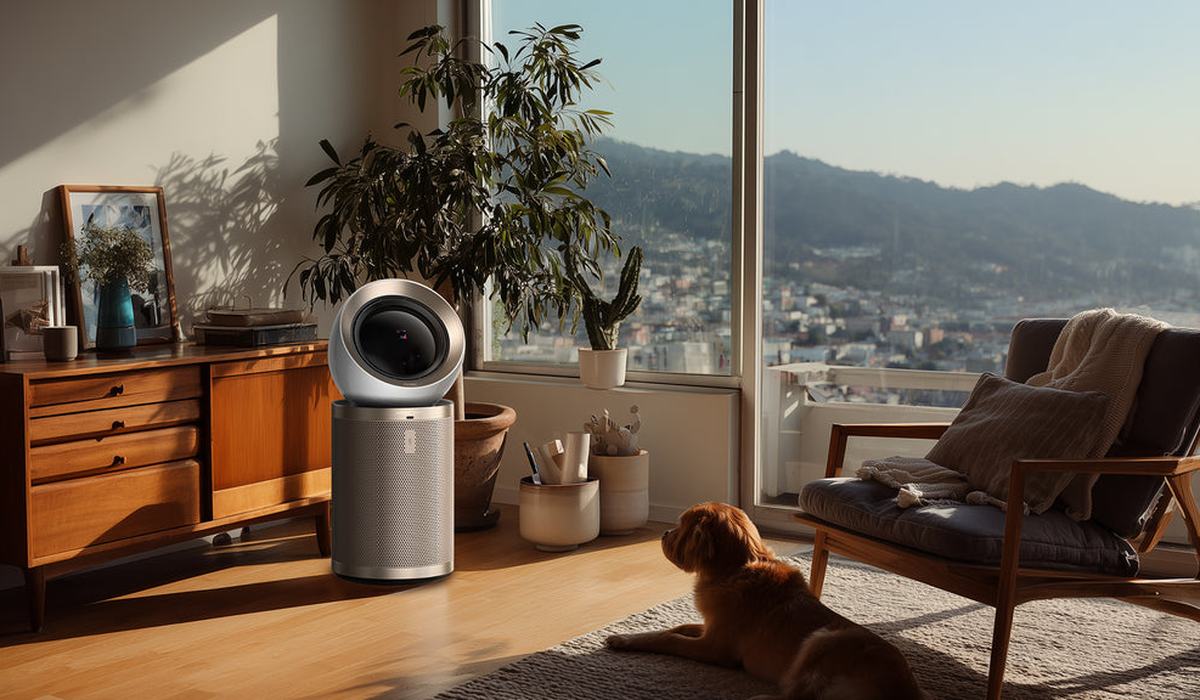
Free-Standing Unit, Zero Fixings
No bracket, no screws, no wall contact. Place it on the floor with clearance around the intake and pair it with a mat and adhesive cord clips.
Check Price on Amazon →Stopping it moving without anchor bolts
The one thing a fixings-free setup genuinely has to solve is stability — particularly in a home with a toddler or a pet.
- A non-slip mat underneath. A rubber or cork mat does double duty: it stops the unit sliding and it decouples it from the floor structure, which cuts noise transmitted to the flat below.
- Push it into a corner or against a wall where the wall itself acts as the backstop. No bracket is needed if the unit cannot fall backwards.
- Choose a low-profile shape when children are involved. A wide-based unit is inherently more stable than a tall narrow tower, and stability is a property of the unit, not of the mounting.
- Use a furniture strap against a fixed item if you have a genuinely tall unit and a determined climber. A strap between the purifier and a secured item is more reversible than anything screwed into a wall, and it leaves no hole.
Handing the flat back damage-free
A checklist for the end of the tenancy:
- Remove cord clips and tape, warming them gently first, and wipe any residue with a little warm soapy water.
- Remove window seals, including any tape residue on the frames.
- Check skirting and paintwork where adhesives sat. Touch-up of a paint scuff is cheaper and simpler than repairing a drilled hole.
- Wipe around where the unit sat, especially if it was near a bathroom where condensation collects.
- Take the mat, the seals and the unit with you — all three will be useful in the next flat.
The whole point of a drilling-free setup is that there is nothing to make good. Every product recommended here is designed to be removed, and the total fixing cost is under $50. Compared with the cost of an unrepaired wall, it is not a decision worth agonising over.
Sources: AHAM (CADR certification program), U.S. EPA (Residential Air Cleaners guide; ozone generator warning), ASHRAE Standard 62.2 (residential ventilation), WHO Environmental Noise Guidelines (night-time bedroom levels), American Academy of Pediatrics (safe sleep and cord safety).
This is one piece of a bigger puzzle — our complete quiet air purifier for a nursery guide covers sizing, noise, light and safety together.
Frequently asked questions
- air purifier placement in a nursery — related guide in this cluster.
- small air purifier for a nursery — related guide in this cluster.
Can I install an air purifier without drilling?
Is a wall-mounted air purifier better than a free-standing one?
How do I hide the cord of an air purifier in a rental?
Can I seal a window in a rented flat without damaging it?
How do I keep a purifier from tipping over without mounting it?
Will an adhesive cord clip damage the paint when I remove it?
Related guides
Air Purifier for Renters: No Drilling, No Damage
The full renter setup, including cost maths.
Air Purifier for a Baby in a Small Apartment
The small-flat setup, with safety and noise rules.

Where to Place an Air Purifier in a Small Apartment
The placements that work in a compact flat.